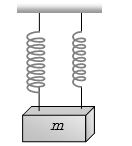
A mass $m$ is suspended separately by two different springs of spring constant $K_1$ and $K_2$ gives the time-period ${t_1}$ and ${t_2}$ respectively. If same mass $m$ is connected by both springs as shown in figure then time-period $t$ is given by the relation
AIPMT 2002, Medium


Download our appand get started for free
Experience the future of education. Simply download our apps or reach out to us for more information. Let's shape the future of learning together!No signup needed.*
Similar Questions
- 1The potential energy of a simple harmonic oscillator when the particle is half way to its end point is (where $E$ is the total energy)View Solution
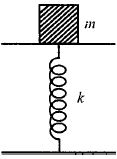
- 2A mass $m = 1.0\,kg$ is put on a flat pan attached to a vertical spring fixed on the ground. The mass of the spring and the pan is negligible. When pressed slightly and released, the mass executes simple harmonic motion. The spring constant is $500\,N/m.$ What is the amplitude $A$ of the motion, so that the mass $m$ tends to get detached from the pan ? (Take $g = 10\,m/s^2$ ). The spring is stiff enough so that it does not get distorted during the motion.View Solution
- 3A particle executes linear simple harmonic motion with an amplitude of $2\, cm$. When the particle is at $1\, cm$ from the mean position the magnitude of its velocity is equal to that of its acceleration. Then its time period in seconds isView Solution
- 4View SolutionIn simple harmonic motion, the ratio of acceleration of the particle to its displacement at any time is a measure of
- 5A particle executes simple harmonic motion according to equation $4 \frac{d^2 x}{d t^2}+320 x=0$. Its time period of oscillation is .........View Solution
- 6$Assertion :$ The amplitude of an oscillating pendulum decreases gradually with timeView Solution
$Reason :$ The frequency of the pendulum decreases with time. - 7View SolutionThe equation of simple harmonic motion may not be expressed as (each term has its usual meaning)
- 8A spring is stretched by $5 \,\mathrm{~cm}$ by a force $10 \,\mathrm{~N}$. The time period of the oscillations when a mass of $2 \,\mathrm{~kg}$ is suspended by it is :(in $s$)View Solution
- 9The amplitude of a particle executing $SHM$ about $O$ is $10\, cm.$ Then :View Solution
- 10A uniform cylinder of length $L$ and mass $M$ having cross-sectional area $A$ is suspended, with its length vertical, from a fixed point by a massless spring, such that it is half submerged in a liquid of density $\sigma $ at equilibrium position. When the cylinder is given a downward push and released, it starts oscillating vertically with a small amplitude. The time period $T$ of the oscillations of the cylinder will beView Solution