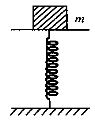
A mass of $2.0\, kg$ is put on a flat pan attached to a vertical spring fixed on the ground as shown in the figure. The mass of the spring and the pan is negligible. When pressed slightly and released the mass executes a simple harmonic motion. The spring constant is $200\, N/m.$ What should be the minimum amplitude of the motion so that the mass gets detached from the pan (take $g = 10 m/s^2$).
AIPMT 2007, Medium
Download our app for free and get started
The spring has a length $l .$ Whem $m$ is placed over it, the equilibrium position becomes $O^{\prime}$
If it is pressed from $O^{\prime}$ $(the\, equilibrium\, position)$ to $O^{\prime \prime}, O^{\prime} O^{\prime \prime}$ is the amplitude.
$O O^{\prime} =\frac{m g}{k}=\frac{2 \times 10}{200}=0.10 \mathrm{m} $
$m g =k x_{0}$
If the restoring force $m A \omega^{2}>m g,$ then the mass will move up with acceleration, detached from the pan.
i.e. $A>\frac{g}{k / m} \Rightarrow A>\frac{20}{200}>0.10 \mathrm{m}$
$The\, amplitude >10 \mathrm{cm}$
i.e. the minimum is just greater than $10 \mathrm{cm}$. (The actual compression will include $x_{0}$ also. But when talking of amplitude, it is always from the equilibrium position with respect to which the mass is oscillating.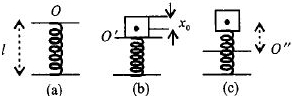

Download our appand get started for free
Experience the future of education. Simply download our apps or reach out to us for more information. Let's shape the future of learning together!No signup needed.*
Similar Questions
- 1A particle executes $S.H.M$ between $x =\, -A$ to $x =\, +A$ . The time taken for it in going from $0$ to $A/2$ is $T_1$ and from $A/2$ to $A$ is $T_2$. ThenView Solution
- 2For a periodic motion represented by the equation $Y=\sin \omega t+\cos \omega t$ The amplitude of the motion isView Solution
- 3A heavy small-sized sphere is suspended by a string of length $l$. The sphere rotates uniformly in a horizontal circle with the string making an angle $\theta $ with the vertical. Then the time period of this conical pendulum isView Solution
- 4The motion of a particle as per $x=Asin \omega t + Bcos\omega t$ is :-View Solution
- 5A particle of mass $m$ performs $SHM$ along a straight line with frequency $f$ and amplitude $A.$View Solution
- 6Two particles undergo $SHM$ along parallel lines with the same time period $(T)$ and equal amplitudes. At a particular instant, one particle is at its extreme position while the other is at its mean position. They move in the same direction. They will cross each other after a further timeView Solution
- 7A particle doing simple harmonic motion, amplitude $= 4\, cm$, time period $= 12\, sec$. The ratio between time taken by it in going from its mean position to $2 \,cm$ and from $2\, cm$ to extreme position isView Solution
- 8The potential energy of a particle of mass $0.1\,kg,$ moving along $x-$ axis, is given by $U = 5x(x-4)\,J$ where $x$ is in metres. It can be concluded thatView Solution
- 9The function $sin^2\,(\omega t)$ representsView Solution
- 10An object of mass $0.2 \mathrm{~kg}$ executes simple harmonic motion along $\mathrm{x}$ axis with frequency of $\left(\frac{25}{\pi}\right) \mathrm{Hz}$. At the position $\mathrm{x}=0.04 \mathrm{~m}$ the object has kinetic energy $0.5 \mathrm{~J}$ and potential energy $0.4 \mathrm{~J}$ The amplitude of oscillation is ............ cm.View Solution