MCQ
A metal plate gets heated, when cathode rays strike against, it due to
  • Kinetic energy of cathode rays
  • B
    Potential energy of cathode rays
  • C
    Linear velocity of cathode rays
  • D
    Angular velocity of cathode rays

Answer

Correct option: A.
Kinetic energy of cathode rays
a
(a)When cathode rays strike the metal plate, they transfer their energy to plate.

Need a full question paper?

Generate a complete, print-ready paper with questions like this in minutes — across 16+ boards, with answer keys.
Start Generating Free

Similar questions

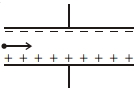
A proton and an $\alpha$-particle having equal kinetic energy are projected in a uniform transverse electric field as shown in figure
In a semiconductor, the forbidden energy gap between the valence band and the conduction band is of the order is:
Two sources of light of wavelengths $2500{\text{ }}\mathop {\text{A}}\limits^o $ and $3500{\text{ }}\mathop {\text{A}}\limits^o $ are used in Young’s double slit expt. simultaneously. Which orders of fringes of two wavelength patterns coincide ?
Water fall from a $40\,m$ high dam at the rate of $9 \times 10^{4}\,kg$ per $hour$. Fifty percentage of gravitational potential energy can be converted into electrical energy. Using this hydroelectric energy number of $100\,W$ lamps, that can be lit, is

(Take $\left.g=10\,ms ^{-2}\right)$

Due to the flow of current in a circular loop of radius $R$, the magnetic induction produced at the centre of the loop is $B$. The magnetic moment of the loop is $({\mu _0} = {\rm{permeability}}\,{\rm{constant)}}$
A ray of light incidents on a plane mirror at an angle of 30°. The deviation produced in the ray is
From the statements given below:$(A)$ The angular momentum of an electron in $n^{\text {th }}$ orbit is an integral multiple of $h$.$(B)$ Nuclear forces do not obey inverse square law.$(C)$ Nuclear forces are spin dependent.$(D)$ Nuclear forces are central and charge independent.$(E)$ Stability of nucleus is inversely proportional to the value of packing fraction.

Choose the correct answer from the options given below :
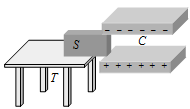
A frictionless dielectric plate S is kept on a frictionless table T. A charged parallel plate capacitance C (of which the plates are frictionless) is kept near it. The plate S is between the plates. When the plate S is left between the plates
The wave nature of electrons was experimentally verified by,
A person's near point is $50 \,cm$ and his far point is $3 \,m$. Power of the lenses he requires for

$(i)$ reading and

$(ii)$ for seeing distant stars are