MCQ
A metal plate is getting heated. It can be because:
  • A
    A direct current is passing through the plate.
  • B
    It is placed in a time varying magnetic field.
  • C
    It is placed in a space varying magnetic field, but does not vary with time.
  • D
    A current (either direct or alternating) is passing through the plate.
Answer

  1. A direct current is passing through the plate.
  2. It is placed in a time varying magnetic field.
  1. a current (either direct or alternating) is passing through the plate.

Solution:

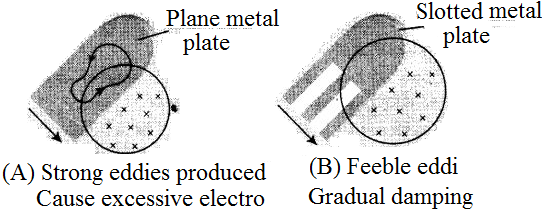
Key concept: Eddy Current: When a changing magnetic flux is applied to a bulk piece of conducting material, then circulating currents called eddy currents are induced in the material. Because the resistance of the bulk conductor is usually low, eddy currents often have large magnitudes and heat up the conductor.

  1. These are circulating currents like eddies in water.
  2. Experimental concept is given by Focault, hence also named as "Focault current".
  3. The production of eddy currents in a metallic block leads to the loss of electric energy in the form of heat.
  4. By lamination, slotting processes, the resistance path for circulation of eddy current increases, resulting into weakening them and also reducing losses causes by them.

​​​​​​​

A metal plate is getting heated when a DC or AC current is passed through the plate, known as heating effect of current. This current (called eddy current) is induced in the plate when a metal plate is subjected to a time varying magnetic field, i.e., the magnetic flux linked with the plate changes and eddy currents comes into existence which make the plate hot.

Need a full question paper?

Generate a complete, print-ready paper with questions like this in minutes — across 16+ boards, with answer keys.

Start Generating Free

Similar questions

A parallel plate air capacitor is charged and then isolated. When a dielectric material is inserted between the plates of the capacitor, then which of the following does not change

(a) Electric field between the plates

(b) Potential difference across the plates

(c) Charge on the plates

(d) Energy stored in the capacitor

Light travels through a glass plate of thickness t and having refractive index n. If c is the velocity of light in vacuum, the time taken by the light to travel this thickness of glass is

(a)  

(b) tnc

(c)         

(d)  

An e.m.f is produced in a coil, which is not connected to an external voltage source. This can be due to:

An ammeter with internal resistance 90 Ω reads 1.85 A when connected in a circuit containing a battery and two resistors 700 Ω and  410 Ω  in series. Actual current will be

(a) 1.85 A

(b) Greater than 1.85 A

(c) Less than 1.85 A

(d) None of these

The explosion of the atomic bomb takes place due to

(a) Nuclear fission

(b) Nuclear fusion

(c) Scattering

(d) Thermionic emission

The energy needed to break a nucleus into its individual nucleons in a nuclear reaction is called:
Two identical bar magnets are fixed with their centres at a distance d apart. A stationary charge Q is placed at P in between the gap of the two magnets at a distance D from the centre O as shown in the figure. The force on the charge Q is:

The unit of intensity of electric field is

(a) Newton/Coulomb

(b) Joule/Coulomb

(c) Volt - metre

(d) Newton/metre

A proton and an electron both moving with the same velocity v enter into a region of magnetic field directed perpendicular to the velocity of the particles. They will now move in circular orbits such that

(a) Their time periods will be same

(b) The time period for proton will be higher

(c) The time period for electron will be higher

(d) Their orbital radii will be same

The direction of induced e.m.f. during electromagnetic induction is given by

(a) Faraday's law

(b) Lenz's law

(c) Maxwell's law

(d) Ampere's law