A metallic block has no potential difference applied across it, then the mean velocity of free electrons is $T$ = absolute temperature of the block)
Easy


Download our appand get started for free
Experience the future of education. Simply download our apps or reach out to us for more information. Let's shape the future of learning together!No signup needed.*
Similar Questions
- 1A potentiometer wire of length $1\,m$ and resistance $10\,\Omega$ is connected in series with a cell of $emf$ $2\,V$ with internal resistance $1 \,\Omega$ and a resistance box including a resistance $R$. If potential difference between the ends of the wire is $1\, mV$, the value of $R$ is ............. $\Omega $View Solution
- 2A $10\, ohm$ electric heater operates on a $110\, V$ line. Calculate the rate at which it develops heat in ............... $watts$View Solution
- 3The resistance of a bulb filmanet is $100\,\Omega$ at a temperature of $100\,^o C$. If its temperature coefficient of resistance be $0.005$ per $^o C$, its resistance will become $200\,\Omega$ at a temperature of ................ $^oC$View Solution
- 4The terminal potential difference of a cell when short-circuited is ($E$ = $E.M.F.$ of the cell)View Solution
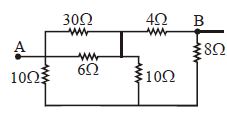
- 5The equivalent resistance across $AB$ would be ............ $\Omega$View Solution
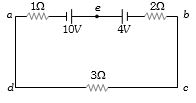
- 6View SolutionThe magnitude and direction of the current in the circuit shown will be
- 7A wire of resitance $R$ and length $L$ is cut into $5$ equal part. if these parts are joined parts are joined paralley, than result resistance will be:View Solution
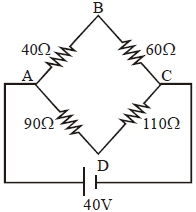
- 8Four resistances $40 \ \Omega, 60\ \Omega, 90\ \Omega$ and $110\ \Omega$ make the arms of a quadrilateral $A,B,C,D$. Across $AC$ is a battery of emf $40\, V$ and internal resistance negligible. The potential difference across $BD$ is $V$ is......View Solution
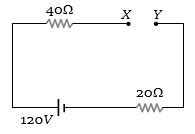
- 9Potential difference across the $40\,\Omega $ resistance will be ............ $V$View Solution
- 10A $60\, watt$ bulb carries a current of $0.5\, amp$. The total charge passing through it in $1$ hour is ............ $coulomb$View Solution