MCQ
A metallic loop is placed in a magnetic field. If a current is passed through it, then
  • A
    The ring will feel a force of attraction
  • B
    The ring will feel a force of repulsion
  • C
    It will move to and fro about its centre of gravity
  • None of these

Answer

Correct option: D.
None of these
  None of these

Need a full question paper?

Generate a complete, print-ready paper with questions like this in minutes — across 16+ boards, with answer keys.
Start Generating Free

Similar questions

Suppose we consider a large number of containers each containing initially $10000$ atoms of a radioactive material with a half life of $1$ year. After $1$ year:
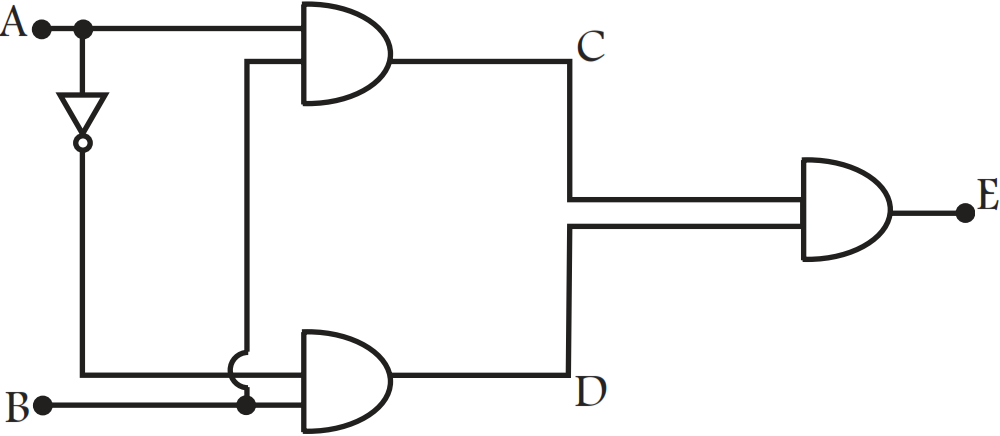
Truth table for the given circuit (Fig.) is:
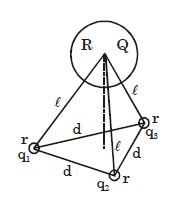
Three identical uncharged metal spheres are at the vertices of an equilateral triangle. One at a time, a small sphere is connected by a conducting wire with a large metal sphere that is charged. The center of the large sphere is in the straight line perpendicular to the plane of equilateral triangle and passing through its centre (see figure). As a result, the first small sphere acquires charge $q_1$ and second charge $q_2 (q_2 < q_1)$ . The charge that the third sphere $q_3$ will acquire is (Assume $l >> R$ , $l >> r$ , $d >> R$ , $d >> r$ )
Debye is the unit of:
A wave can transmit ...... from one place to another
Curie temperature is the temperature above which:
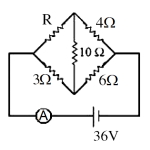
Current measured by the ammeter $(A)$ in the reported circuit when no current flows through $10\,\Omega$ resistance. will be________$A$
In Young's double slit experiment, 62 fringes are seen in visible region for sodium light of wavelength 5893 Å. If violet light of wavelength 4358 Å is used in place of sodium light, then number of fringes seen will be
The energy gaps $(E_g)$ between valence band and conduction band, for diamond, silicon and germanium are in the order
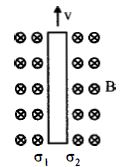
Consider a thin metallic sheet perpendicular to the plane of the paper moving with speed $'v'$ in a uniform magnetic field $B$ going into the plane of the paper (See figure). If charge densities ${\sigma _1}$ and ${\sigma _2}$ are induced on the left and right surfaces, respectively, of the sheet then (ignore fringe effects)