Question
A metallic loop is placed in a nonuniform magnetic field. Will an emf be induced in the loop?

Answer

As the magnetic field is non uniform thus it will induce only small electric field in different directions so there would be no net current in the loop.

Need a full question paper?

Generate a complete, print-ready paper with questions like this in minutes — across 16+ boards, with answer keys.

Start Generating Free

Similar questions

A van is standing on a frictionless portion of a horizontal road. To start the engine, the vehicle must be set in motion in the forward direction. How can the persons sitting inside the van do it without coming out and pushing from behind?
Read the passage given below and answer the following questions from (i) to (v).
A system is said to be isolated if no exchange or transfer of heat occurs between the system and its surroundings. When different parts of an isolated system are at different temperature a quantity of heat transfers from the part at higher temperature to the part at lower temperature. The heat lost by the part at higher temperature is equal to the heat gained by the part at lower temperature. Calorimetry means measurement of heat. When a body at higher temperature is brought in contact with another body at lower temperature, the heat lost by the hot body is equal to the heat gained by the colder body, provided no heat is allowed to escape to the surroundings. A device in which heat measurement can be done is called a calorimeter. It consists of a metallic vessel and stirrer of the same material, like copper or aluminium. The vessel is kept inside a wooden jacket, which contains heat insulating material. Matter normally exists in three states: solid, liquid and gas. A transition from one of these states to another is called a change of state. Two common changes of states are solid to liquid and liquid to gas (and, vice versa). These changes can occur when the exchange of heat takes place between the substance and its surroundings. The change of state from solid to liquid is called melting and from liquid to solid is called fusion. It is observed that the temperature remains constant until the entire amount of the solid substance melts. That is, both the solid and the liquid states of the substance coexist in thermal equilibrium during the change of states from solid to liquid. The temperature at which the solid and the liquid states of the substance is in thermal equilibrium with each other is called its melting point. The change of state from liquid to vapour (or gas) is called vaporisation. It is observed that the temperature remains constant until the entire amount of the liquid is converted into vapour. That is, both the liquid and vapour states of the substance coexist in thermal equilibrium, during the change of state from liquid to vapour. The temperature at which the liquid and the vapour states of the substance coexist is called its boiling point. The change from solid state to vapour state without passing through the liquid state is called sublimation, and the substance is said to sublime. Dry ice (solid CO2) sublimes, so also iodine. During sublimation both the solid and vapour states of a substance coexist in thermal equilibrium.
  1. Device used for measurement of heat is:
  1. Calorimeter
  2. Thermometer
  3. Both a and b
  4. No one of these
  1. The change of state from solid to liquid is called:
  1. Melting
  2. Vaporization
  3. Sublimation
  4. None of these
  1. Define melting point and boiling point:
  2. What is sublimation?
  3. Define fusion process:
Why is conducting easier in gases if the pressure is low? Will the conduction continue to improve if the pressure is made as low as nearly zero?
A short magnet oscillates in an oscillation magnetometern with a time period of 0.10s where the earth's horizontal magnetic field is $24\mu\text{T}.$ A downward current of 18 A is established in a vertical wire placed 20cm east of the magnet. Find the new time period.
Read the passage given below and answer the following questions from 1 to 5.
Kinetic Energy
The energy possessed by a body by virtue of its motion is called kinetic energy. In other words, the amount of work done, a moving object can do before coming to rest is equal to its kinetic energy.
 $\therefore\text{Kinetic energy}, \text{KE}=\frac{1}{2}\text{mv}^2$
where, m is a mass andv is the velocity of a body. The units and dimensions of KE are Joule (inSI) and [ML2-2 ], respectively.
Kinetic energy of a body is always positive. It can never be negative.
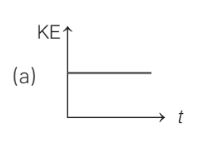
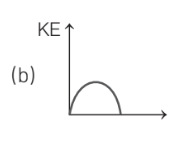
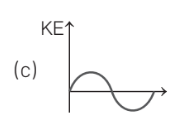
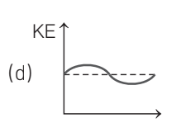
  1. Which of the diagrams shown in figure most closely shows the variation in kinetic energy of the earth as it moves once around the sun in its elliptical orbit?
  1. A force which is inversely proportional to the speed is acting on a body. The kinetic energy of the body starting from rest is:
  1. a constant
  2. inversely proportional to time
  3. directly proportional to time
  4. directly proportional to square of time
  1. The kinetic energy of an air molecule (10 -21 J) in eV is:
  1. 6.2 meV
  2. 4.2 meV
  3. 10.4 meV
  4. 9.7 meV
  1. Two masses of 1 g and 4 g are moving with equal kinetic energy. The ratio of the magnitudes of their momentum is:
  1. 4 : 1
  2. $\sqrt{2}:1$
  3. 1 : 2
  4. 1 : 16
  1. An object of mass 10 kg is moving with velocity of 10 ms -1. Due to a force, its velocity become 20 ms-1 Percentage increase in its KE is:
  1. 25%
  2. 50%
  3. 75%
  4. 300%
A small coin is placed on a record rotating at $33\frac{1}{3}$ rev/ minute. The coin does not slip on the record. Where does it get the required centripetal force from?
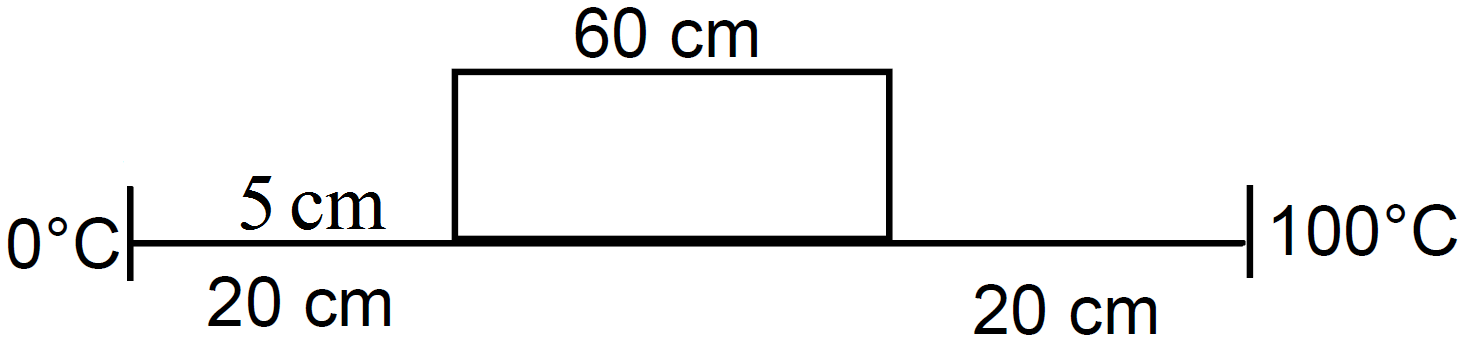
Consider the situation shown in figure. The frame is made of the same material and has a uniform cross-sectional area everywhere. Calculate the amount of heat flowing per second through a cross section of the bent part if the total heat taken out per second from the end at 100°C is 130J.

The friction coefficient between an athelete's shoes and the ground is 0.90. Suppose a superman wears these shoes and races for 50m. There is no upper limit on his capacity of running at high speeds.
  1. Find the minimum time that he will have to take in completing the 50m starting from rest.
  2. Suppose he takes exactly this minimum time to complete the 50m, what minimum time will he take to stop?
Calculate the amplification factor of a triode valve that has plate resistance of $2\text{k}\Omega$ and transconductance of 2 millimho.
An elevator is descending with uniform acceleration. To measure the acceleration, a person in the elevator drops a coin at the moment the elevator starts. The coin is 6ft above the floor of the elevator at the time it is dropped. The person observes that the coin strikes the floor in 1 second. Calculate from these data the acceleration of the elevator.