Question
A metallic ring of mass m and radius l (ring being horizontal) is falling under gravity in a region having a magnetic field. If z is the vertical direction, the z-component of magnetic field is $\text{B}_\text{z}=\text{B}_0(1+\lambda\text{z})$. If R is the resistance of the ring and if the ring falls with a velocity v, find the energy lost in the resistance. If the ring has reached a constant velocity, use the conservation of energy to determine v in terms of $\text{m},\text{B},\lambda$ and acceleration due to gravity g.
Answer

In this problem a relation is established between induced current, power lost and velocity acquired by freely falling ring.
The magnetic flux linked with the metallic ring of mass m and radius l ring being horizontal falling under gravity in a region having a magnetic field whose z-component of magnetic field is $\text{B}_\text{z}=\text{B}_0(1+\lambda\text{z})$ is,
$\phi_\text{m}=\text{B}_\text{z}(\pi\text{l}^2)=\text{B}_0(1+\lambda\text{z})(\pi\text{l})$
Applying Faraday's law of EML, we have emf induced given by $\frac{\text{d}\phi}{\text{dt}}$ = rate of change of flux. Also, by Ohm's law
$\text{B}_0(\pi\text{l}^2)\lambda\frac{\text{dz}}{\text{dt}}=\text{IR}$
We have $\text{I}=\frac{\pi\text{l}^2\text{B}_0\lambda}{\text{R}}\text{v}$
Energy lost/second $=\text{I}^2\text{R}=\frac{(\pi\text{l}^2\lambda)^2\text{B}_0^2\text{v}^2}{\text{R}}$
Rate of change of $\text{PE}=\text{mg}\frac{\text{dz}}{\text{dt}}=\text{mgv}$ [as kinetic energy is constant for v = constant]
According to the law of conservation of energy
Thus, $\text{mgv}=\frac{(\pi\text{l}^2\lambda\text{B}_0)^2\text{v}^2}{\text{R}}\text{ or v}=\frac{\text{mgR}}{(\pi\text{l}^2\lambda\text{B}_0)^2}$
This is the required exspression of velocity.

Need a full question paper?

Generate a complete, print-ready paper with questions like this in minutes — across 16+ boards, with answer keys.

Start Generating Free

Similar questions

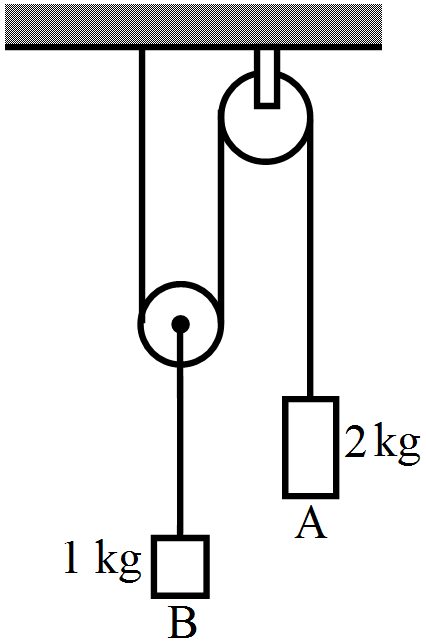
Find the acceleration of the blocks A and B in the three situations shown in figure.


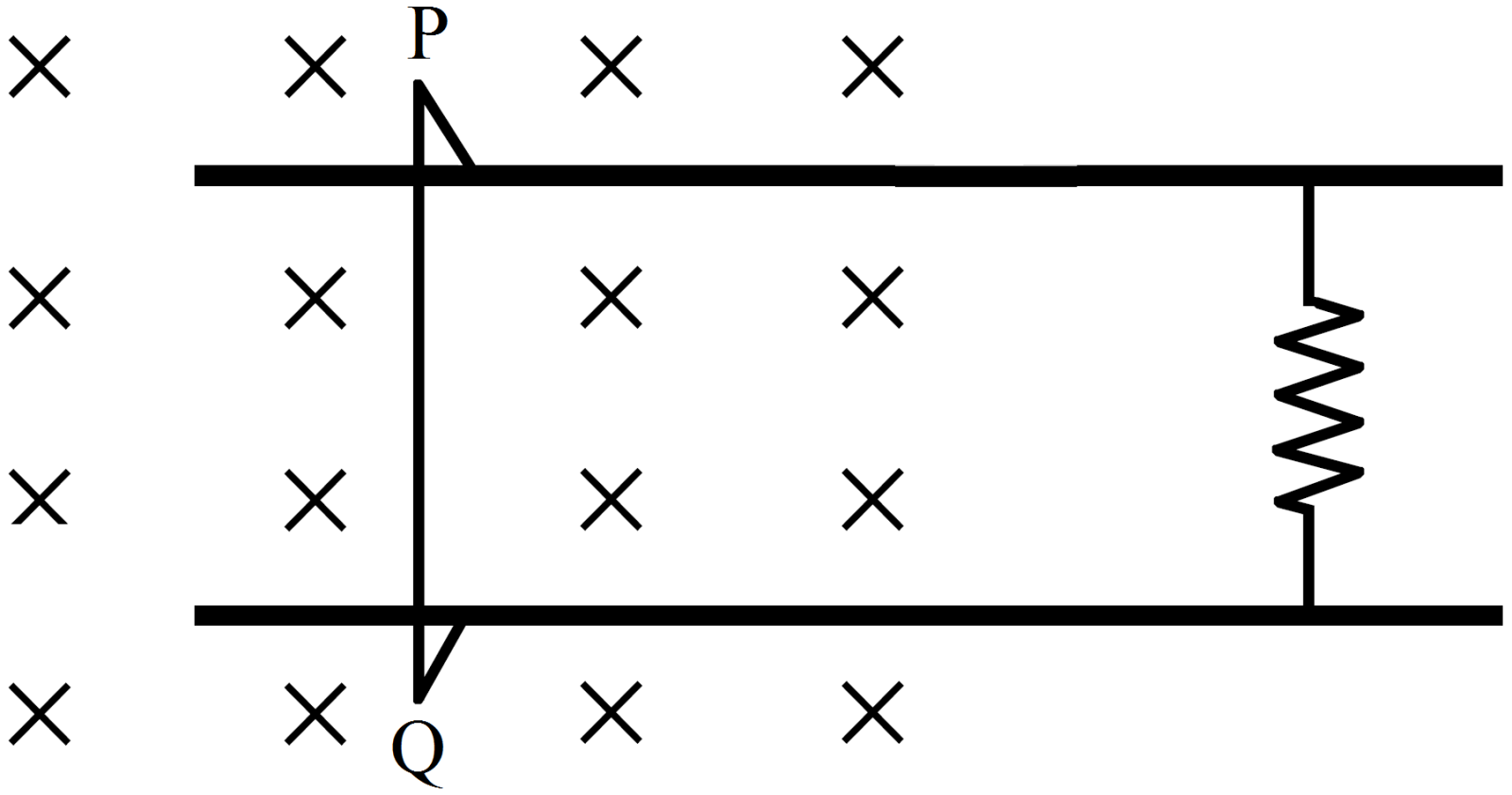
Consider the situation shown in figure. The wire PQ has mass m, resistance r and can slide on the smooth, horizontal parallel rails separated by a distance l. The resistance of the rails is negligible. A uniform magnetic field B exists in the rectangular region and a resistance R connects the rails outside the field region. At t = 0, the wire PQ is pushed towards right with a speed $v_0$. Find
  1. The current in the loop at an instant when the speed of the wire PQ is v.
  2. The acceleration of the wire at this instant.
  3. The velocity vas a functions of x.
  4. The maximum distance the wire will move.
Given below are some famous numbers associated with electromagnetic radiations in different contexts in physics. State the part of the electromagnetic spectrum to which each belongs.
  1. 21 cm (wavelength emitted by atomic hydrogen in interstellar space).
  2. 1057 MHz (frequency of radiation arising from two close energy levels in hydrogen; known as Lamb shift).
  3. 2.7 K [temperature associated with the isotropic radiation filling all space-thought to be a relic of the ‘big-bang’ origin of the universe].
  4. 5890 Å - 5896 Å [double lines of sodium]
  5. 14.4 keV [energy of a particular transition in $^{57}Fe$ nucleus associated with a famous high resolution spectroscopic method (Mössbauer spectroscopy)].
A ball of mass m moving at a speed v makes a head-on collision with an identical ball at rest. The kinetic energy of the balls after the collision is three fourths of the original. Find the coefficient of restitution.
State Biot-Savart law. Use it to derive an expression for the magnetic field at the centre of a circular loop of radius R carrying a steady current I. Sketch the magnetic field lines for such a current carrying loop.
Four equal charges $2.0 \times 10^{-6}C$ each are fixed at the four corners of a square of side 5cm. Find the Coulomb force experienced by one of the charges due to the rest three.

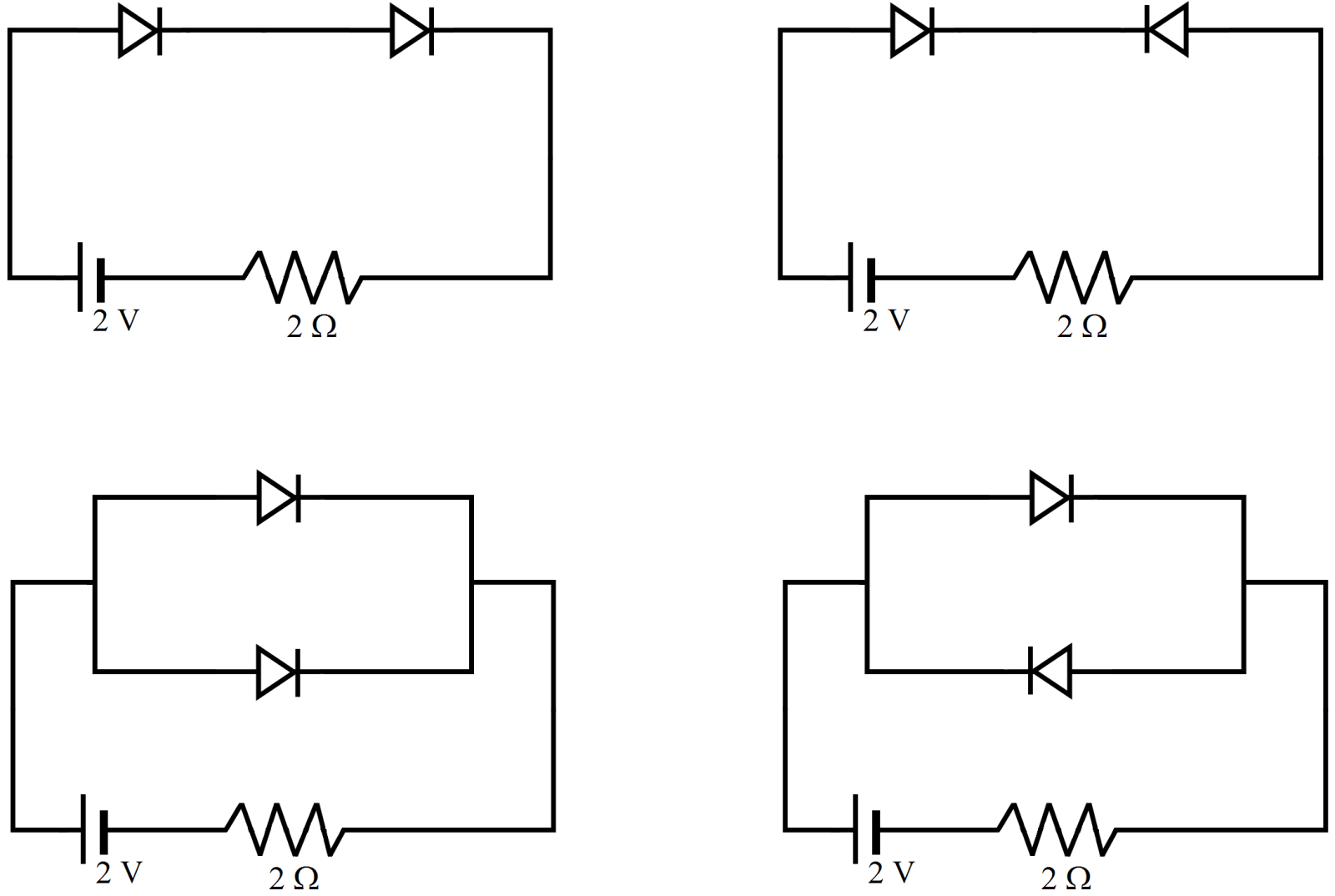
Find the currents through the resistances in the circuits shown in figure.
One end of a 10cm long silk thread is fixed to a large vertical surface of a charged nonconducting plate and the other end is fastened to a small ball having a mass of 10g and a charge of $4.0 \times 10^{-5}C$. In equilibrium, the thread makes an angle of 60° with the vertical. Find the surface charge density on the plate.
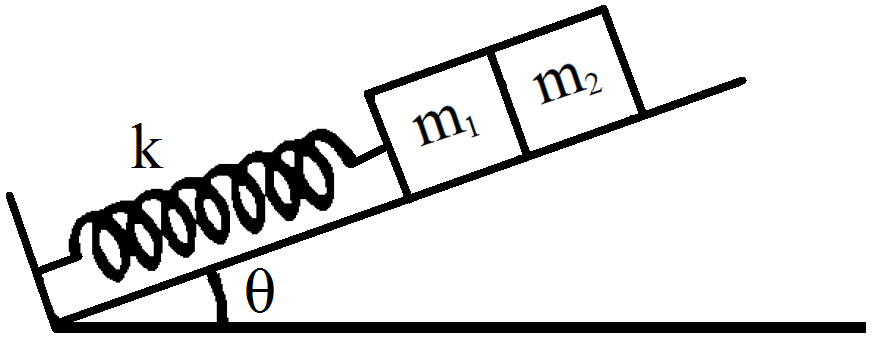
The block of mass $m_1$ shown in figure is fastened to the spring and the block of mass $m_2$ is placed against it.
  1. Find the compression of the spring in the equilibrium position.
  2. The blocks are pushed a further distance $\big(\frac{2}{\text{k}}\big)(\text{m}_1+\text{m}_2)\text{g}\sin\theta$ sine against the spring and released. Find the position where the two blocks separate.
  3. What is the common speed of blocks at the time of separation?
A faulty barometer contains certain amount of air and saturated water vapour. It reads 74.0cm when the atmospheric pressure is 76.0cm of mercury and reads 72.10cm when the atmospheric pressure is 74.0cm of mercury. Saturation vapour pressure at the air temperature = 1.0cm of mercury. Find the length of the barometer tube above the mercury level in the reservoir