Question
A metre stick is held vertically with one end on a rough horizontal floor. It is gently allowed to fall on the floor. Assuming that the end at the floor does not slip, find the angular speed of the rod when it hits the floor.
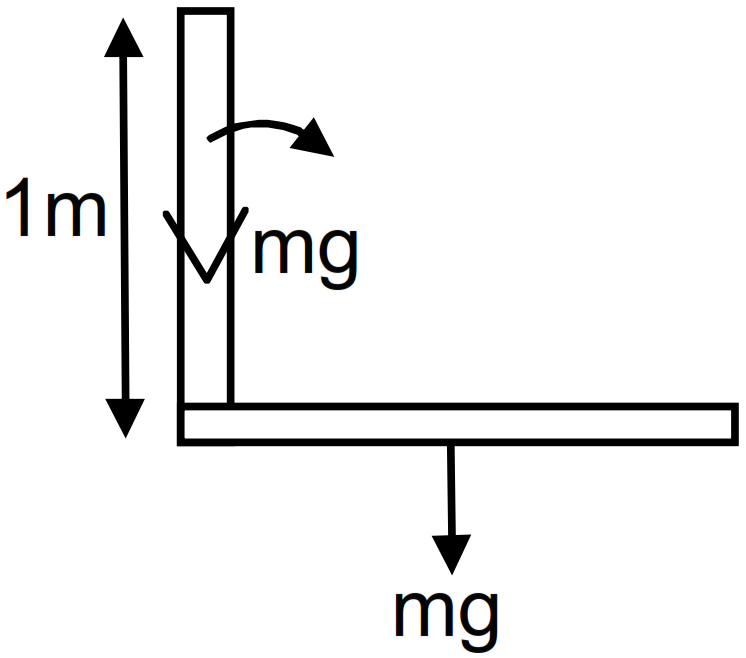
Answer

Let the mass of the rod = m

Therefore applying laws of conservation of energy

$\frac{1}{2}\text{l}\omega^2=\text{mg}\frac{\text{l}}2{}$

$\Rightarrow\frac{1}{2}\times\text{M}\frac{\text{l}^2}{3}\times\omega^2=\text{mg}\frac{1}{2}$

$\Rightarrow\omega^2=\frac{\text{3g}}{\text{l}}$

$\Rightarrow\omega=\sqrt{\frac{\text{3g}}{\text{l}}}=5.42\text{rad/s.}$

Need a full question paper?

Generate a complete, print-ready paper with questions like this in minutes — across 16+ boards, with answer keys.

Start Generating Free

Similar questions

Find the acceleration of a particle placed on the surface of the earth at the equator due to earth's rotation. The diameter of earth = 12800km and it takes 24 hours for the earth to complete one revolution about its axis.
Define the electric resistivity of a conductor.
Plot a graph showing the variation of resistivity with temperature in the case of a (a) conductor, (b) semiconductor.
Briefly, explain, how the difference in the behaviour of the two can be explained in terms of number density of charge carriers and relaxation time.
A river 400m wide is flowing at a rate of 2.0m/s. A boat is sailing at a velocity of 10m/s with respect to the water, in a direction perpendicular to the river.
  1. Find the time taken by the boat to reach the opposite bank.
  2. How far from the point directly opposite to the starting point does the boat reach the opposite bank?
In Young’s double slit experiment, the two slits are separated by a distance of 1·5 mm and the screen is placed 1 m away from the plane of the slits. A beam of light consisting of two wavelengths 650 nm and 520 nm is used to obtain interference fringes. Find.
  1. The distance of the third bright fringe for$\lambda = 520$ nm on the screen from the central maximum.
  2. The least distance from the central maximum where the bright fringes due to both the wavelengths coincide.
You are given prisms made of crown glass and flint glass with a wide variety of angles. Suggest a combination of prisms which will
  1. deviate a pencil of white light without much dispersion.
  2. disperse (and displace) a pencil of white light without much deviation.
Estimate the proportion of boron impurity whieh will increase the conductivity of a pure silicon sample by a factor of 100. Assume that each boron atom creates a hole and the concentration of holes in pure silicon at the same temperature is 7 × 10¹⁵ holes per cubic metre. Density of silicon is 5 × 10²¹ atoms per cubic metre.
A straight wire carrying an electric current is placed along the axis of a uniformly charged ring. Will there be a magnetic force on the wire if the ring starts rotating about the wire? If yes, in which direction?
A charged capacitor of capacitance C is discharged through a resistance R. A radioactive sample decays with an average-life $\tau.$ Find the value of R for which the ratio of the electrostatic field energy stored in the capacitor to the activity of the radioactive sample remains constant in time.
An electron and alpha particle have the same kinetic energy. How are the de Broglie wavelengths associated with them related?
State the underlying principle of working of a moving coil galvanometer. Write two reasons why a galvanometer can not be used as such to measure current in a given circuit. Name any two factors on which the current sensitivity of a galvanometer depends.