MCQ
A micron is related to centimetre as
  • A
    $1\,micron = {10^{ - 8}}cm$
  • B
    $1\,micron = {10^{ - 6}}cm$
  • C
    $1\,micron = {10^{ - 5}}cm$
  • $1\,micron = {10^{ - 4}}\,cm$

Answer

Correct option: D.
$1\,micron = {10^{ - 4}}\,cm$
d
(d) $1\,\,micron = {10^{ - 6}}m = {10^{ - 4}}cm$

Need a full question paper?

Generate a complete, print-ready paper with questions like this in minutes — across 16+ boards, with answer keys.
Start Generating Free

Similar questions

At the height $80 \,m$, an aeroplane is moving with $150\, m/s$. A bomb is dropped from it so as to hit a target. At what distance from the target should the bomb be dropped ......... $m$.
The rms speed of oxygen at room temperature is about 500m/ s. The rms speed of hydrogen at the same temperature is about:
  1. 125ms-1
  2. 2000ms-1
  3. 8000ms-1
  4. 31ms-1
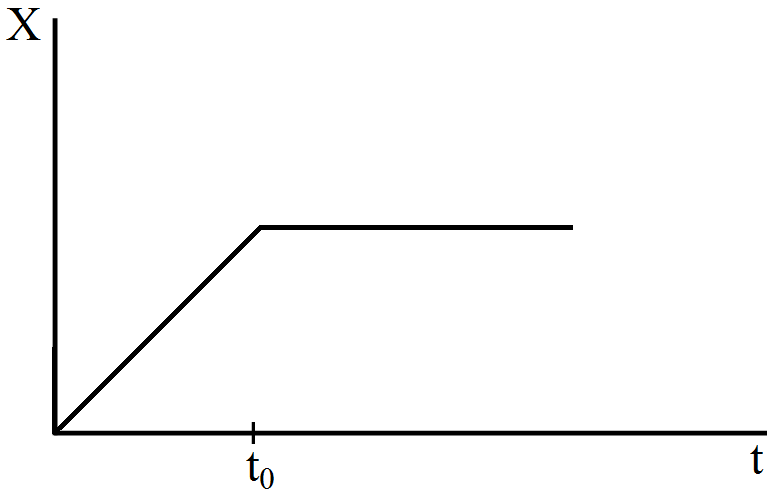
Figure shows the displacement-time graph of a particle moving on the X-axis.

Two particles of mass $5\, kg$ and $10\, kg$ respectively are attached to the two ends of a rigid rod of length $1\, m$ with negligible mass. The centre of mass of the system from the $5\, kg$ particle is nearly at a distance of $..........\, cm$
The range of the projectile projected at an angle of $15^{\circ}$ with horizontal is $50\,m$. If the projectile is projected with same velocity at an angle of $45^{\circ}$ with horizontal, then its range will be $........\,m$
Range of a bullet fired at $45^o$ to horizontal is $980m$. If the bullet is fired at same  angle from a car travelling horizontally at $18\, km/hr$ towards target then range will be  increased by :-
A source of sound of frequency $500 Hz$ is moving towards an observer with velocity $30 m/s$. The speed of sound is $330 m/s$. the frequency heard by the observer will be  .... $Hz$
A body of mass $40\,kg$ resting on rough horizontal surface is subjected to a force $P$ which is just enough to start the motion of the body. If $\mu_{ s }=5, \mu_{ x }=0.4$, $g =10\,m / s ^2$ and the force $P$ is continuously applied on the body, then the acceleration of the body is $.........m/s^{2}$
One end of a slack wire (Young's modulus $Y$, length $L$ and cross-sectional area $A$ ) is clamped to a rigid wall and the other end to a block (mass $m$ ), which rests on a smooth horizontal plane. The block is set in motion with a speed $v$. What is the maximum distance, then the block will travel after the wire becomes taut?
The focal power of a lens has the dimensions