MCQ
A microscope objective gathers light over a cone of semi-vertex $30^o$ and used visible light of wavelength $5500\mathop A\limits^0 $. Its resolving limit is
  • A
    $2.5 \times {10^{ - 5}}\ cm$
  • B
    $4.6 \times {10^{ - 5}}\ cm$
  • C
    $3.9 \times {10^{ - 5}}\ cm$
  • $6.7 \times {10^{ - 5}}\ cm$

Answer

Correct option: D.
$6.7 \times {10^{ - 5}}\ cm$
d
Resolving limits of microscope is $\mathrm{S}=\frac{1.22 \lambda}{2 \sin \mathrm{i}}$

$\mathrm{i}=$ semi cone angle of light

$s=\frac{1.22 \times 5.5 \times 10^{-5} \mathrm{cm}}{2 \times \sin 30}=6.7 \times 10^{-5} \mathrm{cm}$

Need a full question paper?

Generate a complete, print-ready paper with questions like this in minutes — across 16+ boards, with answer keys.

Start Generating Free

Similar questions

The angular velocity of seconds hand of a watch will be 
A constant potential difference is applied to the ends of a graphite rod, whose resistance decreases with a rise of temperature. The rod can be $(1)$ covered with asbestos or $(2)$ left open to atmosphere. Answer for steady state.
Which of the following graphs represent the behavior of an ideal gas ? Symbols have their usual meaning.
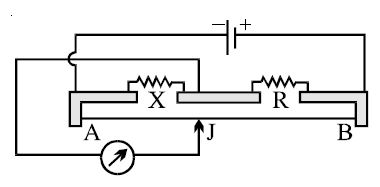
The figure shows a meter-bridge circuit, with $AB = 100\, cm$,$ X = 12\,\Omega$ and $R = 18\,\Omega$ , and the jockey $J$ in the position of balance. If $R$ is now made $8\,\Omega$ , through what distance will $J$ have to be moved to obtain balance? .............. $cm$
A wire of length $5 \,m$ is twisted through $30^{\circ}$ at free end. If the radius of wire is $1 \,mm$, the shearing strain in the wire is ..........,.
A body covers first one-third of the distance with a velocity $20\, ms^{-1}$, the second one-third with a velocity of $30\, ms^{-1}$ and last one-third with a velocity of $40\, ms^{-1}$. The average velocity is nearly........$m/s$
In $NPN$ transistor the collector current is $10\, mA$. If $90\%$ of electrons emitted reach the collector, then
Equipotential surfaces associated with an electric field which is increasing in magnitude along the $x$-direction are
Two wires of same diameter of the same material having the length $l$ and $2l.$ If the force $  F$ is applied on each, the ratio of the work done in the two wires will be
Number of visible lines in Balmer's series