Question
A mixture contains water, kerosene and sand. How will you separate this mixture?

Answer

The mixture of water, kerosene and sand is filtered with the help of filter paper first. Sand remains as residue on the filter paper while mixture of water and kerosene is obtained as filtrate .The mixture of water and kerosene is then put in separating funnel and allowed to stand for some time. The mixture separates into two layers according to the difference in the densities of water and kerosene. Water is heavier than kerosene. So, water forms lower layer while kerosene forms upper layer. On opening the stop clock of separating funnel, the lower layer of water comes out first and collected in beaker leaving behind kerosene in the separating funnel.
Need a full question paper?

Generate a complete, print-ready paper with questions like this in minutes — across 16+ boards, with answer keys.

Start Generating Free

Similar questions

An element $X$ forms the following compounds with hydrogen, carbon and oxygen:
$H_2X, CX_2, XO_2, XO_3$
  1.  
  1.  
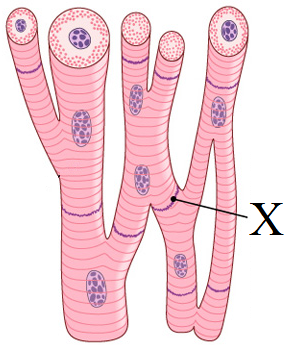
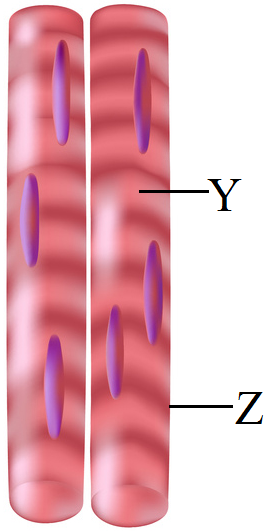
  1. Identify figures A and B.
  2. Label X, Y and Z.
  3. Which one act as impulse booster?
  4. Which one is under control our will?
Discuss various methods for weed control.
Mention any two desirable agronomic characters for crop improvement. Explain how farmers get desired characters incorporated into the new varieties produced. List two conditions necessary for the new varieties to be accepted.
There is a large group of materials P which can be divided into three groups Q, R, and S on the basis of their properties. The substances belonging to group Q can be solids, liquids or gases. The solids belonging to group Q are usually electrical insulators. Most of the substances of group R are solids which are good conductors of electricity. The substances belonging to group S are neither insulators like Q nor good conductors like R. The properties of S are intermediate between those of Q and R.
  1. What could the group of materials P be?
  2. Name the substances Q. Give two examples of such substances.
  3. Name the substances R. Write two examples of such substances.
  4. Name the substances S. Give two examples of such substances.
  5. Out of Q, R and S, which substances are malleable and ductile?
What is lymph? Describe its function.
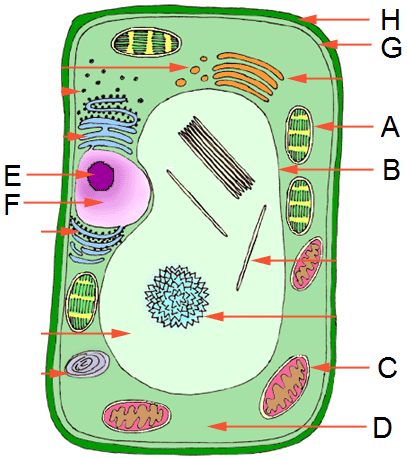
Given along side is a diagrammatic sketch of a certain generalised cell.
  1. Name the parts labeled as A-H.
  2. Is it a plant cell or an animal cell? Give two reasons in support of your answer.
  3. List the functions of parts marked as A, F and H.
A liquid compound X of molecular mass 18u can be obtained from a number of natural sources. All the animals and plants need liquid X for their survival. When an electric current is passed through 200 grams of pure liquid X under suitable conditions, then 178 grams of gas Y and 22 grams of gas Z are produced. Gas Y is produced at the positive electrode whereas gas Z is obtained at the negative electrode. Moreover, gas Y supports combustion whereas gas Z burns itself causing explosions.
  1. Name (i) liquid X (ii) gas Y, and (iii) gas Z
  2. What is the ratio to the mass of element Z to the mass of element Y in the liquid X?
  3. Which law of chemical combination is illustrated by this example?
  4. Name two sources of liquid X.
  5. Gate an important use of Y in our life.
State the main points of difference between homogeneous and heterogeneous mixtures.
A mixture contains water, kerosene and sand. How will you separate this mixture?