Question
A monkey climbs up a slippery pole for 3 seconds and subsequently slips for 3 seconds. Its velocity at time t is given by v(t) = 2t(3 - t); 0 < t < 3 and v(t) = -(t - 3)(6 - t) for 3 < t < 6s in m/s. It repeats this cycle till it reaches the height of 20m.
How many cycles (counting fractions) are required to reach the top?
Answer

Given velocity
$\text{v}(\text{t})=2\text{t}(3-\text{t})=6\text{t}-2\text{t}^2$
Distance covered in 0 to 3s = 9m
Distance covered in 3 to 6s
$=\int_3^6(18-9\text{t}+\text{t}^2)\text{dt}=\Big(18\text{t}-\frac{9\text{t}^2}{2}+\frac{\text{t}^3}{3}\Big)^6$
$=18\times6-\frac{9}{2}\times6^2+\frac{6^3}{3}-\Big(18\times3-\frac{9\times3^2}{2}+\frac{3^3}{3}\Big)$
$=108-9\times18+\frac{6^3}{3}-18\times3+\frac{9}{2}\times9-\frac{27}{3}$
$=-4.5\text{m}$
$\therefore$ Total distance travelled in one cycle
$=\text{s}_1+\text{s}_2=9-4.5=4.5\text{m}$
Number of cycles to be covered in total distance $=\frac{20}{4.5}\approx4.44\approx5$

Need a full question paper?

Generate a complete, print-ready paper with questions like this in minutes — across 16+ boards, with answer keys.

Start Generating Free

Similar questions

Show that there are two values of time for same height during the course of flight of a projectile and the sum of these times is equal to the total time of flight.
A train start moving from rest and its speed increases with uniform acceleration for 10 sec . At the end of 5 sec . its speed become $54 km /$ hour.
(a) Find the acceleration of the train.
(b) What will be its speed after 10 sec ?
(c) How much distance will the train travel in 10 sec?
(d) How much distance did the train cover in the seventh and tenth second respectively?
A simple pendulum is suspended from the ceiling of a car taking a turn of radius 10m at a speed of 36km/ h. Find the angle made by the string of the pendulum with the vertical if this angle does not change during the turn. Take g= 10m/s2.
The number of electrons in an insulator is of the same order as the number of electrons in a conductor. What is then the basic difference between a conductor and an insulator?
A monkey of mass 40 kg climbs on a rope which can stand a maximum tension 600 N . In which of the following cases will the rope break?
The monkey
a. climbs up with an acceleration of $6 m / s ^2$
b. climbs down with an acceleration of $4 m / s ^2$
c. climbs up with a uniform speed of $5 m / s$
d. falls down the rope freely under gravity. Take $g=10 m / s ^2$ and ignore the mass of the rope.
State law of conservation of linear momentum. Derive the law of conservation of momentum from Newton's third law of motion.
A cylinder rotating at an angular speed of 50rev/s is brought in contact with an identical stationary cylinder. Because of the kinetic friction, torques act on the two cylinders, accelerating the stationary one and decelerating the moving one. If the common magnitude of the acceleration and deceleration be one revolution per second square, how long will it take before the two cylinders have equal angular speed?
A certain substance has a mass of $50 g /$ mole. When 300 J of heat is added to 25 g of sample of this material, its temperature rises from $25^{\circ} C$ to $45^{\circ} C$. Calculate
i. the thermal capacity,
ii. specific heat capacity, and
iii. molar heat capacity of the sample.
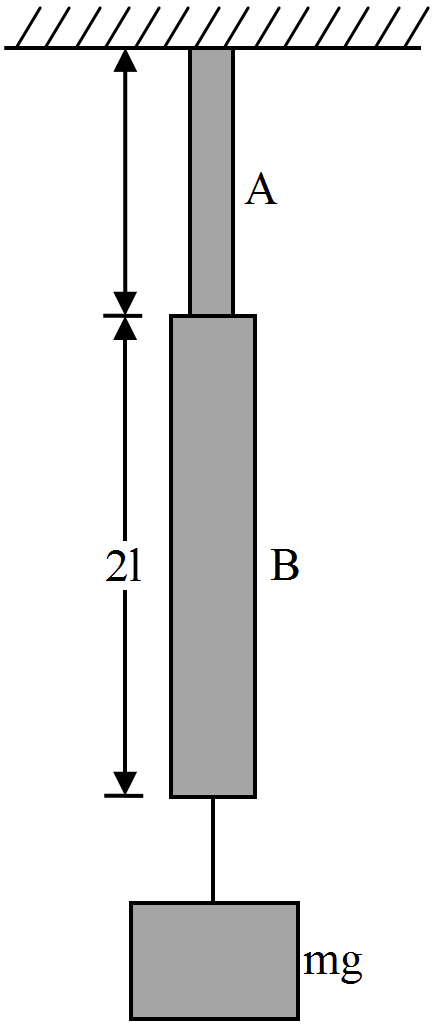
Two wires A and B of length l, radius r and length 2l, radius 2r having same Young's modulus Y are hung with a weight mg, see fig. What is the net elongation in the two wires?

A man walking briskly in rain with speed v must slant his umbrella forward making an angle $\theta$ with the vertical. A student derives the following relation between $\theta$ and v: $\tan \theta = \text{v}$ and checks that the relation has a correct limit: as $\text{v}\rightarrow 0,\ \theta \rightarrow0,$ as expected. (We are assuming there is no strong wind and that the rain falls vertically for a stationary man). Do you think this relation can be correct? If not, guess the correct relation.