Question
A monochromatic light source of intensity 6mW emits 8 × 10¹⁶ photons per second. This light ejects photoelectrons from a metal surface. The stopping potential for this setup is 2.0V. Calculate the work function of the metal.

Answer

$\text{w}_0=\text{hv}-\text{ev}_0$

$=\frac{5\times10^{-3}}{8\times10^{15}}-1.6\times10^{-19}\times2$

(Given V0 = 2V, No. of photons = 8 × 10¹⁵, Power = 5mW)

$=6.25\times10^{-19}-3.2\times10^{-19}=3.05\times10^{-19}\text{J}$

$=\frac{3.05\times10^{-19}}{1.6\times10^{-19}}=1.906\text{ev.}$

Need a full question paper?

Generate a complete, print-ready paper with questions like this in minutes — across 16+ boards, with answer keys.
Start Generating Free

Similar questions

An electric bulb is designed to operate at 12 volts DC. If this bulb is connected to an AC source and gives normal brightness, what would be the peak voltage of the source?
What are the advantages of using soft iron as a core, instead of steel, in the coils of galvanometers?
Does the temperature of a body depend on the frame from which it is observed?
A uranium reactor develops thermal energy at a rate of 300MW. Calculate the amount of 235U being consumed every second. Average released per fission is 200MeV.
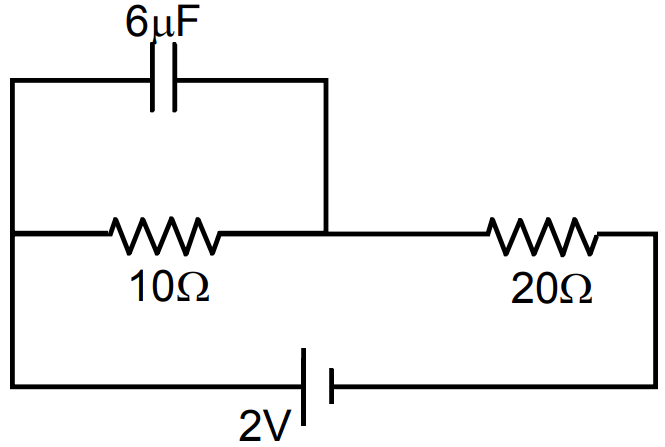
Find the charge on the capacitor shown in figure.

Explain the formation of energy band in solids. Draw energy band diagram for (i) a conductor, (ii) an intrinsic semiconductor.
A laser beam has intensity 2.5 × 10¹⁴Wm-2. Find amplitudes of electric and magnetic fields in the beam.
A proton describes a circle of radius 1cm in a magnetic field of strength 0.10T. What would be the radius of the circle described by an α-particle moving with the same speed in the same magnetic field?
Two cells of EMFs $1 V, 2 V$ and internal resistance $2 \Omega$ and $1 \Omega$ respectively are connected in
i. series,
ii. parallel. What should be the external resistance in the circuit so that the current through the resistance be the same in the two cases? In which case, more heat is generated in the cells?
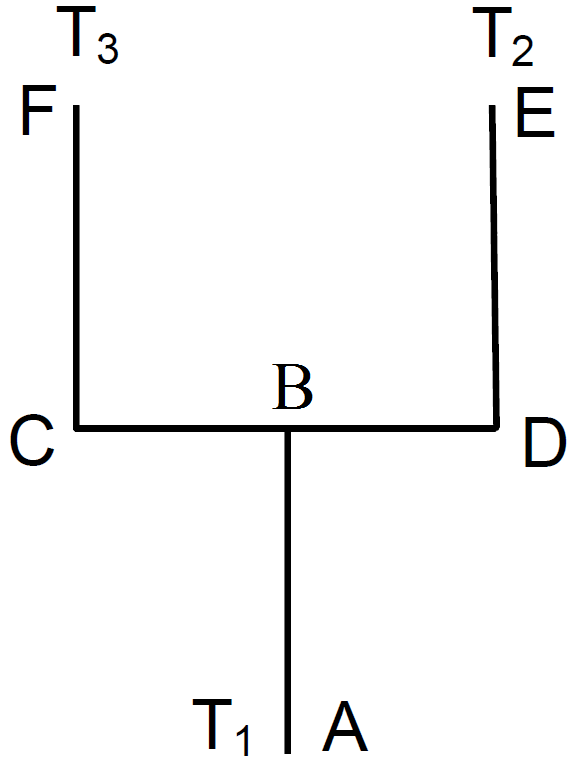
Four identical rods AB, CD, CF and DE are joined as shown in figure. The length, cross-sectional area and thermal conductivity of each rod are l, A and K respectively. The ends A, E and F are maintained at temperatures T1, T2 and T3 respectively. Assuming no loss of heat to the atmosphere, find the temperature at B.