Question
A monochromatic light source of power $5\ mW$ emits $8 \times 10^{15}$ photons per second. This light ejects photo electrons from a metal surface. The stopping potential for this set up is $2V$. Calculate the work function of the metal.

Answer

$P = 5 \times 10^{-3}W, n = 8 \times 10^{15}$ photons per secondEnergy of each photon,
$\text{E}=\frac{\text{p}}{\text{n}}=\frac{5\times10^{-3}}{8\times10^{15}}=6.25\times10^{-19}\text{J}=\frac{6.25\times10^{-19}\text{J}}{1.6\times10^{-19}}\text{eV}$
$\text{E}=3.9\text{eV}$
Work function$, W_0 = E - V_0 = (3.9 - 2)\ eV = 1.9\ eV$

Need a full question paper?

Generate a complete, print-ready paper with questions like this in minutes — across 16+ boards, with answer keys.
Start Generating Free

Similar questions

When a compass needle be placed at magnetic north pole, how would it behave? If a dip needle be placed at the place, how would it behave?
A short bar magnet of magnetic moment $5.25 \times 10^{–2}J T^{–1}$ is placed with its axis perpendicular to the earth’s field direction. At what distance from the centre of the magnet, the resultant field is inclined at $45^\circ$ with earth’s field on $(a)$ its normal bisector and $(b)$ its axis. Magnitude of the earth’s field at the place is given to be $0.42 G$. Ignore the length of the magnet in comparison to the distances involved.
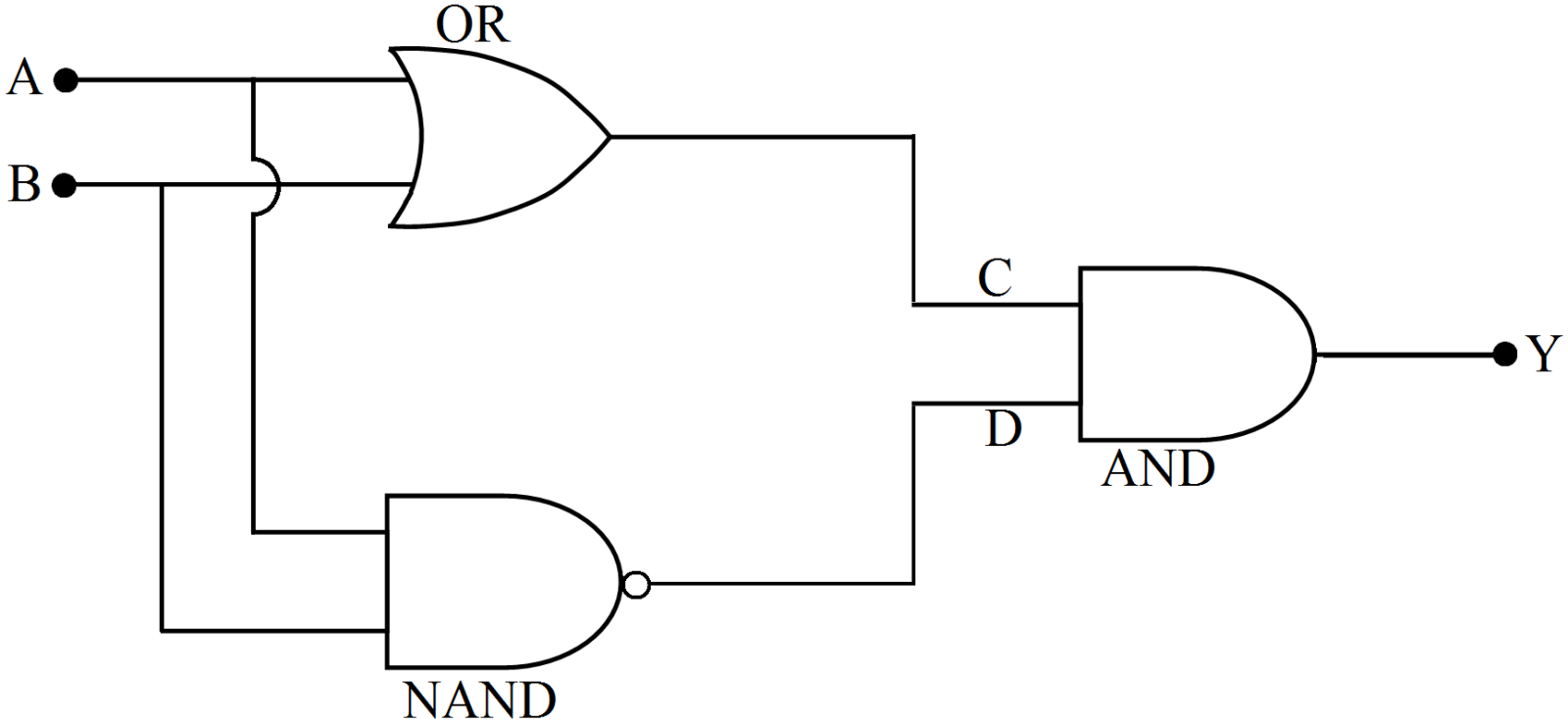
Identify the logic gate represented by the following circuit by writing its truth table:
(i) Obtain an expression of average power in AC circuit.
(ii) In an alternating circuit, if alternating current $I=4 \sin \omega t$ and voltage V-200sin $(\omega t+\pi / 3)$ then calculate the average power dissipated in the circuit.
Explain the quantisation of angular momentum for an electron orbiting a nucleus.
Write second postulate of Bohr's model and De-Broglie's explanation of it.
Answer the following question :
Why must both the objective and the eyepiece of a compound microscope have short focal lengths?
Use the formula $\lambda _m T = 0.29 \ cm K$ to obtain the characteristic temperature ranges for different parts of the electromagnetic spectrum. What do the numbers that you obtain tell you?
(a) When a telescope is turned upside down and looked at the objective, it appears very small, why?
(b) Why does this not happen in a microscope?
A proton is projected with a velocity of $3 \times 10^6 ms^{-1}$ perpendicular to a uniform magnetic field of $0.6T.$ Find the acceleration of the proton.
Draw a graph showing change of alternating current with frequency in LCR series resonant circuit and obtain expression for bandwidth.