Question
A motor cyclist going round in a circular track at constant speed has

Answer

Linear velocity, acceleration and force varies in direction

Need a full question paper?

Generate a complete, print-ready paper with questions like this in minutes — across 16+ boards, with answer keys.

Start Generating Free

Similar questions

A cannon ball is fired with a velocity $200\, m/sec$ at an angle of $60° $ with the horizontal. At the highest point of its flight it explodes into $3$ equal fragments, one going vertically upwards with a velocity $100 \,m/sec$, the second one falling vertically downwards with a velocity $100\, m/sec$. The third fragment will be moving with a velocity
The beautiful iridescent (like a rainbow) colors on the wings of a tropical or morpho butterfly are due to
A galvanometer is connected to the secondary coil. The galvanometer shows an instantaneous deflection of 7 divisions when current is started in the primary coil of the solenoid. Now, if the primary coil is suddenly rotated through $180^{\circ}$, then the new instantaneous deflection will be:
If the water falls from a dam into a turbine wheel $19.6\, m$ below, then the velocity of water at the turbine is ............. $\mathrm{m/s}$ $(g = 9.8\,m/{s^2})$
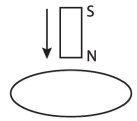
Assertion $(A):$ The bar magnet falling vertically along the axis of the horizontal coil will be having acceleration less than $g$.

Reason $(R):$ Clockwise current induced in the coil.
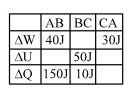
A student records $\Delta Q, \Delta U \& \Delta W$ for a thermodynamic cycle $A$ $\rightarrow$ $B \rightarrow C \rightarrow A$. Certain entries are missing. Find correct entry in following options.
Mass $M$ is lowered by the help of a string at constant acceleration $\frac{g}{2}$ for distance $x$. Work done by string will be :-
A particle executing simple harmonic motion with amplitude of $0.1 \,m$. At a certain instant when its displacement is $0.02 \,m$, its acceleration is $0.5 \,m/s^2$. The maximum velocity of the particle is (in $m/s$)
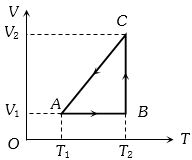
A cyclic process for $1\, mole$ of an ideal gas is shown in figure in the $V-T,$ diagram. The work done in $AB, BC$ and $CA$ respectively
Time taken by an object falling from rest to cover the height of ${h_1}$ and ${h_2}$ is respectively ${t_1}$ and ${t_2}$ then the ratio of ${t_1}$ to ${t_2}$ is