Question
A moving charge produces:

Answer

  1. Both of them.
Explanation:
Because of the presence of a charge, a particle produces an electric field. Also, because of its motion, that is, the flow of charge or current, there is generation of a magnetic field.

Need a full question paper?

Generate a complete, print-ready paper with questions like this in minutes — across 16+ boards, with answer keys.
Start Generating Free

Similar questions

The battery connections required to forward bias a pn junction are ____________:
The area of each plate of a parallel plate capacitor is $100\ cm^2$ and the distance between the plates is $1\ mm$. It is filled with mica of dielectric $6$. The radius of the equivalent capacity of the sphere will be
The angle of minimum deviation for a prism is 40° and the angle of the prism is 60°. The angle of incidence in this position will be(a) 30°  (b) 60°(c) 50° (d) 100°
       
A dip circle is taken to geomagnetic equator. The needle is allowed to move in a vertical plane perpendicular to the magnetic meridian. The needle will stay:
  1. In horizontal direction only.
  2. In vertical direction only.
  3. In any direction except vertical and horizontal.
  4. In the direction it is released.
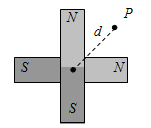
Two short magnets of equal dipole moments $M$ are fastened perpendicularly at their centre $($figure$).$ The magnitude of the magnetic field at a distance $d$ from the centre on the bisector of the right angle is
A bright star is indicated to have a brightness magnitude of – 5 compared to a star of brightness zero magnitude. It means that this star compared to the reference star of zero brightness is            (a) 100 times less bright(b) 5 times more bright(c) 5 times less bright(d) 100 times more bright
   
   
A triode whose mutual conductance is 2.5 m A/volt and anode resistance is 20 kilo ohm, is used as an amplifier whose amplification is 10. The resistance connected in plate circuit will be(a) 1 kW  (b) 5 kW(c) 10 kW(d) 20 kW
       
Which of the following statement is not correct about two parallel conductors carrying equal currents in the same direction?
The time period of a bar magnet suspended horizontally in the earth's magnetic field and allowed to oscillate(a) Is directly proportional to the square root of its mass(b) Is directly proportional to its pole strength(c) Is inversely proportional to its magnetic moment(d) Decreases if the length increases but pole strength remains same


The relation between the linear magnification $m,$ the object distance $u$ and the focal length $f$ is