Question
A moving object can do work. An object moving faster can do more work than an identical object moving relatively slow. A moving bullet, blowing wind, a rotating wheel, a speeding stone can do work. How does a bullet pierce the target? How does the wind move the blades of a windmill? Objects in motion possess energy. We call this energy kinetic energy.

Thus, the kinetic energy possessed by an object of mass, m and moving with a uniform velocity, v is

KE = ½ *mv2

The energy possessed by an object is thus measured in terms of its capacity of doing work. The unit of energy is, therefore, the same as that of work, that is, joule (J).

(i) Energy possessed by body which is in motion is called

(a) Potential energy

(b) Kinetic energy

(c) Nuclear energy

(d) None of these

(ii) Which of the following has same unit?

(a) Potential energy and Force

(b) Kinetic energy and work

(c) Both a and b

(d) None of these

(iii) Kinetic energy depends

(a) Inversely on velocity of body

(b) Directly on square of velocity of body

(c) Directly on  velocity of body

(d) None of these

(iv) Define kinetic energy of body. Give its SI unit

(v) Is kinetic energy scalar or vector? Justify your answer

Answer

(i) b

(ii) b

(iii) b

(iv) Energy possessed by object due to its motion is called as kinetic energy. Its SI unit is N-m or Joule(J).

(v) kinetic energy is scalar quantity as it is a work done and work done is scalar quantity hence kinetic energy is also scalar quantity and doesn’t have any direction.

Need a full question paper?

Generate a complete, print-ready paper with questions like this in minutes — across 16+ boards, with answer keys.

Start Generating Free

Similar questions

 Do we always need to heat or change pressure for changing the state of matter? Can you quote some examples from everyday life where change of state from liquid to vapour takes place without the liquid reaching the boiling point? In the case of liquids, a small fraction of particles at the surface, having higher kinetic energy, is able to break away from the forces of attraction of other particles and gets converted into vapour. This phenomenon of change of a liquid into vapors at any temperature below its boiling point is called evaporation.

i.) Evaporation of liquid takes place at

a.) Boiling point

b.) Above boiling point

c.) Below boiling point

d.) None of these

ii.) Evaporation takes place at surface of liquid because

a.) They are heavy as compare to other particles

b.) They have sufficient kinetic energy to break the force

c.) They are light weight as compare to other particles

d.) None of these

iii.) During evaporation particles of liquid change into vapour

a.) From the surface

b.) From the bottom

c.) From all over the liquid

d.) None of these

iv.) Define evaporation.

v.) Explain process of evaporation

Archimedes’ principle, stated as follows: When a body is immersed fully or partiallyin a fluid, it experiences an upward force thatis equal to the weight of the fluid displacedby it. The upward force is known as up thrust or buoyant force. In fact, all objects experience a force of buoyancy when they are immersed in a fluid. The magnitude of this buoyant force depends on the density of the fluid.Objects having density less than that of the liquid in which they are immersed float on the surface of the liquid. If the density of the object is more than the density of the liquid in which it is immersed then it sinks in the liquid. Hence body will float or sink depends upon difference between density of body and fluid.

(i)The up thrust of the body is equal to the

(a) Mass of liquid

(b) Weight of liquid

(c) Weight of liquid displaced by body

(d) None of these

(ii) If the density of the object is more than the density of the liquid in which it is immersed then

(a) It sinks in liquid

(b) It floats on liquid

(c) It comes out of liquid

(d) None of these

(iii) When anybody immersed in liquid it experience a force called as

(a) Gravitational force

(b) Buoyancy force

(c) Nuclear force

(d) None of these

(iv) State Archimedes’ principle.

(v) Why does cube of plastic released deep down under the water come up to surface of water?

Sound is produced by vibrating objects. The matter or substance through which sound is transmitted is called a medium. It can be solid, liquid or gas. Sound moves through a medium from the point of generation to the listener. When an object vibrates, it sets the particles of the medium around it vibrating. The particles do not travel all the way from the vibrating object to the ear. Sound waves are characterized by the motion of particles in the medium and are called mechanical waves.When a vibrating objectmoves forward, it pushes and compresses theair in front of it creating a region of highpressure; this region is called a compression(C).When the vibrating object moves backwards,it creates a region of low pressure calledrarefaction (R). Hence sound is longitudinal wave.

(i) Sound waves are

(a) Mechanical waves

(b) Electromagnetic wave

(c) Transverse waves

(d) None of these

(ii) Sound travel in medium with

(a) Compression and rare fraction

(b) Crest and trough

(c) Both can be possible

(d) None of these

(iii) Compression is the region of

(a) High pressure

(b) Low pressure

(c) Medium pressure

(d) None of these

(iv) What is sound and how is it produced?

(v) Why sound wave is called as longitudinal wave?

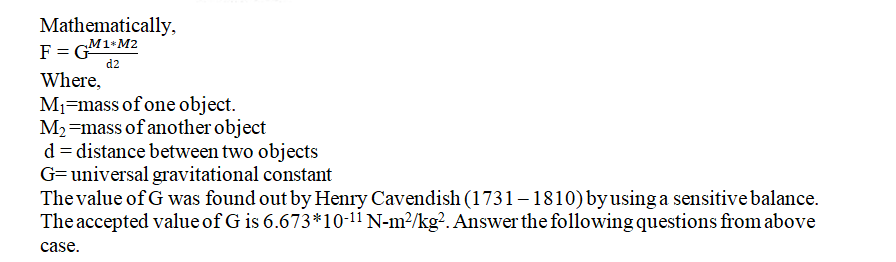
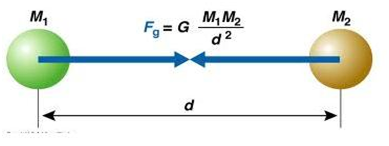
Every object in the universe attracts every other object with a force which is proportional to the product of their masses (m1*m2) and inversely proportional to the square of the distance (d2) between them. The force is along the line joining the centers of two objects.

(i)Gravitational force does not depend on

(a) Masses of objects

(b) Separation between objects

(c) Charges on objects

(d) None of these

(ii) Force of gravitation varies with masses of object as

(a) Product of masses

(b) Sum of masses

(c) Difference of masses

(d) None of these

(iii) When mass of one body is doubled then force of gravitation will become

(a) Force will remain same

(b) Force will become double

(c) Force will become halved

(d) None of these

(iv)What is universal gravitational constant? What is its SI unit?

(v) Two objects of masses 10kg and 20kg separated by distance 10m. What is gravitational force between them?

Work done by force acting on an object is equal to the magnitude of the force multiplied by the distance moved in the direction of the force. Work has only magnitude and no direction. Work done is negative when the force acts opposite to the direction of displacement. Work done is positive when the force is in the direction of displacement.The unit of work is newton-metre (N m)or joule (J).

(i) Work done is

(a) Scalar quantity

(b) Vector quantity

(c) Tensor quantity

(d) None of these

(ii) When force acts against the direction of displacement then work done will be

(a) positive

(b) negative

(c) both a and b can possible

(d) None of these

(iii) SI unit of work is

(a) Joule(J)

(b) Newton meter(N-m)

(c) both a and b

(d) None of these

(iv)You are lifting stone from floor. Work is done by theforce exerted by you on the stone. Theobject moves upwards. The force youexerted is in the direction ofdisplacement. However, there is theforce of gravity acting on the object. Which one of these forces is doingpositive work?

 Which one is doing negative work?

(v) Define 1J of work.

You must have observed that the rate of evaporation increases with–

  • an increase of surface area:
  • We know that evaporation is a surface phenomenon. If the surface area is increased, the rate of evaporation increases. For example, while putting clothes for drying up we spread them out.
  • an increase of temperature:

With the increase of temperature, more number of particles get enough kinetic energy to go into the vapour state.

In an open vessel, the liquid keeps on evaporating. The particles of liquid absorb energy from the surrounding to regain the energy lost during evaporation. This absorption of energy from the surroundings makes the surroundings cold. What happens when you pour some acetone (nail polish remover) on your palm? The particles gain energy from your palm or surroundings and evaporate causing the palm to feel cool. After a hot sunny day, people sprinkle water on the roof or open ground because the large latent heat of vaporization of water helps to cool the hot surface.

i.) Evaporation is surface phenomenon. True or false

a.) True

b.) False

c.) None of these

ii.) As temperature increases the rate of evaporation is

a.) increases

b.) decreases

c.) remains constant

d.) None of these

iii.) The rate of evaporation increases with

a.) Increase in wind speed

b.) Decrease in wind speed

c.) Does not have any effect from wind speed

d.) None of these

iv.) What happens when you pour some acetone (nail polish remover) on your palm?

v.) We are able to sip hot tea from saucer than from cup. Why?

The covering or protective tissues in the animal body are epithelial tissues. Epithelium covers most organs and cavities within the body. External and Internal covering of the body and organs are all made of epithelial tissue.

Epithelial tissue cells are tightly packed and form a continuous sheet. They have only a small or almost no intercellular spaces.it plays an important role in regulating the exchange of materials between the body and the external environment and also between different parts of the body.

Simple squamous epithelial cells are extremely thin and flat and form a delicate lining. The oesophagus and the lining of the mouth are also covered with squamous epithelium. The skin, which protects the body, is also made of squamous epithelium.

Where absorption and secretion occur, as in the inner lining of the intestine, tall epithelial cells are present. This columnar (meaning ‘pillar-like’) epithelium facilitates movement across the epithelial barrier. In the respiratory tract, the columnar epithelial tissue also has cilia, which are hair-like projections on the outer surfaces of epithelial cells. These cilia can move, and their movement pushes the mucus forward to clear it. This type of epithelium is thus ciliated columnar epithelium.

Cuboidal epithelium (with cube-shaped cells) forms the lining of kidney tubules and ducts of salivary glands, where it provides mechanical support. Epithelial cells often acquire additional specialisation as gland cells, which can secrete substances at the epithelial surface. Sometimes a portion of the epithelial tissue folds inward, and a multicellular gland is formed. This is glandular epithelium.

(1) The ciliated columnar epithelium is present in

(a) Respiratory tract

(b) Bile duct and oesophagus

(c) Fallopian tube and urethra

(d) Eustachian tube and stomach lining

(2) The cuboidal epithelium is present in

(a) Bronchioles

(b) Bile duct and oesophagus

(c) Fallopian tube and urethra

(d) Kidney tubules ducts of salivary glands

(3) External and Internal covering of the body and organs are all made of ________

(a) Skin Tissue

(b) Epithelial Tissue

(c) Nerves Tissue

(d) Connective Tissue

(4) How are cells arranged in epithelial tissue?

(a) Loosely packed  

(b) Closely packed

(c) Arranged in discontinuous form   

(d) Both a and c

(5) Enlist the types of Epithelial Tissue?
Sound bounces off a solid or a liquid like a rubber ball bounces off a wall. Like light, sound

gets reflected at the surface of a solid or liquid and follows the same laws of reflection. The directions in which the sound is incident and is reflected make equal angles with the normal to the reflecting surface at the point of incidence, and the three are in the same plane. If we clap near a suitable reflecting object such as a tall building or a mountain, we will hear the same sound again a little later. This sound which we hear is called an echo. The sensation of sound persists in our brain for about 0.1 s. To hear a distinct echo the time interval between the original sound and the reflected one must be at least 0.1s. Hence, for hearingdistinct echoes, the minimum distance of theobstacle from the source of sound must be 17.2 m. Thisdistance will change with the temperature ofair. Another phenomenon of reflection of sound is reverberation.A sound created in a big hall will persist byrepeated reflection from the walls until it isreduced to a value where it is no longeraudible. The repeated reflection that resultsin this persistence of sound is called reverberation. Excessive reverberation is highly undesirable.

(i) Which of the following is true related to reflection of sound?

(a) Directions in which the sound is incident and is reflected make equal angles with the normal to the reflecting surface at the point of incidence.

(b) Incident wave reflected wave and normal lies in same plane

(c) Both a and b are true.

(d) None of these

(ii)For hearing distinct echoes, the minimum distance of the obstacle from the source of sound must be

(a) 10m

(b) 20m

(c) 17.2m

(d) None of these

(iii) Excessive reverberation is 

(a) Desirable phenomenon

(b) Undesirable phenomenon

(c) Does not exist

(d) None of these

(iv) A person makes sound near a obstacle and heard the echo after 1 s. What is the distance of the obstacle from the person if the speed of the sound, v is taken as 346 m/s?

(v) State law of reflection of sound.

Blood is a type of connective tissue. The cells of connective tissue are loosely spaced and embedded in an intercellular matrix. The matrix may be jelly like, fluid, dense or rigid. The nature of matrix differs in concordance with the function of the particular connective tissue.

Blood has a fluid (liquid) matrix called plasma, in which red blood corpuscles (RBCs), white blood corpuscles (WBCs) and platelets are suspended. The plasma contains proteins, salts and hormones. Blood flows and transports gases, digested food, hormones and waste materials to different parts of the body.

Bone is another example of a connective tissue. It forms the framework that supports the body. It also anchors the muscles and supports the main organs of the body. It is a strong and nonflexible tissue. Bone cells are embedded in a hard matrix that is composed of calcium and phosphorus compounds. Two bones can be connected to each other by another type of connective tissue called the ligament. This tissue is very elastic.

Another type of connective tissue, cartilage, has widely spaced cells. The solid matrix is composed of proteins and sugars. Cartilage smoothens bone surfaces at joints and is also present in the nose, ear, trachea and larynx.

Areolar connective tissue is found between the skin and muscles, around blood vessels and nerves and in the bone marrow. It fills the space inside the organs, supports internal organs and helps in repair of tissues.

(1) A connective tissue

(a) Has no matrix

(b) Covers the skin

(c) Has abundant matrix

(d) None of these

(2) Areolar connective tissue is found between

(a) Skin and muscles

(b) Blood vessels and nerves

(c) Both a & b

(d) None of these

(3) Two bones are connected to each other by another type of connective tissue called__

(a) Ligament

(b) Cartilage

(c) Bone marrow

(d) Blood

(4) What are the function of connective tissue?

(5) Give the examples of connective tissue.

The given mixture contains three constituents A, B and C. The constituent A is a yellow coloured, solid element which dissolves in a liquid D. The constituents B is a blue coloured salt which is insoluble in liquid D but dissolves easily in another liquid E. The constitudent C is a liquid wlich is used in coolking food and forms a solid fat on hydrogenation.
  1. What do you think could (i) constituent A, and (ii) liquid D be?
  2. What could (i) constituent B, and (ii) liquid E be?
  3. What could liquid C be?
  4. How will you separate the mixture containing A, B and C.