Question
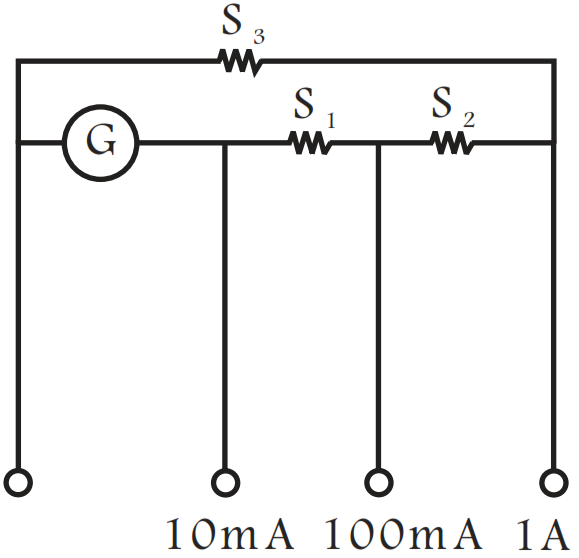
A multirange current meter can be constructed by using a galvanometer circuit as shown in Fig. We want a current meter that can measure 10mA, 100mA and 1A using a galvanometer of resistance 10Ω and that prduces maximum deflection for current of 1mA. Find $S_1, S_2$ and $S_3$ that have to be used.
Answer

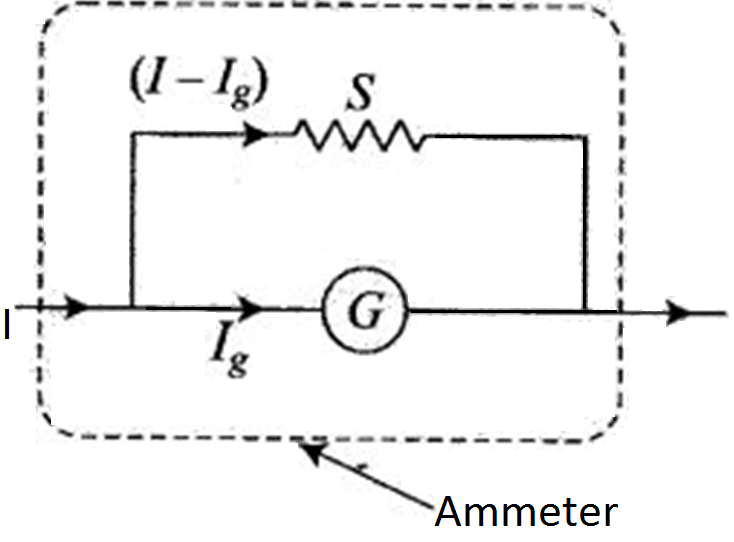
Key concept: A galvanometer can be converted into ammeter by connecting a very low resistance wire (shunt S) connected in parallel with galvanometer. The relationship is given by $I_gG = (l - I_g) S$, where $I_g$ is the range of galvanometer, G is the resistance of galvanometer.

For measuring $I_1 = 10mA : IG.G = (I_1 - IG)(S_1 + S_2 + S_3)$
For measuring $I_2 = 100mA : IG(G + S_1) = (I_2 - IG)(S_2 - S_3)$
For measuring $I_3 = 1A : IG(G + S_1 + S_2) =(I_3 - IG)(S_3)$
Gives $S_1 = 1Ω, S_2 = 0.1Ω $ and $S_3 = 0.01Ω.$

Need a full question paper?

Generate a complete, print-ready paper with questions like this in minutes — across 16+ boards, with answer keys.

Start Generating Free

Similar questions

In semiconductors, thermal collisions are responsible for taking a valence electron to the conduction band. Why does the number of conduction electrons not go on increasing with time as thermal collisions conμnuously take place?
A ball of mass 100g and having a charge of $4.9 \times 10^{-5}C$ is released from rest in a region where a horizontal electric field of $2.0 \times 10^4NC^{-1}$ exists.
  1. Find the resultant force acting on the ball.
  2. What will be the path of the ball?
  3. Where will the ball be at the end of 2s?
A wire of length l is bent in the form of an equilateral triangle and carries an electric currrent i.
  1. Find the magnetic field B at the centre.
  2. If the wire is bent in the form of a square, what would be the value of B at the centre?
Two identical pith balls are charged by rubbing against each other. They are suspended from a horizontal rod through two strings of length 20cm each, the separation between the suspension points being 5cm. In equilibrium, the separation between the balls is 3cm. Find the mass of each ball and the tension in the strings. The charge on each ball has a magnitude $2.0 \times 10^{-8}C.$
It is 260km from Patna to Ranchi by air and 320km by road. An aeroplane takes 30 minutes to go from Patna to Ranchi whereas a delux bus takes 8 hours.
  1. Find the average speed of the plane.
  2. Find the average speed of the bus.
  3. Find the average velocity of the plane.
  4. Find the average velocity of the bus.
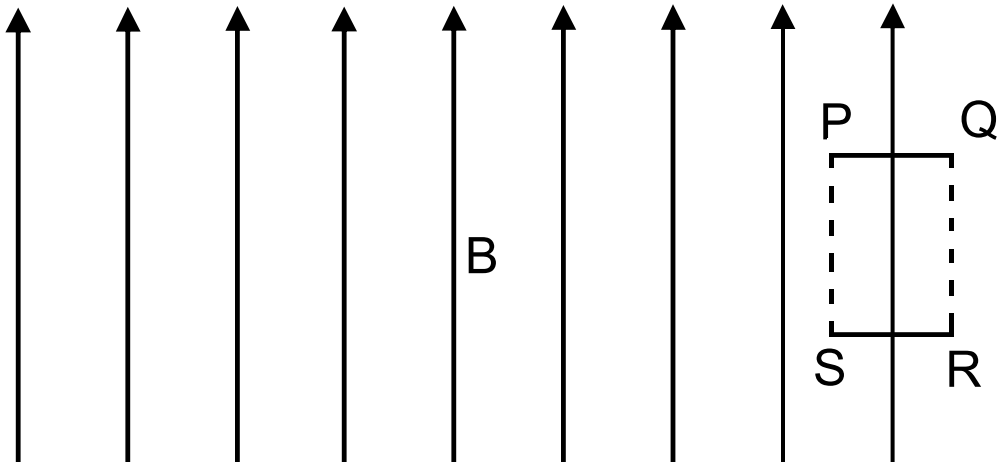
Sometimes we show an idealised magnetic field which is uniform in a given region and falls to zero abruptly. One such field is represented in figure. Using Ampere's law over the path PQRS, show that such a field is not possible.
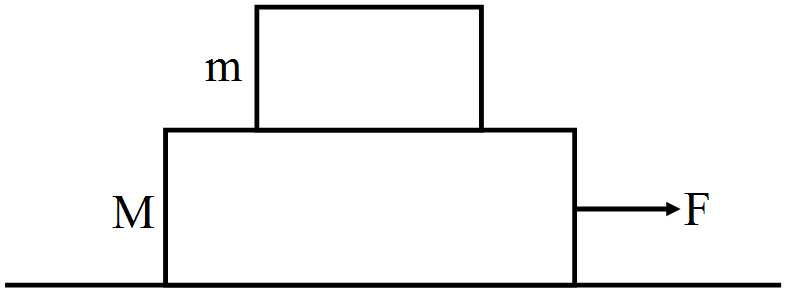
A block of mass m is kept over another block of mass M and the system rests on a horizontal surface figure. A constant horizontal force F acting on the lower block produces an acceleration $\frac{\text{F}}{2(\text{m+M})}$ in the system, the two blocks always move together.
  1. Find the coefficient of kinetic friction between the bigger block and the horizontal surface.
  2. Find the frictional force acting on the smaller block.
  3. Find the work done by the force of friction on the smaller block by the bigger block during a displacement d of the system.
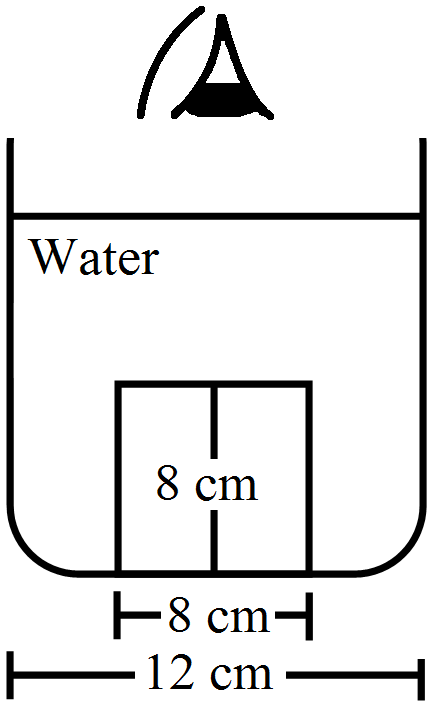
A cylindrical vessel of diameter 12cm contains $800\pi\text{cm}^3$ of water. A cylindrical glass piece of diameter 8.0 cm and height 8.0cm is placed in the vessel. If the bottom of the vessel under the glass piece is seen by the paraxial rays, locate its image. The index of refraction of glass is 1.50 and that of water is 1.33.
A closed coil having 100 turns is rotated in a uniform magnetic field $B = 4.0 \times 10^{-4}T$ about a diameter which is perpendicular to the field. The angular velocity of rotation is 300 revolutions per minute. The area of the coil is $25cm^2$ and its resistance is $4.0\Omega.$ Find
  1. The average emf developed in half a turn from a position where the coil is perpendicular to the magnetic field.
  2. The average emf in a full turn.
  3. The net charge displaced in part (a).
A group of hydrogen atoms are prepared in n = 4 states. List the wavelength that are emitted as the atoms make transitions and return to n = 2 states.