Question
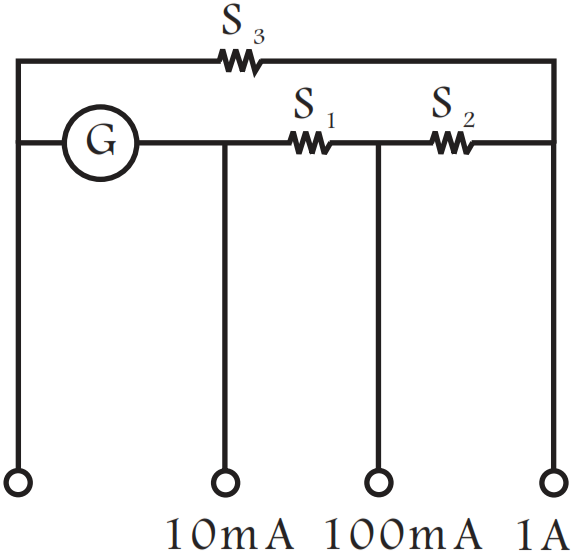
A multirange current meter can be constructed by using a galvanometer circuit as shown in Fig. We want a current meter that can measure $10mA,$ $100mA$ and $1A$ using a galvanometer of resistance $10\Omega$ and that prduces maximum deflection for current of $1mA.$ Find $S_1, S_2$ and $S_3$ that have to be used.
Answer

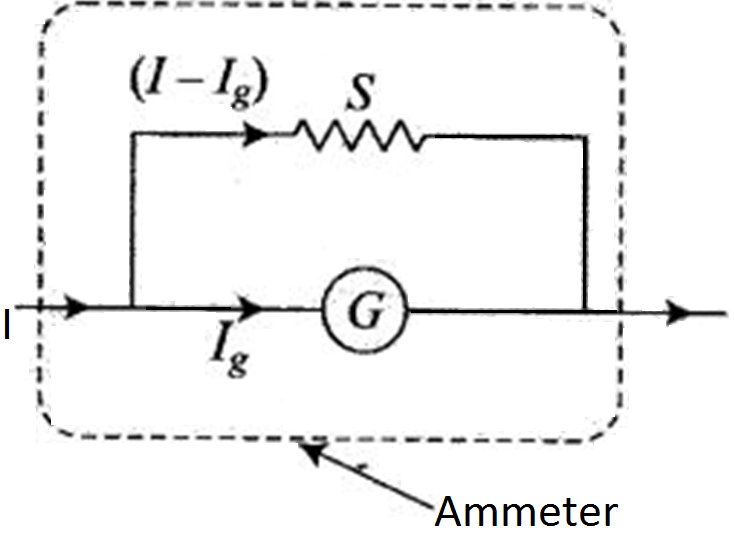
Key concept: A galvanometer can be converted into ammeter by connecting a very low resistance wire (shunt S) connected in parallel with galvanometer. The relationship is given by $I_gG = (l - I_g) S,$ where $I_g$ is
the range of galvanometer, G is the resistance of galvanometer.

For measuring $I_1 = 10mA : IG.G = (I_1 - IG)(S_1 + S_2 + S_3)$
For measuring $I_2 = 100mA : IG(G + S_1) = (I_2 - IG)(S_2 - S_3)$
For measuring $I_3 = 1A : IG(G + S_1 + S_2) =(I_3 - IG)(S_3)$
Gives $S_1 = 1\Omega , S_2 = 0.1\Omega$ and $S_3 = 0.01\Omega .$

Need a full question paper?

Generate a complete, print-ready paper with questions like this in minutes — across 16+ boards, with answer keys.

Start Generating Free

Similar questions

Suppose the second charge in the previous problem is $-1.0 \times 10^{-6}C.$ Locate the position where a third charge will not experience a net force.
The magnetic field inside a long solenoid having $50 turns/cm$ is increased from $2·5 \times 10.3T$ to $2.5T$ when an iron core of cross$-$sectional area $4\ cm^2$ is inserted into it. Find:
  1. The current in the solenoid.
  2. The magnetization I of the core.
  3. The pole strength developed in the core.
Explain graphically the flow of current in semiconductors in the presence of an external electric field.
A boy riding on his bike is going towards east at a speed. of $4\sqrt{2}\ \text{m/s}$ At a certain point he produces a sound pulse of frequency $1650\ Hz$ that travels in air at a speed of $334\ m/s$. A second boy stands on the ground $45^\circ$ south of east from him. Find the frequency of the pulse as received by the second boy.
Find the magnetic field B at the centre of a rectangular loop of length l and width b, carrying a current i.
An electrical device draws $2kW$ power from $AC$ mains $(\text{voltage }223\text{V}\text{(rms)}=\sqrt{50.000}\text{V})$. The current differs (lags) in phase by $\phi\Big(\tan\phi=\frac{-3}{4}\Big)$ as compared to voltage. Find,
  1. $R,$
  2. $X_C - X_L,$
  3. $I_M$. Another device has twice the values for $R, X_C$ and $X_L$. How are the answers affected?
  1. An electron moves along a circle of radius 1m in a perpendicular magnetic field of strength 0.50T. What would be its speed? Is it reasonable?
  2. If a proton moves along a circle of the same radius in the same magnetic field, what would be its speed?

Identify which logic gate OR, AND and NOT is represented by the circuits in the dotted line boxes 1, 2 and 3. Give the truth table for the entire circuit for all possible values of A and B.
  1. In the explanation of photo electric effect, we asssume one photon of frequency $ν$ collides with an electron and transfers its energy. This leads to the equation for the maximum energy $E_\text{max}$ of the emitted electron as,
  1. $\text{E}_\text{max}=\text{hv}-\phi_0$
    where $\phi_0$ is the work function of the metal. If an electron absorbs $2$ photons $($each of frequency $ν)$ what will be the maximum energy for the emitted electron?
  2. Why is this fact $($two photon absorption$)$ not taken into consideration in our discussion of the stopping potential?
A charge is distributed uniformly over a ring of radius ‘a’. Obtain an expression for the electric intensity E at a point on the axis of the ring. Hence show that for point’s at large distances from the ring, it behaves like a point charge.