Question
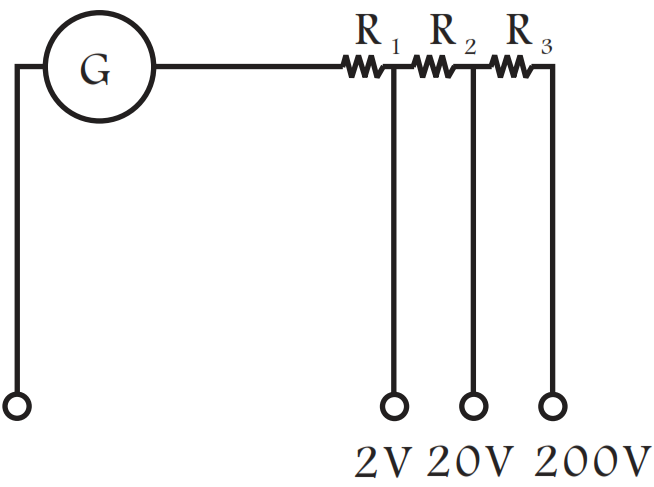
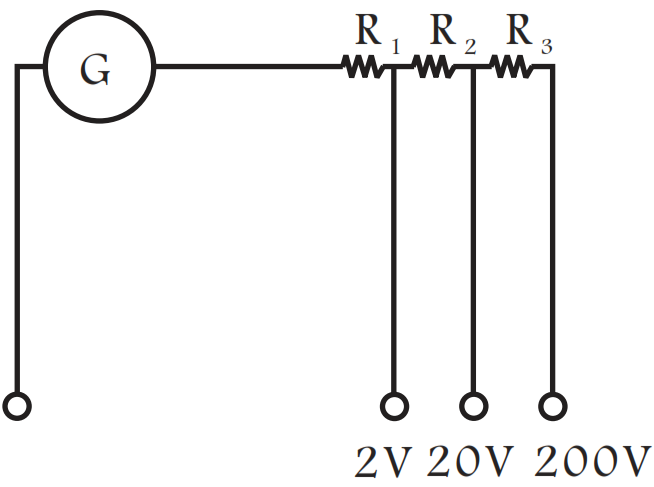
A multirange voltmeter can be constructed by using a galvanometer circuit as shown in Fig. We want to construct a voltmeter that can measure 2V, 20V and 200V using a galvanometer of resistance 10Ω and that produces maximum deflection for current of 1mA. Find R1, R2 and R3 that have to be used.
Answer

Key concept: The galvanometer can also be used as a voltmeter to measure the voltage across a given section of the circuit. For this a very high resistance wire is to be connected in series with galvanometer. The relationship is given by Ig(G + R) where Ig is the range of galvanometer, G is the resistance of galvanometer and R is the resistance of wire connected in series with galvanometer.

Applying expression in different situations

For Ig(G + R1) = 2 for 2V range

For Ig(G + R1 + R2) = 20 for 20V range

And For Ig(G + R1 + R2 + R3) = 200 for 200V range

By solving, we get

R1 = 1990Ω, R2 = 18kΩ and R3 = 180kΩ.

Need a full question paper?

Generate a complete, print-ready paper with questions like this in minutes — across 16+ boards, with answer keys.

Start Generating Free

Similar questions

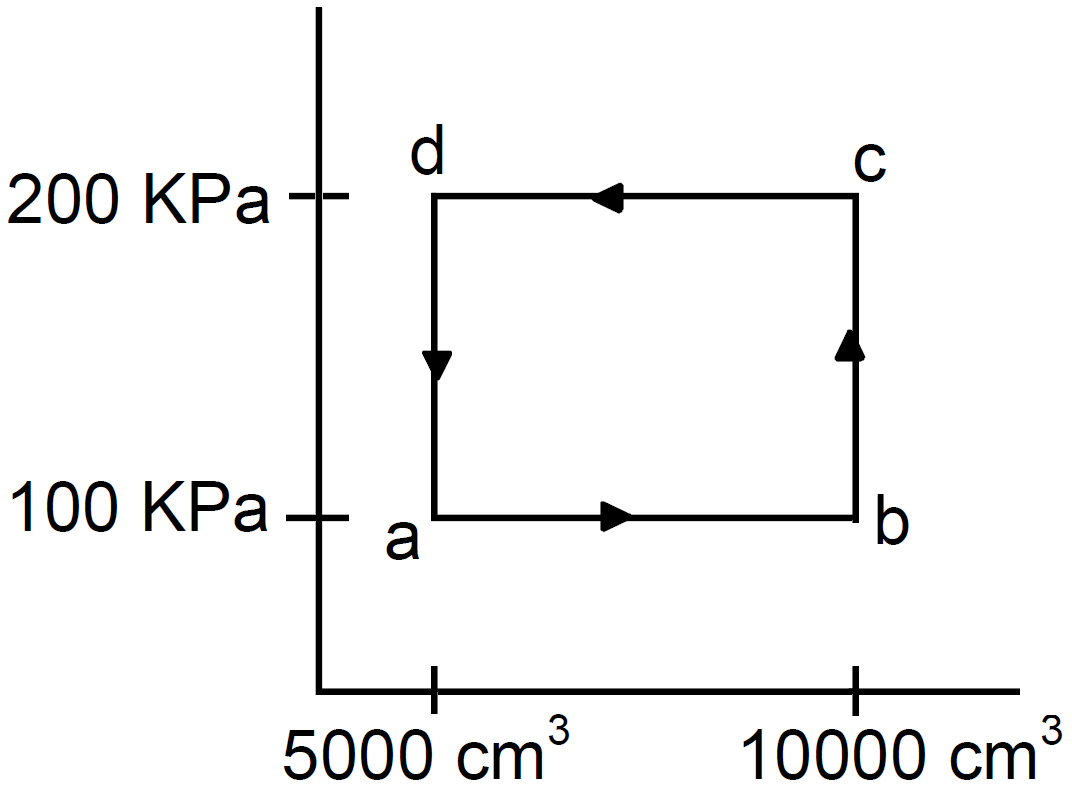
Half mole of an ideal gas $\Big(\gamma=\frac{5}{3}\Big)$ is taken through the cycle abcda, as shown in the figure. Take $\text{R}=\frac{25}{3}\text{JK}^{-1}\text{mol}^{-1}.$
  1. Find the temperature of the gas in the states a, b, c and d.
  2. Find the amount of heat supplied in the processes ab and bc.
  3. Find the amount of heat liberated in the processes cd and da.

A radioactive isotope has a half-life of T years. How long will it take the activity to reduce to
  1. 3.125%,
  2. 1% of its original value?
The half-life of 199Au is 2.7 days.
  1. Find the activity of a sample containing $1.00\mu\text{g}$ of 198Au.
  2. What will be the activity after 7 days? Take the atomic weight of 198Au to be 198g/mol.
With the help of a labelled diagram, state the underlying principle of a cyclotron.
Explain clearly how it works to accelerate the charged particles. Show that cyclotron frequency is independent of energy of the particle. Is there an upper limit on the energy acquired by the particle? Give reason.
A small block of mass m and a concave mirror of radius R fitted with a stand lie on a smooth horizontal table with a separation d between them. The mirror together with its stand has a mass m. The block is pushed at t = 0 towards the mirror so that it starts moving towards the mirror at a constant speed V and collides with it. The collision is perfectly elastic. Find the velocity of the image:
  1. At a time $\text{t}<\frac{\text{d}}{\text{V}}$
  2. At a time $\text{t}>\frac{\text{d}}{\text{V}}.$
Obtain an expression for motional electromotive force.
If the above capacitor is connected across a 6.0V battery, find:
  1. The charge supplied by the battery.
  2. The induced charge on the dielectric.
  3. The net charge appearing on one of the coated surfaces.
  1. Derive an expression for equivalent capacitance of three capacitors when connected in series.
  2. Derive an expression for equivalent capacitance of three capacitors when connected in parallel.
A proton goes undeflected in a crossed electric and magnetic field (the fields are perpendicular to each other) at a speed of 2.0 × 10⁵ms-1. The velocity is perpendicular to both the fields. When the electric field is switched off, the proton moves along a circle of radius 4.0cm. Find the magnitudes of the electric and magnetic fields. Take the mass of the proton = 1.6 × 10⁻²⁷kg
Two circular coils of radii 5.0cm and 10cm carry equal currents of 21 A. The coils have 50 and 100 turns reepectively and are placed in such a way that their planes as well as the centres coincide. Find the magnitude of the magnetic field B at the common centre of the coils if the currents in the coils are (a) in the same sense (b) in the opposite sense.