MCQ

A narrow beam of white light goes through a slab having parallel faces.

  • A
    The light never splits in different colours.
  • B
    The emergent beam is white.
  • C
    The light inside the slab is split into different colours.
  • D
    The light inside the slab is white.

Answer

  1. The emergent beam is white.
  2. The light inside the slab is split into different colours.

Explanation:

White light will split into different colours inside the glass slab because the value of refractive index is different for different wavelengths of light; thus, they suffer different deviations. But the emergent light will be white light. As the faces of the glass slide are parallel, the emerging lights of different wavelengths will reunite after refraction.

Need a full question paper?

Generate a complete, print-ready paper with questions like this in minutes — across 16+ boards, with answer keys.

Start Generating Free

Similar questions

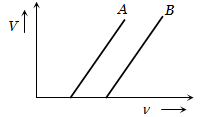
The stopping potential as a function of the frequency of the incident radiation is plotted for two different photoelectric surfaces A and B. The graphs show that work function of A is

(a) Greater than that of B

(b) Smaller than that of B

(c) Equal to that of B

(d) No inference can be drawn about their work functions from the given graphs

Two equal charges q are placed at a distance of 2a and a third charge -2q is placed at the midpoint. The potential energy of the system is

(a)  

(b)

(c)

(d)

Ionisation energy of 10 times ionised sodium atom will be :

Resistance of a voltameter is 2, it is connected in series to a battery of 10 V through a resistance of 3. In a certain time mass deposited on cathode is 1 gm. Now the voltameter and the 3 resistance are connected in parallel with the battery. Increase in the deposited mass on cathode in the same time will be

(a) 0 

(b) 1.5 gm

(c) 2.5 gm

(d) 2 gm

The magnetic susceptibility is negative for:
  1. Pramagnetic materials only.
  2. Diamagnetic materials only.
  3. Ferromagnetic materials only.
  4. Paramagnetic and ferromagnetic materials.

The minimum wavelength of photon is 5000 Å, its energy will be

(a) 2.5 eV

(b) 50 V

(c) 5.48 eV

(d) 7.48 eV

The ultimate individual unit of magnetism in any magnet is called

(a) North pole

(b) South pole

(c) Dipole

(d) Quadrupole

The electric intensity  E, current density j  and specific resistance k are related to each other by the relation

(a) E = j/k

(b) E = jk

(c) E = k/j

(d) k = jE

If L is the coherent length and c the velocity of light, the coherent time is:
A parallel plate capacitor is charged to a certain voltage. Now, if the dielectric material (with dielectric constant k) is removed then the