Question

A narrow electron beam passes undeviated through an electric field E = 3  and an overlapping magnetic field B = 2 . If electric field and magnetic field are mutually perpendicular. The speed of the electrons is

(a) 60 m/s

(b) 10.3  

(c) 1.5  

(d) 0.67  

Answer

(c) 1.5  

Need a full question paper?

Generate a complete, print-ready paper with questions like this in minutes — across 16+ boards, with answer keys.

Start Generating Free

Similar questions

An alternating voltage $\text{E}=50\sqrt{2}\sin(100\text{t})$ V is connected to a $1\mu\text{F}$ capacitor through an ac ammeter. What will be the reading of the ammeter?

Two similar bar magnets P and Q, each of magnetic moment M, are taken, If P is cut along its axial line and Q is cut along its equatorial line, all the four pieces obtained have

(a) Equal pole strength

(b) Magnetic moment  

(c) Magnetic moment  

(d) Magnetic moment M

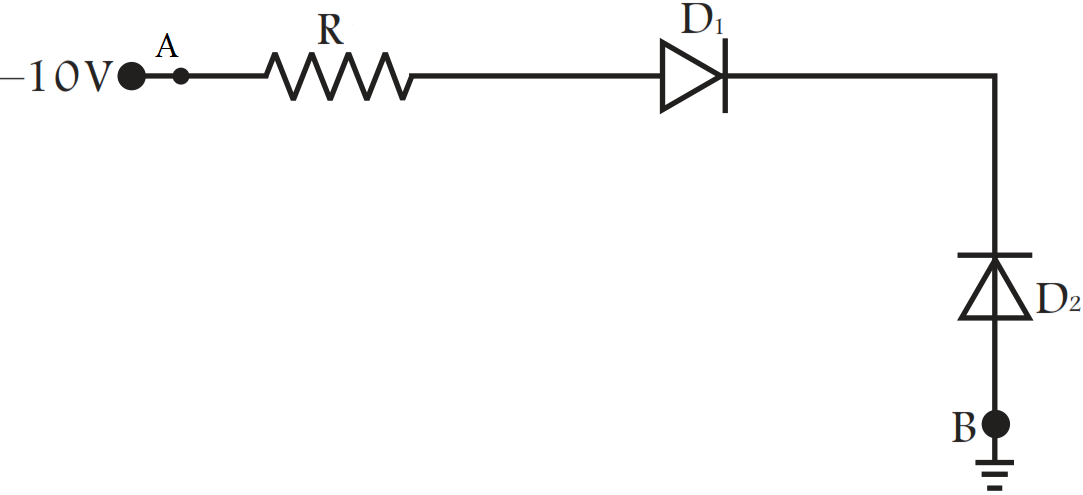
In Fig., assuming the diodes to be ideal:

The total charge of the electric dipole is:

If an electron and a positron annihiliate, then the energy released is

(a) 3.2  

(b) 1.6  

(c) 4.8  

(d) 6.4  

S.I. unit of decay constant is :

Select the correct statement

(a) In a full wave rectifier, two diodes work alternately

(b) In a full wave rectifier, two diodes work simultaneously

(c) The efficiency of full wave and half wave rectifiers is same

(d) The full wave rectifier is bi-directional

A hank of uninsulated wire consisting of seven and a half turns is stretched between two nails hammered into a board to which the ends of the wire are fixed. The resistance of the circuit between the nails is determined with the help of electrical measuring instruments. Determine the proportion in which the resistance will change if the wire is unwound so that the ends remain to be fixed to the nails.

Assertion  :   When a magnetic dipole is placed in a non uniform magnetic field, only a torque acts on the dipole.

Reason      : Force would also acts on dipole if magnetic field were uniform.

(a) If both assertion and reason are true and the reason is the correct explanation of the assertion.

(b) If both assertion and reason are true but reason is not the correct explanation of the assertion.

(c) If assertion is true but reason is false.

(d) If the assertion and reason both are false.

In the given figure, equivalent resistance between A and B will be

(a)  

(b)  

(c)    

(d)