Question
A neutron initially at rest, decays into a proton, an electron and an antineutrino. The ejected electron has a momentum of $1.4 \times 10^{-26}$kg-m/s and the antineutrino $6.4 \times 10^{-27}$kg-m/s. Find the recoil speed of the proton:
  1. If the electron and the antineutrino are ejected along the same direction.
  2. If they are ejected along perpendicular directions. Mass of the proton $= 1.67 \times 10^{-27}$kg.
Answer

Mass of proton $= 1.67 \times 10^{-27}$
Let $‘V_p’$ be the velocity of proton.
Given, momentum of electron $= 1.4 \times 10^{-26}$kg m/sec.
Given, momentum of antineutrino $= 6.4 \times 10^{-27}$kg m/sec
  1. The electron & the antineutrino are ejected in the same direction. As the total momentum is conserved the proton should be ejected in the opposite direction.
$1.67 \times 10^{-27} \times V_p = 1.4 \times 10^{-26} + 6.4 \times 10^{-27} = 20.4 \times 10^{-27}$​​​​​​​
$\Rightarrow\text{V}_{\text{p}}=\Big(\frac{20.4}{1.67}\Big)=12.2\text{m}/\text{sec}$ in the opposite direction.
  1. The electron & antineutrino are ejected $\perp$ to each other.
Total momentum of electron and antineutrino,
$=\sqrt{(14)^2+(6.4)^2}\times10^{-27}\text{kg}\ \ \text{m}/\text{s}=15.4\times10^{-27}\text{kg}\ \ \text{m}/\text{sec}$
Since, $1.67 \times 10^{-27}, V_p = 15.4 \times 10^{-27}$kg m/s
So, $V_p = 9.2m/s$

Need a full question paper?

Generate a complete, print-ready paper with questions like this in minutes — across 16+ boards, with answer keys.

Start Generating Free

Similar questions

Find the rms speed of hydrogen molecules in a sample of hydrogen gas at 300K. Find the temperature at which the rms speed is double the speed calculated in the previous part.
A car accelerates on a horizontal road due to the force exerted by:
  1. The engine of the car.
  2. The driver of the car.
  3. The earth.
  4. The road.
A small object is placed at the centre of the bottom of a cylindrical vessel of radius 3cm and height 4cm filled completely with water. Consider the ray leaving the vessel through a corner. Suppose this ray and the ray along the axis of the vessel are used to trace the image. Find the apparent depth of the image and the ratio of real depth to the apparent depth under the assumptions taken. Refractive index of water = 1.33
A ball is thrown horizontally from a point 100m above the ground with a speed of 20m/s. Find:
  1. The time it takes to reach the ground.
  2. The horizontal distance it travels before reaching the ground.
  3. The velocity (direction and magnitude) with which it strikes the ground.
Derive an expression for equivalent capacitance of three capacitors when connected
i. in series and
ii. in parallel.
An ideal gas at pressure $2.5 \times 10^5Pa$ and temperature 300K occupies 100cc. It is adiabatically compressed to half its original volume. Calculate,
  1. The final pressure.
  2. The final temperature.
  3. The work done by the gas in the process. Take $\gamma=1.5.$
A spherical ball A of surface area $20cm^2$ is kept at the centre of a hollow spherical shell B of area $80cm^2$. The surface of A and the inner surface of B emit as blackbodies. Both A and B are at 300K.
  1. How much is the radiation energy emitted per second by the ball A?
  2. How much is the radiation energy emitted per second by the inner surface of B
  3. How much of the energy emitted by the inner surface of B falls back on this surface itself?
The plates of a parallel plate capacitor have an area of $90cm^2$ each and are separated by 2.5mm. The capacitor is charged by connecting it to a 400V supply.
  1. How much electrostatic energy is stored by the capacitor?
  2. View this energy as stored in the electrostatic field between the plates, and obtain the energy per unit volume u. Hence arrive at a relation between u and the magnitude of electric field E between the plates.
Two current-carrying wires may attract each other. In absence of other forces, the wires will move towards each other increasing the kinetic energy. Does it contradict the fact that the magnetic force cannot do any work and hence cannot increase the kinetic energy?
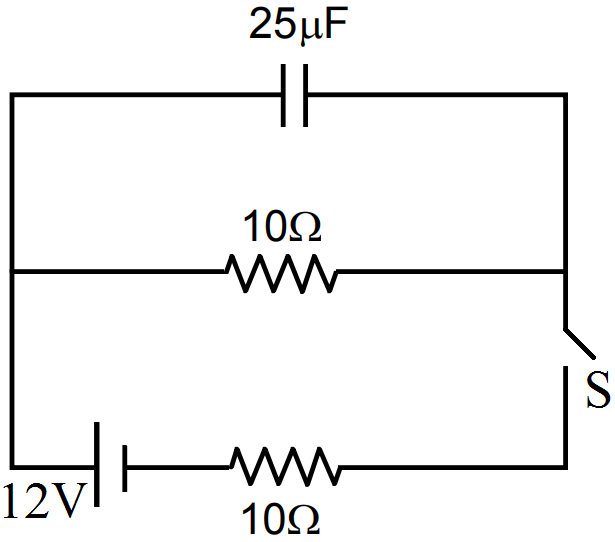
The switch S shown in figure. is kept closed for a long time and is then opened at t = 0. Find the current in the middle $1.0\Omega$ resistor at t = 1ms.