Question
A number when divided by 4 is reduced by 21 . Find the number.

Answer

28

Need a full question paper?

Generate a complete, print-ready paper with questions like this in minutes — across 16+ boards, with answer keys.

Start Generating Free

Similar questions

The heights (in cm) of 35 students of a class are given below :
Height (in cm) 157152153154155156
Number of students 743597
Find the median height.
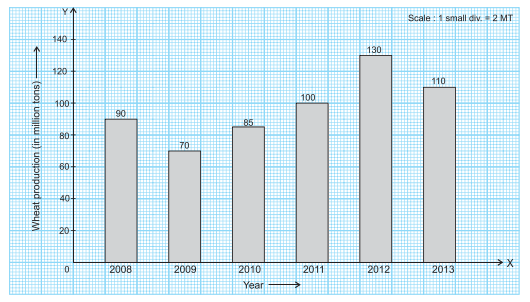
Read the bar graph given below :
Image
Answer the following questions :
(i) What information is given by the bar graph?
(ii) What was the wheat production in 2010?
(iii) In which year the production was minimum?
(iv) In which year there was maximum increase in production of wheat?
Ranjan Singh makes statues of brass. Brass is an alloy of copper and zinc. Ranjan uses two varieties of brass for different kinds of statues. Variety 1 contains copper and zinc mixed in the ratio $7: 4$ and variety 2 contains these metals in the ratio $5: 3$. Ranjan makes an elephant statue from variety 1 and a horse statue from variety 2. The elephant statue weighs 176 g and it is known that the brass used in the horse statue contains 135 g zinc.
Q.1. Find the quantity of copper present in the brass used to make the elephant statue.
(a) 98 g $\quad$$\quad$(b) 112 g$\quad$$\quad$ (c) 121 g $\quad$$\quad$(d) 132 g
Q.2. How much copper is contained in the brass used to make the horse statue?
(a) 165 g $\quad$$\quad$(b) 175 g$\quad$$\quad$ (c) 205 g$\quad$$\quad$ (d) 225 g
Q.3. How much zinc is contained in the brass used to make the two statues?
(a) 169 g $\quad$$\quad$(b) 179 g$\quad$$\quad$ (c) 189 g$\quad$$\quad$ (d) 199 g
Q.4. The ratio of the quantities of copper and zinc used to make the two statues is:
(a) $113: 98$ $\quad$$\quad$(b) $337: 148$ $\quad$$\quad$(c) $221: 199$ $\quad$$\quad$(d) $337: 199$
Add the rational number : $\frac{-1}{18}$ and $\frac{-7}{27}$
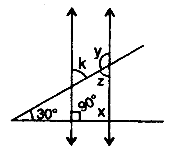
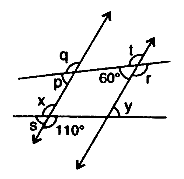
In the given figure, the directed lines are parallel to each other. Find the unknown angles.

Solve: $\frac{\mathrm{y}+2}{3}+\frac{\mathrm{y}+5}{4}=6$
Construct a ∆ ABC such that AB = 6 cm, BC = 5.6 cm and CA = 6.5 cm.
Inscribe a circle to this triangle and measure its radius.
Kunal pulled out a string from one of his shoes. He found that it was 66 cm long. He bent it into different shapes one by one.
Q.1. If Kunal formed an equilateral triangle from the shoe string, what will be the length of each side of the triangle formed ?
(a) 11 cm $\quad$$\quad$(b) 13 cm$\quad$$\quad$(c) 22 cm$\quad$$\quad$(d) 33 cm
Q.2. If he formed a square from the string, the area of the square would be :
(a) $212.5 cm^2$$\quad$$\quad$ (b) $272.25 cm^2$ $\quad$$\quad$(c) $312.75 cm^2$$\quad$$\quad$ (d) $324 cm^2$
Q.3. He formed a circle from the string. Find the radius of the circle formed. [Use $\pi \frac{22}{7}$ ]
(a) 7 cm $\quad$$\quad$(b) 7.5 cm $\quad$$\quad$(c) 9 cm$\quad$$\quad$ (d) 10.5 cm
Q.4. The area of the circle formed from the string will be : [Use $\pi \frac{22}{7}$ ]
(a) $272.25 cm^2$$\quad$$\quad$(b) $346.5 cm^2$ $\quad$$\quad$(c) $414.75 cm^2$ $\quad$$\quad$(d) $452 cm^2$
In the given figure, the directed lines are parallel to each other. Find the unknown angles.
Evaluate: $\frac{-5}{9}+\frac{-7}{12}+\frac{11}{18}$