Question
(a) Obtain an expression for current flowing through an ideal inductor joined with an ac source of voltage $v=v_0 \sin \omega t$ by using phasor diagram. Draw a graph between (i) voltage applied and (ii) current as a function of (wt.).
(b) Obtain an expression for average power dissipation in any series LCR circuit.
Answer

SELF

Need a full question paper?

Generate a complete, print-ready paper with questions like this in minutes — across 16+ boards, with answer keys.

Start Generating Free

Similar questions

An ac voltage $V = V _{ m } \sin \omega t$ is applied to a series $\text{LCR}$ circuit. Obtain an expression for the current in the circuit and the phase angle between the current and voltage. What is resonance frequency?
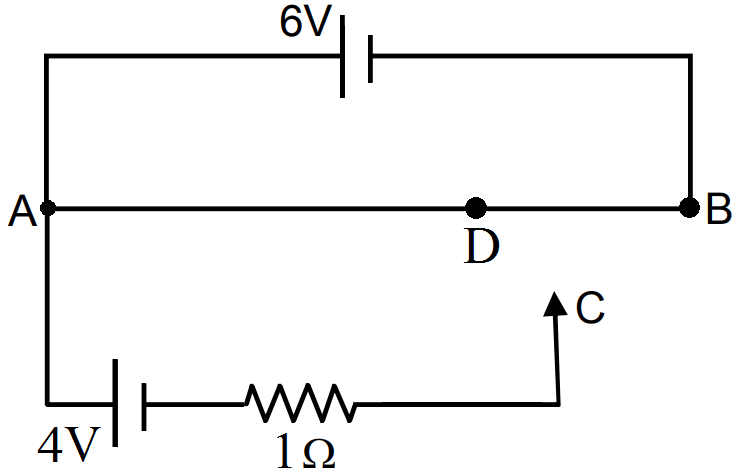
A $6$ volt battery of negligible internal resistance is connected across a uniform wire $AB$ of length $100\ cm.$ The positive terminal of another battery of emf $4V$ and internal resistance $1\Omega$ is joined to the point $A,$ as shown in the figure. Take the potential at $B$ to be zero.$ (a)$ What are the potentials at the points $A$ and $C$ ? $(b) $ At which point $D$ of the wire $AB,$ the potential is equal to the potential at $C$ ? $ (c)$ If the points $C$ and $D$ are connected by a wire, what will be the current through it? $(d)$ If the $4V$ battery is replaced by a $7.5V $ battery, what would be the answers of parts $(a)$ and $(b)$?
Define resistivity of a conductor. Plot a graph showing the variation of resistivity with temperature for a metallic conductor. How does one explain such a behaviour, using the mathematical expression of the resistivity of a material?
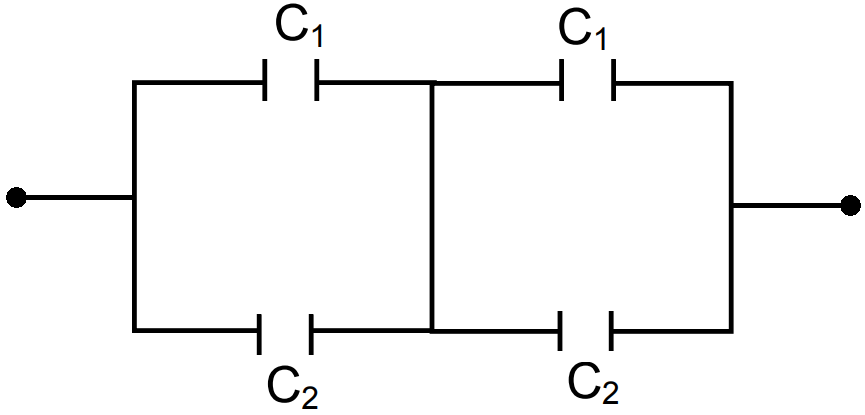
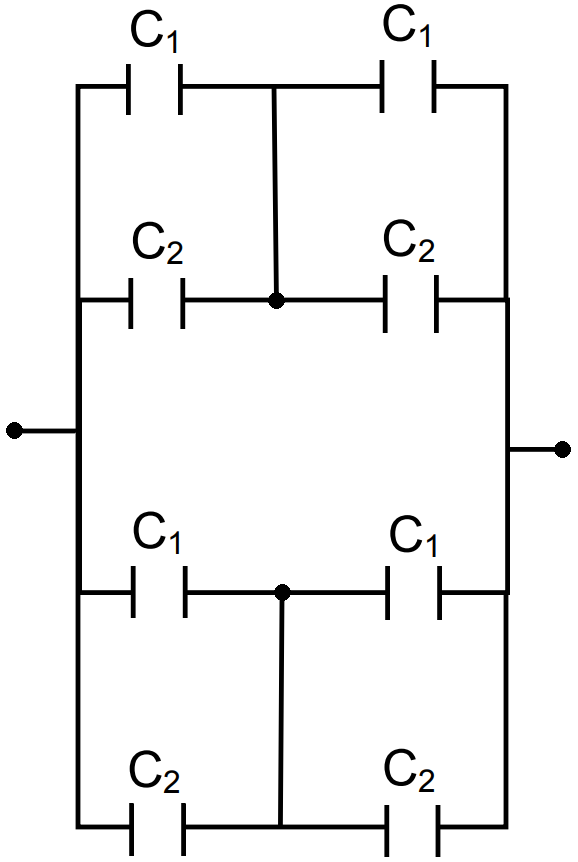
Take $\text{C}_1=4.0\mu\text{F}$ and $\text{C}_2=6.0\mu\text{F}$ in figure. Calculate the equivalent capacitance of the combination between the points indicated.

First a set of n equal resistors of R each are connected in series to a battery of emf E and internal resistance R. A current I is observed to flow. Then the n resistors are connected in parallel to the same battery. It is observed that the current is increased 10 times. What is 'n'?
Consider the Atwood machine of the previous problem. The larger mass is stopped for a moment $2.0s$ after the system is set into motion. Find the time elapsed before the string is tight again.
A glass vessel measures exactly $10\ cm \times 10\ cm \times 10\ cm$ at $0^\circ C$. It is filled completely with mercury at this temperature. When the temperature is raised to $10^\circ C, 1.6\ cm^3$ of mercury overflows. Calculate the coefficient of volume expansion of mercury. Coefficient of linear expansion of glass $= 6.5 \times 10^{-6 ^\circ} C.$
The resistance of an iron wire and a copper wire at 20°C are $3.9\Omega$ and $4.1\Omega,$ respectively. At what temperature will the resistance be equal? Temperature coefficient of resistivity for iron is $5.0\times10^{-3}\text{K}^{-1}$ and for copper, it is $4.0\times10^{-3}\text{K}^{-1}.$ Neglect any thermal expansion.
Oxygen is filled in a closed metal jar of volume $1.0 \times 10^{-3}m^3$ at a pressure of $1.5 \times 10^5Pa$ and temperature $400K$ The jar has a small leak in it. The atmospheric pressure is $1.0 \times 10^5Pa$ and the atmospheric temperature is $300K$ Find the mass of the gas that leaks out by the time the pressure and the temperature inside the jar equalise with the surrounding.
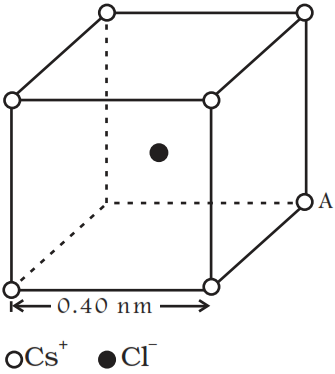
Fig. represents a crystal unit of cesium chloride $, \ce{CsCl}.$ The cesium atoms, represented by open circles are situated at the corners of a cube of side $0.40\ nm,$ whereas a $Cl$ atom is situated at the centre of the cube. The $Cs$ atoms are deficient in one electron while the $Cl$ atom carries an excess electron.
  1. What is the net electric field on the $Cl$ atom due to eight $Cs$ atoms?
  2. Suppose that the $Cs$ atom at the corner $A$ is missing. What is the net force now on the $Cl$ atom due to seven remaining $Cs$ atoms?