Question
A p-type semiconductor is:
  1. Positively charged.
  2. Negatively charged.
  3. Uncharged.
  4. Uncharged at 0K but charged at higher ternperatures.

Answer

  1. Uncharged.
Explanation:
A p-type semiconductor is formed by doping a pure semiconductor with a p-type material. As impurity atoms take the position of the germanium atom in a germanium crystal, three electrons of a p-type material form covalent bonds by sharing electrons with three neighbouring germanium atoms. However, the fourth covalent bond is left incomplete, with a want of one electron. This creates a hole. As the atom as a whole is neutral, the p-type material is also neutral.

Need a full question paper?

Generate a complete, print-ready paper with questions like this in minutes — across 16+ boards, with answer keys.
Start Generating Free

Similar questions

In Huygens' theory, the plane of particles vibrating in the same state is called:
In an NPN transistor the collector current is 24 mA. If 80% of electrons reach collector its base current in mA is(a) 36(b) 26(c) 16       (d) 6
       
Two metal plates having charges Q, -Q face each other at some separation and are dipped into an oil tank. If the oil is pumped out, the electric field between the plates will:
  1. Increase.
  2. Decrease.
  3. Remain the same.
  4. Become zero.
A negatively charged plate has charge density of $2 \times 10^{-6}\ C/m^2$. The initial distance of an electron which is moving toward plate, cannot strike the plate, if it is having energy of $200\ eV$
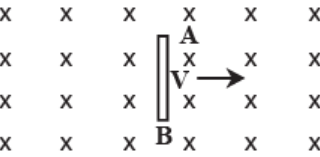
A rod AB moves with a uniform velocity v in a uniform magnetic field as shown in figure:
Image
The magnetic field produced by a current - carrying wire at a given point depends on:
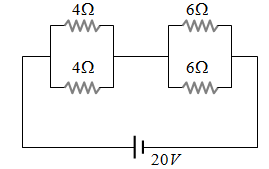
Four resistances are connected in a circuit in the given figure. The electric current flowing through $4$ ohm and $6$ ohm resistance is respectively
A achromatic combination is made with a lens of focal length f and dispersive power ω with a lens having dispersive power of 2ω. The focal length of second will be(a) 2f (b) f/2 (c) -f/2 (d) – 2 f
       
In charging a battery of motor-car, the following effect of electric current is used(a) Magnetic(b) Heating(c) Chemical(d) Induction
       
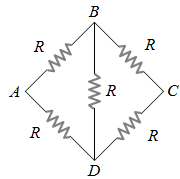
Five equal resistances each of value $R$ are connected in a form shown alongside. The equivalent resistance of the network