MCQ
A parallel plate capacitor has capacitance $C.$ If it is equally filled with parallel layers of materials of dielectric constants $K_1$ and $K_2$ its capacity becomes $C_1$. The ratio of $C_1$ to $C $ is
  • A
    $K _1+ K _2$
  • B
    $\frac{K_1 K_2}{K_1- K _2}$
  • C
    $\frac{K_1+ K _2}{K_1 K_2}$
  • $\frac{2 K_1 K_2}{K_1+ K _2}$

Answer

Correct option: D.
$\frac{2 K_1 K_2}{K_1+ K _2}$

Need a full question paper?

Generate a complete, print-ready paper with questions like this in minutes — across 16+ boards, with answer keys.

Start Generating Free

Similar questions

The earth’s magnetic field at a given point is $0.5\times 10^{-5}Wb-m^2$. This field is to be annulled by magnetic induction at the center of a circular conducting loop of radius $5.0\ cm.$ The current required to be flown in the loop is nearly
When an $AC$ voltage of $220V$ is applied to the capacitor $C$ :
The refractive index of a prism for a monochromatic wave is $\sqrt{2}$ and its refracting angle is $60^\circ .$ For minimum deviation, the angle of incidence will be
The velocity of light in a medium is half its velocity in air. If ray of light emerges from such a medium into air, the angle of incidence, at which it will be totally internally reflected, is
A thin lens made of glass of refractive index 1.5 has a front surface + 11 D power and back surface – 6 D. If this lens is submerged in a liquid of refractive index 1.6, the resulting power of the lens is(a) – 0.5 D(b) + 0.5 D (c) – 0.625 D(d) + 0.625 D
       
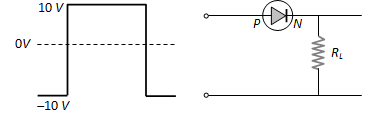
If the following input signal is sent through a $PN-$junction diode, then the output signal across $R_L$ will be
A loop, made of straight edges has six corners at $\ce{A(0, 0, 0), B(L, O, 0) C(L, L, 0), D(0, L, 0) E(0, L, L)}$ and $\ce{F(0, 0, L)}$. A magnetic field $\text{B}=\text{B}_0(\hat{\text{I}}+\hat{\text{k}})\text{T}$ is present in the region. The flux passing through the loop $\ce{ABCDEFA} ($in that order$)$ is:
The waves which are electromagnetic in nature are:
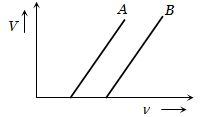
The stopping potential as a function of the frequency of the incident radiation is plotted for two different photoelectric surfaces $A$ and $B.$ The graphs show that work function of $A$ is
$\beta$-particles are of high speed :