MCQ
A parallel plate capacitor has capacitance C. If it is equally filled with parallel layers of materials of dielectric constants $\mathrm{K}_1$ and $\mathrm{K}_2$ its capacity becomes $C_1$. The ratio of $C_1$ to $C$ is
  • A
    $K_1+K_2$
  • B
    $\frac{K_1+K_2}{K_1-K_2}$
  • C
    $\frac{K_1+K_2}{K_1K_2}$
  • $\frac{2K_1K_2}{K_1+K_2}$

Answer

Correct option: D.
$\frac{2K_1K_2}{K_1+K_2}$
(d) $\frac{2K_1K_2}{K_1+K_2}$

Need a full question paper?

Generate a complete, print-ready paper with questions like this in minutes — across 16+ boards, with answer keys.

Start Generating Free

Similar questions

An electron experiences a force equal to its weight when placed in an electric field. The intensity of the field will be
If $\overrightarrow E $ and $\overrightarrow B $ are the electric and magnetic field vectors of E.M. waves then the direction of propagation of E.M. wave is along the direction of
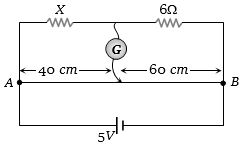
In the circuit shown, a meter bridge is in its balanced state. The meter bridge wire has a resistance $0.1\, ohm/cm$. The value of unknown resistance $X$ and the current drawn from the battery of negligible resistance is
A $4\,\mu F$ condenser is connected in parallel to another condenser of $8\,\mu F$. Both the condensers are then connected in series with a $12\,\mu F$ condenser and charged to $20\;volts$. The charge on the plate of $4\,\mu F$ condenser is......$\mu C$
At what angle of incidence, the light reflected from a glass slab will become completely polarised, if the angle of refraction at that incident angle is $33.6^o$?.......$^o$
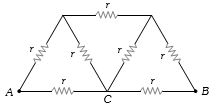
In the circuit shown, the value of each resistance is $r$, then equivalent resistance of circuit between points $A$ and $B$ will be
The electric field of a plane polarized electromagnetic wave in free space at time $t = 0$ is given by an expression

$\vec E(x,y) = 10\hat j\, cos[(6x + 8z)]$

The magnetic field $\vec B (x,z, t)$ is given by : ($c$ is the velocity of light)

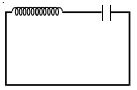
In an $LC$ circuit, the capacitor has maximum charge $q_0$. The value of is ${\left. {\frac{{di}}{{dt}}} \right|_{\max }}$
A thin diamagnetic rod is placed vertically between the poles of an electromagnet. When the current in the electromagnet is switched on, then the diamagnetic rod is pushed up, out of the horizontal magnetic field. Hence the rod gains gravitational potential energy. The work required to do this comes from 
A coil of 100 turns and area 5 square centimetre is placed in a magnetic field B = 0.2 T. The normal to the plane of the coil makes an angle of 60° with the direction of the magnetic field. The magnetic flux linked with the coil is