MCQ
A parallel plate capacitor has plate area $A$ and separation $d$. It is charged to a potential difference $V_o$. The charging battery is disconnected and the plates are pulled apart to three times the initial separation. The work required to separate the plates is
  • A
    $\frac{{3{\varepsilon _0}AV_0^2}}{d}$
  • B
    $\frac{{{\varepsilon _0}AV_0^2}}{{2d}}$
  • C
    $\frac{{{\varepsilon _0}AV_0^2}}{{3d}}$
  • $\frac{{{\varepsilon _0}AV_0^2}}{d}$

Answer

Correct option: D.
$\frac{{{\varepsilon _0}AV_0^2}}{d}$
d
(d) Work done $W = {U_f} - {U_i}$
${U_i} = \frac{1}{2}C{V_0}^2{\rm{\, and \,}}{{\rm{U}}_{\rm{f}}} = \frac{1}{2}\frac{{(C)}}{3}.{(3{V_0})^2}$$ = 3 \times \frac{1}{2}C{V_0}^2$
So $W = \frac{{{\varepsilon _0}A{V_0}^2}}{d}$

Need a full question paper?

Generate a complete, print-ready paper with questions like this in minutes — across 16+ boards, with answer keys.

Start Generating Free

Similar questions

A silver ball of radius $4.8 \ cm$ is suspended by a thread in the vacuum chamber. $UV$ light of wavelength $200 nm$ is incident on the ball for some times during which a total energy of $1 \times 10^{-7}$ J falls on the surface. Assuming on an average one out of $10^3$ photons incident is able to eject electron. The potential on sphere will be
In the disintegration series the $_{92}^{238}U\xrightarrow{\alpha }X\xrightarrow{{\beta  - }}_Z^AY$ values of $Z$ and $A$ respectively will be
When the energy of the incident radiation is increased by $20\%$, the kinetic energy of the photoelectrons emitted from a metal surface increased from $0.5eV$ to $0.8eV$. The work function of the metal is?
What is the valence electron in alkali metal?
The resistance of a wire is $R$. It is bent at the middle by $180^o$ and both the ends are twisted together to make a shorter wire. The resistance of the new wire is
The first diffraction minimum due to the single slit diffraction is seen at $\theta  = {30^o}$ for a light of wavelength $5000\,\mathop A\limits^o $ falling perpendicularly on the slit. The width of the slit is
Two point sources $P$ and $Q$ are $24\,cm $ apart. Where should a convex lens of focal length $9\, cm$ be placed in between them so that the images of both sources are formed at the same place?
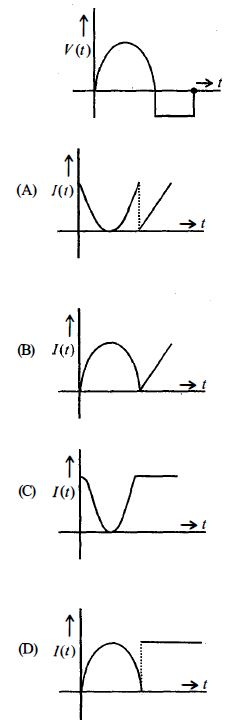
Two coils, $X$ and $Y$, are kept in close vicinity of each other. When a varying current, $I(t)$, flows through coil $X$, the induced emf $(V(t))$ in coil $Y$, varies in the manner shown here. The variation of $I(t)$; with time, can then be represented by the graph labelled as graph
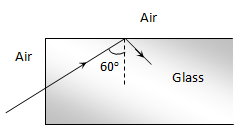
A light ray from air is incident (as shown in figure) at one end of a glass fiber (refractive index m = 1.5) making an incidence angle of $60^{\circ}$ on the lateral surface, so that it undergoes a total internal reflection. How much time would it take to traverse the straight fiber of length 1 km
Young's experiment is performed in air and then performed in water, the fringe width