MCQ
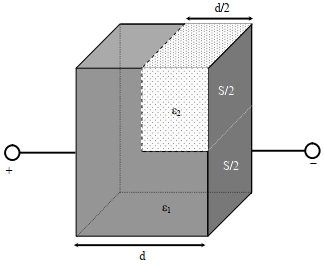
A parallel plate capacitor having plates of area $S$ and plate separation $d$, has capacitance $C _1$ in air. When two dielectrics of different relative permittivities $\left(\varepsilon_1=2\right.$ and $\left.\varepsilon_2=4\right)$ are introduced between the two plates as shown in the figure, the capacitance becomes $C _2$. The ratio $\frac{ C _2}{ C _1}$ is
  • A
    $6 / 5$
  • B
    $5 / 3$
  • C
    $7 / 5$
  • $7 / 3$

Answer

Correct option: D.
$7 / 3$
d
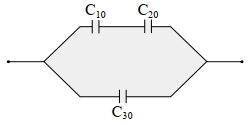
$C _{10}=\frac{4 \varepsilon_0 \frac{ S }{2}}{ d / 2}=\frac{4 \varepsilon_0 S }{ d }$

$C _{20}=\frac{2 \varepsilon_0 S }{ d }, C _{30}=\frac{\varepsilon_0 S }{ d }$

$\frac{1}{ C _{10}^{\prime}}=\frac{1}{ C _{10}}+\frac{1}{ C _{10}}=\frac{ d }{2 \varepsilon_0 S }\left[1+\frac{1}{2}\right]$

$\Rightarrow C _{10}^{\prime}=\frac{4 \varepsilon_0 S }{3 d }$

$C _2= C _{30}+ C _{10}^{\prime}=\frac{7 \varepsilon_0 S }{3 d }$

$\frac{ C _2}{ C _1}=\frac{7}{3}$

Need a full question paper?

Generate a complete, print-ready paper with questions like this in minutes — across 16+ boards, with answer keys.

Start Generating Free

Similar questions

The radius of electron's second stationary orbit in Bohr's atom is $R$. The radius of the third orbit will be
In satellite communication, the uplink frequency band used is
The sun revolves around the galaxy with a speed of $250\,km/sec$ and it's radius is $3 ×10^{4}$ light year. The mass of the milky way is
A radioactive material decays by simultaneous emission of two particles with respective half lives $1620$ and $810$ years. The time (in years) after which one- fourth of the material remains is
Television signals broadcast from the moon can be received on the earth while the TV broadcast from Delhi cannot be received at places about 100 km distant from Delhi. This is because
A lens is placed between a source of light and a wall. It forms images of area $A_1$ and $A_2$ on the wall for its two different positions. The area of the source or light is
The ionisation energy of hydrogen atom is 13.6 eV. Following Bohr's theory, the energy corresponding to a transition between the 3rd and the 4th orbit is
de-Broglie wavelength of an electron in the nth Bohr orbit is $\lambda_n$ and the angular momentum is $J_n$, then: 
When $10^{19}$ electrons are removed from a neutral metal plate, the electric charge on it is
A 10 $\mu \mathrm{F}$ capacitor and a 20 $\mu \mathrm{F}$ capacitor are connected in series across a 200 V supply line. The charged capacitors are then disconnected from the line and reconnected with their positive plates together and negative plates together and no external voltage is applied. What is the potential difference across each capacitor