Question
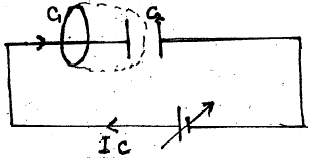
A parallel plate capacitor is being charged by a time varying current. Explain briefly how Ampere's circuital law is generalized to incorporate the effect due to the displacement current. 
Answer


According to Ampere's circuital law, $\oint\overline{\text{B}}.\overline{\text{dl}} = \mu_{o}\text{I}_{en}$

For C$\oint\overline{\text{B}}.\overline{\text{dl}} = \mu_{o}\text{I}_{en}$

For C$\oint\overline{\text{B}}.\overline{\text{dl}} = 0 $

There is an inconsistency in Ampere's circuital law.To explain this displacement current was incorporated.

Using Ampere's law, we find different values of B for the two loops.

Hence displacement current was introduced.

Need a full question paper?

Generate a complete, print-ready paper with questions like this in minutes — across 16+ boards, with answer keys.

Start Generating Free

Similar questions

The magnetic field inside a tightly wound, long solenoid is $\text{B}=\mu_0\text{ni}.$ It suggests that the field does not depend on the total length of the solenoid, and hence if we add more loops at the ends of a solenoid the field should not increase. Explain qualitatively why the extra-added loops do not have a considerable effect on the field inside the solenoid.
Find the wavelength of electromagnetic waves of frequency 5 × 10¹⁹Hz in free space. Give its two applications.
What is self induction ? Obtain expression for self induced emf.
A hydrogen atom in a state having a binding energy of 0.85eV makes transition to a state with excitation energy 10.2eV (a) Identify the quantum numbers n of the upper and the lower energy states involved in the transition. (b) Find the wavelength of the emitted radiation.
Assume that the magnetic field is uniform in a cubical region and is zero outside. Can you project a charged particle from outside into the field so that the particle describes a complete circle in the field?
Two electric charges $+Q$ and $-Q(x-y)$ are placed at the points $\left(-x_2, 0\right)$ and $\left(x_1, 0\right)$ respectively in the plane. Find the magnitude and direction of the resultant electric field at the origin $(0,0)$.
A charge Q is placed at the centre of a cube. Find the flux of the electric field through the six surfaces of the cube.
Write applications of the resonance phenomenon in the $L - C - R$ series circuit.
A point charge is taken from a point A to a point B in an electric field. Does the work done by the electric field depend on the path of the charge?
At what temperature will the speed of sound be double of its value at 0°C?