Question
A parallel plate capacitor is charged by a battery. After some time the battery is disconnected and a dielectric slab with its thickness equal to the plate separation is inserted between the plates. What change, in any will take place in
i. charge on the plates
ii. electric field intensity between the plates
iii. the capacitance of the capacitor,
iv. a potential difference between the plates and
v. the energy stored in the capacitor? Justify your answer in each case. OR
Answer

i. The charge $q _0$ on the capacitor plates remains the same because the battery has been disconnected, before placing the dielectric slab.
ii. The surface charges induced on the dielectric slab reduce electric field intensity to a new value given by $E=\frac{E_0}{\kappa}$
iii. The reduction in the electric field induces the potential difference $V=E d=\frac{E_0 d}{k}=\frac{V_0}{k}$
iv. Due to the decrease in p.d., the capacitance increases k times $C=\frac{q_0}{V}=\frac{q_0}{V_0 / k }= K \frac{q_0}{V_0}=\kappa C _0$ v. Energy stored decreases by a factor of $\kappa$ :
\[
U=\frac{1}{2} C V^2=\frac{1}{2}\left(\kappa C_0\right)\left(\frac{V_0}{K}\right)^2=\frac{1}{\kappa} \cdot \frac{1}{2} C_0 V_0^2=\frac{U_0}{\kappa}
\]

Need a full question paper?

Generate a complete, print-ready paper with questions like this in minutes — across 16+ boards, with answer keys.

Start Generating Free

Similar questions

Four particles having masses m, 2m, 3m and 4m are placed at the four corners of a square of edge a. Find the gravitational force acting on a particle of mass m placed at the centre.
Answer the following question:
Long distance radio broadcasts use short-wave bands. Why?
If neutrons exert only attractive force, why don't we have a nucleus containing neutrons alone?
4 × 10²³ tritium atoms are contained in a vessel. The half-life of decay tritium nuclei is 12.3y. Find:
  1. The activity of the sample.
  2. The number of decay in the next 10 hours.
  3. The number of decays in the next 6.15y.
The count rate of nuclear radiation coming from a radiation coming from a radioactive sample containing 128I varies with time as follows.
Time t(minute): 0 25 50 75 100
Ctount rate R(109s-1): 30 16 8.0 3.8 2.0
  1. Plot In $\Big(\frac{\text{R}_0}{\text{R}}\Big)$ against t.
  2. From the slope of the best straight line through the points, find the decay constant $\lambda.$
  3. Calculate the half-life $\text{t}_{\frac{1}{2}}.$
When a proton is released from rest in a room, it starts with an initial acceleration a0 towards west. When it is projected towards north with a speed v0, it moves with an initial acceleration 3a0 towards west. Find the electric field and the maximum possible magnetic field in the room.
Two circular coils of radii 5.0cm and 10cm carry equal currents of 21 A. The coils have 50 and 100 turns reepectively and are placed in such a way that their planes as well as the centres coincide. Find the magnitude of the magnetic field B at the common centre of the coils if the currents in the coils are (a) in the same sense (b) in the opposite sense.
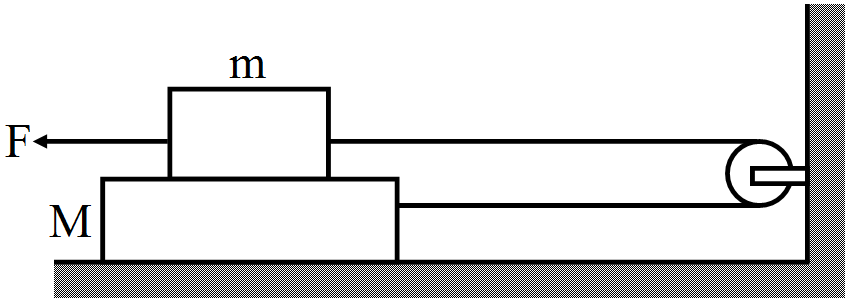
The friction coefficient between the two blocks shown in figure is $\mu$ but the floor is smooth.
  1. What maximum horizontal force F can be applied without disturbing the equilibrium of the system?
  2. Suppose the horizontal force applied is double of that found in part (a). Find the accelerations of the two masses.
​​​​​​​
Can static friction do nonzero work on an object? If yes, give an example. If no, give reason.
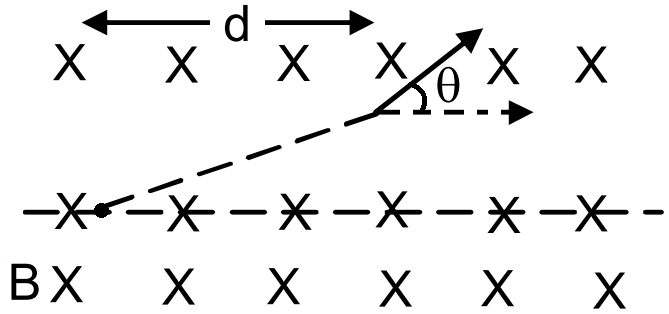
A particle of mass m and charge q is projected into a region that has a perpendicular magnetic field B. Find the angle of deviation of the particle as it comes out of the magnetic field if the width d of the region is very slightly smaller than

  1. $\frac{\text{mv}}{\text{qB}}$

  2. $\frac{\text{mv}}{2\text{qB}}$

  3. $\frac{2\text{mv}}{\text{qB}}.$