MCQ
A parallel plate capacitor is charged to a certain potential and the charging battery is then disconnected. Now, if the plates of the capacitor are moved apart then:
  • The stored energy of the capacitor increases
  • B
    Charge on the capacitor increases
  • C
    Voltage of the capacitor decreases
  • D
    The capacitance increases

Answer

Correct option: A.
The stored energy of the capacitor increases
a
When a capacitor is charged and then disconnect battery, first the capacitance will remain constant and then slowly discharge according to time constant.

The potential between the plates is $V=\frac{q d}{A \in_{0}},$ so when increasing the between plate, the voltage will increase.

The energy stored in capacitor is $W=\frac{1}{2} C V^{2} .$ Thus, the electrostatic energy stored in the

capacitor also increases.

Need a full question paper?

Generate a complete, print-ready paper with questions like this in minutes — across 16+ boards, with answer keys.

Start Generating Free

Similar questions

The ratio of frequencies of fundamental harmonic produced by an open pipe to that of closed pipe having the same length is
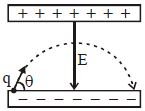
A proton is fired at an initial velocity of $150 \,m/s$ at an angle of $60^o $ above the horizontal into a uniform electric field of $2 \times 10^{-4} \,N/C$ between two charged parallel plates as shown in figure. Then the total time the particle is in motion is :-
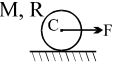
In the following problems, indicate the correct direction of friction force acting on the cylinder, which is pulled on a rough surface by a constant force $F$. $A$ cylinder of mass $M$ and radius $R$ is pulled horizontally by a force $F$. The friction force can be given by which of the following diagrams
A plane polarised light passed through successive polarisers which are rotated by $30^{\circ}$ with respect to each other in the clockwise direction. Neglecting absorption by the polarisers and given that the first polariser's axis is parallel to the plane of polarisation of the incident light, the intensity of light at the exit of the fifth polariser is closest to
A train of $150 $ meter length is going towards north direction at a speed of $10m/\sec $. A parrot flies at the speed of $5\,\,m/\sec $ towards south direction parallel to the railway track. The time taken by the parrot to cross the train is........$sec$
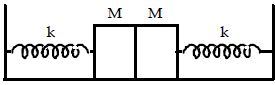
An assembly of identical spring-mass systems is placed on a smooth horizontal surface as shown. Initially the springs are relaxed. The left mass is displaced to the left while the right mass is displaced to the right and released. The resulting collision is elastic. The time period of the oscillations of the system is :-
If an $AC$ main supply is given to be $220\,V$. The average $emf$ during a positive half cycle will be.....$V$
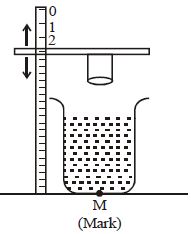
A beaker containing liquid is placed on a table, underneath a microscope which can be moved along a vertical scale. The microscope is focused, through the liquid onto a mark on the table when the reading on the scale is $a$ .

It is next focused on the upper surface of the liquid and the reading is $b$. More liquid is added and the observations are repeated, the corresponding readings are $c$ and $d$. The refractive index of the liquid is

List-$I$ shows different radioactive decay processes and List-$II$ provides possible emitted particles. Match each entry in List-$I$ with an appropriate entry from List-$II$, and choose the correct option.
List-$I$ List-$II$
($P$) ${ }_{92}^{238} U \rightarrow{ }_{91}^{234} \mathrm{~Pa}$ ($1$) one $\alpha$ particle and one $\beta^{+}$particle
($Q$) ${ }_{82}^{214} \mathrm{~Pb} \rightarrow{ }_{82}^{210} \mathrm{~Pb}$ ($2$) three $\beta^{-}$particles and one $\alpha$ particle
($R$) ${ }_{81}^{210} \mathrm{Tl} \rightarrow{ }_{82}^{206} \mathrm{~Pb}$ ($3$) two $\beta^{-}$particles and one $\alpha$ particle
($S$) ${ }_{91}^{228} \mathrm{~Pa} \rightarrow{ }_{88}^{224} \mathrm{Ra}$ ($4$) one $\alpha$ particle and one $\beta^{-}$particle
  ($5$) one $\alpha$ particle and two $\beta^{+}$particles
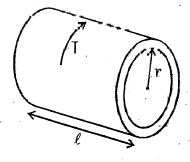
A hollow cylinder has length $l$ , radius $r$ , and thickness $d$ , where $l >> r >> d$ , and is made of a material with resistivity $\rho $ . A timevarying current $I$ flows through the cylinder in the tangential direction. Assume the current is always uniformly distributed along the length of the cylinder. The cylinder is fixed so that it cannot move; assume that there are no externally generated magnetic fields during the time considered for the problems below. Assume current at $t = 0$ to be $I_0$. What is current  $I(t)$ for $t > 0$