Question
A parallel plate capacitor is to be designed with a voltage rating $1kV,$ using a material of dielectric constant $3$ and dielectric strength about $10^7Vm^{–1}.\  ($Dielectric strength is the maximum electric field a material can tolerate without breakdown, i.e., without starting to conduct electricity through partial ionisation.$)$ For safety, we should like the field never to exceed, say $10\%$ of the dielectric strength. What minimum area of the plates is required to have a capacitance of $50pF$ ?
Answer

Potential rating of a parallel plate capacitor $, V = 1kV= 1000V$
Dielectric constant of a matertal, $\epsilon_{\text{r}}={3}$
Dielectric strength $={10}^{7}\frac{\text{V}}{\text{m}}$
For safety, the field intensity never exceeds $10\%$ of the dielectric strength.
Hence, electric field intensity $, E = 10\% of 10^7 = 10^6$ $\frac{\text{V}}{\text{m}}$
Capacitance of the parallel plate capacitor $, C = 50pf = 50 \times 10^{-12}F$
Distance between the plates is given by,$\text{d}=\frac{\text{V}}{\text{E}}$
$=\frac{1000}{{10}^{6}}={10}^{-3}\text{m}$
Capacitance i given by the relation, $\text{C}=\frac{\epsilon_{0}\epsilon_{\text{r}\text{A}}}{\text{d}}$ where $, A =$ Area of each plate $\epsilon_{0} =$ Permittivity of free space $= 8.85 \times 10^{-12} N^{-1} C^2 m^{-2}$
$\therefore\ \text{A}=\frac{\text{Cd}}{\epsilon_{0}\epsilon_{\text{r}}}$
$=\frac{{50}\times{10}^{-12}\times{10}^{-3}}{{8.85}\times{10}^{-12}\times{3}}\approx{19}\text{cm}^{2}$
Hence, the area of each plate is about $19\ cm^2$.

Need a full question paper?

Generate a complete, print-ready paper with questions like this in minutes — across 16+ boards, with answer keys.

Start Generating Free

Similar questions

A rod of length $L$ has a total charge $Q$ distributed uniformly along its length. It is bent in the shape of a semicircle. Find the magnitude of the electric field at the centre of curvature of the semicircle.
Two wires of equal length, one of aluminium and the other of copper have the same resistance. Which of the two wires is lighter? Hence explain why aluminium wires are preferred for overhead power cables.
$(\rho_{\text{A}1}=2.63\times10^{-8}\Omega\ \text{m,}$ Relative density of $Al=2.7,\ \text{of Cu}=8.9)$
A metal ball of mass $1\ kg $is heated by means of a $20W$ heater in a room at $20^\circ C$. The temperature of the ball becomes steady at $50^\circ C.$
Briefly explain the principle of a capacitor. Derive an expression for the capacitance of a parallel plate capacitor, whose plates are separated by a dielectric medium.
A sound source, fixed at the origin, is continuously emitting sound at a frequency of 660Hz. The sound travels in air at a speed of 330m/s. A listener is moving along the line x = 336m at a constant speed of 26m/s. Find the frequency of the sound as observed by the listener when he is:
  1. At y = - 140m.
  2. At y = 0.
  3. At y = 140m.
A capacitor of capacitance $5.00\mu\text{F}$ is charged to $24.0V$ and another capacitor of capacitance $6.0\mu\text{F}$ is charged to $12.0V$ :
  1. Find the energy stored in each capacitor.
  2. The positive plate of the first capacitor is now connected to the negative plate of the second and vice versa. Find the new charges on the capacitors.
  3. Find the loss of electrostatic energy during the process.
  4. Where does this energy go?
Find the equation of the equipotentials for an infinite cylinder of radius $r_0,$ carrying charge of linear density $\lambda$.
Sea water at frequency $v = 4 \times 10^8\ Hz$ has permittivity $\epsilon\approx80\epsilon_0,$ permeability $\mu \approx\mu_0$ and resistivity $\rho=0.25\Omega-\text{m}$. Imagine a parallel plate capacitor immersed in sea water and driven by an alternating voltage source $\text{V(t)}=\text{V}_0\sin(2\pi\text{vt})$. What fraction of the conduction current density is the displacement current density?
The magnetic field inside a long solenoid having $50 turns/cm$ is increased from $2·5 \times 10.3T$ to $2.5T$ when an iron core of cross-sectional area $4\ cm^2$ is inserted into it. Find:
  1. The current in the solenoid.
  2. The magnetization I of the core.
  3. The pole strength developed in the core.
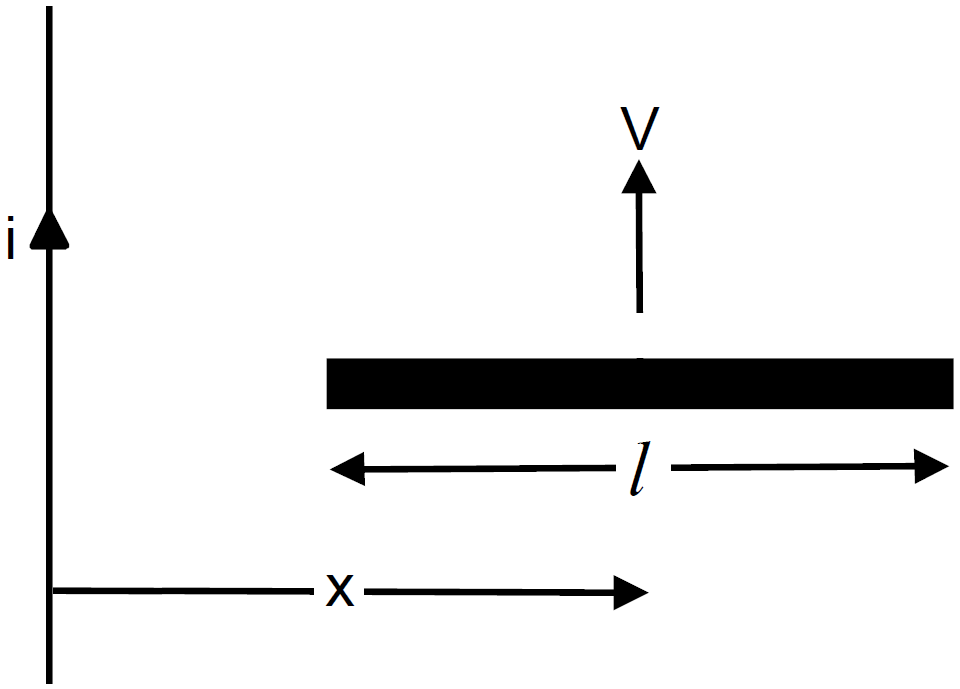
Figure shows a straight, long wire carrying a current i and a rod of length l coplanar with the wire and perpendicular to it. The rod moves with a constant velocity v in a direction parallel to the wire. The distance of the wire from the centre of the rod is x. Find motional emf induced in the rod.