Question
A parallel-plate capacitor with plate area 20cm2 and plate separation 1.0mm is connected to a battery. The resistance of the circuit is $10\text{k}\Omega.$ Find the time constant of the circuit.

Answer

$\text{A}=20\text{cm}^2=20\times10^{-4}\text{m}^2$
$\text{d}=1\text{mm}=1\times10^{-3}\text{m};\text{R}=10\text{K}\Omega$
$\text{C}=\frac{\text{E}_0\text{A}}{\text{d}}=\frac{8.85\times10^{-12}\times20\times10^{-4}}{1\times10^{-3}}$
$=\frac{8.85\times10^{-12}\times2\times10^{-3}}{10^{-3}}=17.7\times10^{-2}\text{Farad}.$
Time constant $=\text{CR}=17.7\times10^{-2}\times10\times10^3$
$=17.7\times10^{-8}=0.177\times10^{-6}\text{s}=0.18\mu\text{s}.$

Need a full question paper?

Generate a complete, print-ready paper with questions like this in minutes — across 16+ boards, with answer keys.

Start Generating Free

Similar questions

In a soccer practice session the football is kept at the centre of the field 40 yards from the 10ft high goalposts. A goal is attempted by kicking the football at a speed of 64ft/s at an angle of 45° to the horizontal. Will the ball reach the goal post?
Water is boiled in a container having a bottom of surface area 25cm2, thickness 1.0mm and thermal conductivity $50\text{wm}^{-1}{^{\circ}}\text{C}^{-1}.$ 100g of water is converted into steam per minute in the steady state after the boiling starts. Assuming that no heat is lost to the atmosphere, calculate the temperature of the lower surface of the bottom. Latent heat of vaporization of water $=0.26\times10^6\text{Jkg}^{-1}.$
A swimmer wishes to cross a 500m wide river flowing at 5km/h. His speed with respect to water is 3km/h.
  1. If he heads in a direction making an angle 0 with the flow, find the time he takes to cross the river.
  2. Find the shortest possible time to cross the river.
A uniform magnetic field of magnitude 0.20T exists in space from east to west. With what speed should a particle of mass 0.010g and with charge 1.0 × 10⁻⁵C be projected from south to north so that it moves with uniform velocity?
Consider a non-conducting ring of radius r and mass m that has a total charge q distributed uniformly on it. The ring is rotated about its axis with an angular speed $\omega.$
  1. Find the equivalent electric current in the ring.
  2. Find the magnetic moment $\mu$ of the ring.
  3. Show that $\mu=\frac{\text{q}}{2\text{m}}\text{l}$ where l is the angular momentum of the ring about its axis of rotation.
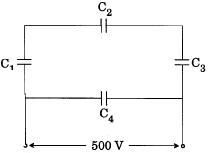
A network of four capacitors each of 12 μF capacitance is connected to a 500 V supply as shown in the figure. Determine (a) equivalent capacitance of the network and (b) charge on each capacitor. 

Give reasons for each of the following:
  1. The intensity of light at some points on the screen in Young’s double slit experiment is zero.
  2. The intensity of light transmitted by a polaroid is less than the intensity of the unpolarised light incident on it.
  3. In the single slit diffraction experiment, some coloured fringes around the central white maximum are observed on the screen when one uses a source of white light.
A wire AB is carrying a steady current of 12 A and is lying on the table. Another wire CD carrying 5A is held directly above AB at a height of 1 mm. Find the mass per unit length of the wire CD so that it remains suspended at its position when left free. Give the direction of the current flowing in CD with respect to that in AB. [Take the value of g = 10 ms–2]
A point charge is moving along a straight line with a constant velocity u. Consider a small area A perpendicular to the direction of motion of the charge (El). Calculate the displacement current through the area when its distance from the charge is x. The value of x is not large so that the electric field at any instant is essentially given by Coulomb's law.

Explain the difference between conductor, insulator and semiconductor on the basis of energy band in solids.