Question
A parallel-plate capacitor with plate area 20cm2 and plate separation 1.0mm is connected to a battery. The resistance of the circuit is $10\text{k}\Omega.$ Find the time constant of the circuit.

Answer

$\text{A}=20\text{cm}^2=20\times10^{-4}\text{m}^2$

$\text{d}=1\text{mm}=1\times10^{-3}\text{m};\text{R}=10\text{K}\Omega$

$\text{C}=\frac{\text{E}_0\text{A}}{\text{d}}=\frac{8.85\times10^{-12}\times20\times10^{-4}}{1\times10^{-3}}$

$=\frac{8.85\times10^{-12}\times2\times10^{-3}}{10^{-3}}=17.7\times10^{-2}\text{Farad}.$

Time constant $=\text{CR}=17.7\times10^{-2}\times10\times10^3$

$=17.7\times10^{-8}=0.177\times10^{-6}\text{s}=0.18\mu\text{s}.$

Need a full question paper?

Generate a complete, print-ready paper with questions like this in minutes — across 16+ boards, with answer keys.
Start Generating Free

Similar questions

The magnetic field due to a long straight wire has been derived in terms of $\mu_0,$ i and d. Express this in terms of $\in_0,$ C, i and d.
Calculate the % increase in the length of a wire of diameter 2.5mm stretched by a force of 100kg f. Y for the wire = 12.5 × 10¹¹ dyne cm-2.
Calculate the efficiency of a Carnot's engine working between steam point and ice point.
Show that the area of the triangle contained between the vectors a and b is one half of the magnitude of a × b.
The length, breadth and thickness of a rectangular sheet of metal are 4.234m, 1.005m, and 2.01cm respectively. Give the area and volume of the sheet to correct significant figures.
Discuss the variation of 'g' with depth. What happens to 'g' at the centre of earth?
A transverse harmonic wave travelling on a string is described by $\text{y}(\text{x, t}) = 3.0\sin \Big[(36\text{t}+0.018\text{x})+\frac{\pi}{4}\Big]$ where x and y are in cm and t in sec. The positive direction of x is from left to right.
  1. What is its amplitude and frequency?
  2. What is the initial phase at the origin?
  3. What is the least distance between to successive crest in the wave?
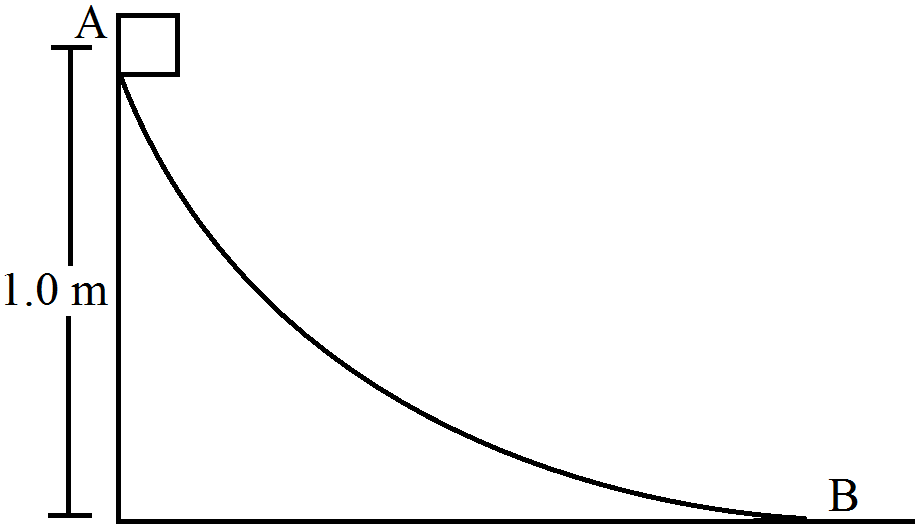
A block weighing 10N travels down a smooth curved track AB joined to a rough horizontal surface (figure). The rough surface has a friction coefficient of 0.20 with the block. If the block starts slipping on the track from a point 1.0m above the horizontal surface, how far will it move on the rough surface?

Suppose the average mass of raindrops is 3.0 × 10⁻⁵kg and their average terminal velocity 9m s-1. Calculate the energy transferred by rain to each square metre of the surface at a place which receives 100 cm of rain in a year.
Two cars A and B are running at velocities of 60km/ hr and 45km/ hr respectively. Calculate the relative velocity of car A if:
  1. They are both travelling eastwards.
  2. Car A is travelling eastwards and car B is travelling westwards.