MCQ
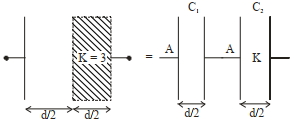
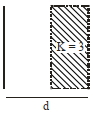
A parallel plate capacitor with plate area $A$ and plate separation $d =2 \,m$ has a capacitance of $4 \,\mu F$. The new capacitance of the system if half of the space between them is filled with a dielectric material of dielectric constant $K =3$ (as shown in figure) will be .........$ \mu \,F$
  • A
    $2$
  • B
    $32$
  • $6$
  • D
    $8$

Answer

Correct option: C.
$6$
c
$C _{\text {original }}=\frac{ A \varepsilon_{0}}{ d }$

$C _{1}=\frac{ A \varepsilon_{0}}{ d / 2}=\frac{2 A \varepsilon_{0}}{ d }= C$

$C _{2}=\frac{ KA \varepsilon_{0}}{ d / 2}=\frac{2 KA \varepsilon_{0}}{ d }=\frac{6 A \varepsilon_{0}}{ d }=3 C$

$C_{1}$ and $C_{2}$ are in series

$C _{\text {new }}=\frac{ C _{1} C _{2}}{ C _{1}+ C _{2}}=\frac{ C \times 3 C }{ C +3 C }=\frac{3 C }{4}$

$=\frac{3}{4} \times \frac{2 A \varepsilon_{0}}{d}=\frac{3}{2} \times \frac{A \varepsilon_{0}}{d}$

$C _{\text {new }}=\frac{3}{2} C _{\text {original }}$

$=\frac{3}{2} \times 4=6\, \mu\, F$

Need a full question paper?

Generate a complete, print-ready paper with questions like this in minutes — across 16+ boards, with answer keys.

Start Generating Free

Similar questions

The diagram shows a small bead of mass $m$ carrying charge $q$. The bead can freely move on the smooth fixed ring placed on a smooth horizontal plane. In the same plane a charge $+Q$ has also been fixed as shown. The potential atthe point $P$ due to $+Q$ is $V$. The velocity with which the bead should projected from the point $P$ so that it can complete a circle should be greater than
A series $R-C$ circuit is connected to an alternating voltage source. Consider two situations 

$(a)$ When capacitor is air filled.

$(b)$ When capacitor is mica filled.

Current through resistor is $i$ and voltage across capacitor is $V$ then

Photo cell is a device to
A single slit of width $b$ is illuminated by a coherent monochromatic light of wavelength $\lambda $. If the second and fourth minima in the diffraction pattern at a distance $1\,m$ from the slit are at $3\, cm$ and $6\, cm$ respectively from the central maximum, what is the width of the central maximum ?......$cm$ (i.e. distance between first minimum on either side of the central maximum)
The magnet of a vibration magnetometer is heated so as to reduce its magnetic moment by $19\%$. By doing this the periodic time of the magnetometer will
$\alpha$ -particle consists of 
A rocket is going away from the earth at a speed of $10^6 m/s$ If the wavelength of the light wave emitted by it be $5700 \mathring A$ , what will be its Doppler's shift
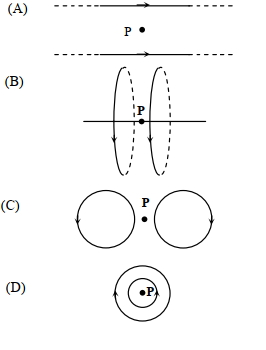
Two wires each carrying a steady current $I$ are shown in four configurations in Column $I$. Some of the resulting effects are described in Column $II$. Match the statements in Column $I$ with the statements in Column $II$ and indicate your answer by darkening appropriate bubbles in the $4 \times 4$ matrix given in the $ORS$.

Column $I$ Column $II$
$(A)$ Point $P$ is situated midway between the wires. $Image$ $(p)$ The magnetic fields $(B)$ at $P$ due to the currents in the wires are in the same direction.
$(B)$ Point $P$ is situated at the mid-point of the line joining the centers of the circular wires, which have same radii. $Image$ $(q)$ The magnetic fields $(B)$ at $P$ due to the currents in the wires are in opposite directions.
$(C)$ Point $P$ is situated at the mid-point of the line joining the centers of the circular wires, which have same radii. $Image$ $(r)$ There is no magnetic field at $P$.
$(D)$ Point $P$ is situated at the common center of the wires. $Image$ $(s)$ The wires repel each other.


For a glass prism, the angle of minimum deviation will be smallest for the light of:
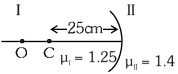
Region $I$ and $II$ are separated by a spherical surface of radius $25\, {cm}$. An object is kept in region $I$ at a distance of $40\, {cm}$ from the surface. The distance of the image from the surface is $.....\,cm$