Question
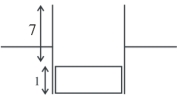
A parallel plate capacitor with width $4\,cm$, length $8\,cm$ and separation between the plates of $4\,mm$ is connected to a battery of $20\,V$. A dielectric slab of dielectric constant $5$ having length $1\,cm$, width $4\,cm$ and thickness $4\,mm$ is inserted between the plates of parallel plate capacitor. The electrostatic energy of this system will be......... $\in_{0}\,J$. (Where $\epsilon_{0}$ is the permittivity of free space)
Answer

$C _{\text {eff }}=\left[\frac{\varepsilon_{0}(7 \times 4)}{4 / 10}+\frac{5 \varepsilon_{0}(1 \times 4)}{4 / 10}\right] \times 10^{-2}$

$C _{\text {eff }}=1.2 \varepsilon_{0}$

Energy $=\frac{1}{2} C _{\text {eff }} V ^{2}$

$=\frac{1}{2}(1.2) \varepsilon_{0}(20)(20)=240 \varepsilon_{0}$

Need a full question paper?

Generate a complete, print-ready paper with questions like this in minutes — across 16+ boards, with answer keys.

Start Generating Free

Similar questions

If ${R}_{{E}}$ be the radius of Earth, then the ratio between the acceleration due to gravity at a depth $' {r} '$ below and a height $' r '$ above the earth surface is:

(Given : $\left.{r}<{R}_{{E}}\right)$

From a supply of identical capacitors rated $8\  \mu F$, $250\  V$, the minimum number of capacitors required to form a composite $16$ $\mu F$, $1000$ $V$ is :
The energy required to excite an electron from the ground state of hydrogen atom to the first excited state, is
Under elastic limit the stress is 
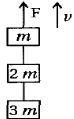
Three blocks with masses $m, 2m $ and $3 m$ are connected by strings, as shown in the figure. After an upward force $F$ is applied on block $m,$ the masses move upward at constant speed $v.$ What is the net force on the block of mass $2\ m\ ?\, (g$ is the acceleration due to gravity$)$
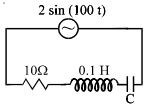
The power factor of the circuit is $1/ \sqrt 2 $ is equal to . The capacitance of the circuit.....$\mu F$
Two spherical bodies $\mathrm{A}$ (radius $6 \mathrm{~cm}$ ) and $\mathrm{B}$ (radius $18 \mathrm{~cm}$ ) are at temperature $\mathrm{T}_1$ and $\mathrm{T}_2$, respectively. The maximum intensity in the emission spectrum of $\mathrm{A}$ is at $500 \mathrm{~nm}$ and in that of $\mathrm{B}$ is at $1500 \mathrm{~nm}$. Considering them to be black bodies, what will be the ratio of the rate of total energy radiated by $A$ to that of $B$ ?
Match List $I$ with List $II.$

  List $I$   List $II$
$(a)$ Rectifier $(i)$ Used either for stepping up or stepping down the $a.c.$ voltage
$(b)$ Stabilizer $(ii)$ Used to convert $a.c.$ voltage into $d.c.$ voltage
$(c)$ Transformer $(iii)$ Used to remove any ripple in the rectified output voltage
$(d)$ Filter $(iv)$ Used for constant output voltage even when the input voltage or load current change

Choose the correct answer from the options given below:

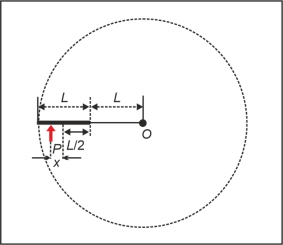
A thin uniform rod of length $L$ and certain mass is kept on a frictionless horizontal table with a massless string of length $L$ fixed to one end (top view is shown in the figure). The other end of the string is pivoted to a point $O$. If a horizontal impulse $P$ is imparted to the rod at a distance $x=L / n$ from the mid-point of the rod (see figure), then the rod and string revolve together around the point $O$, with the rod remaining aligned with the string. In such a case, the value of $n$ is. . . . . . 
A particle comes round a circle of radius $1 \,m$ once. The time taken by it is $10 \,sec$. The average velocity of motion is