Question
A particle A having a charge of $2.0 \times 10^{-6}C$ is held fixed on a horizontal table. A second charged particle of mass $80g$ stays in equilibrium on the table at a distance of $10cm$ from the first charge. The coefficient of friction between the table and this second particle is $\mu=0.2.$ Find the range within which the charge of this second particle may lie.
Answer


$\text{q}_\text{A}=2\times10^{-6}\text{C},\ \text{M}_\text{b}=80\text{g},\ \mu=0.2$
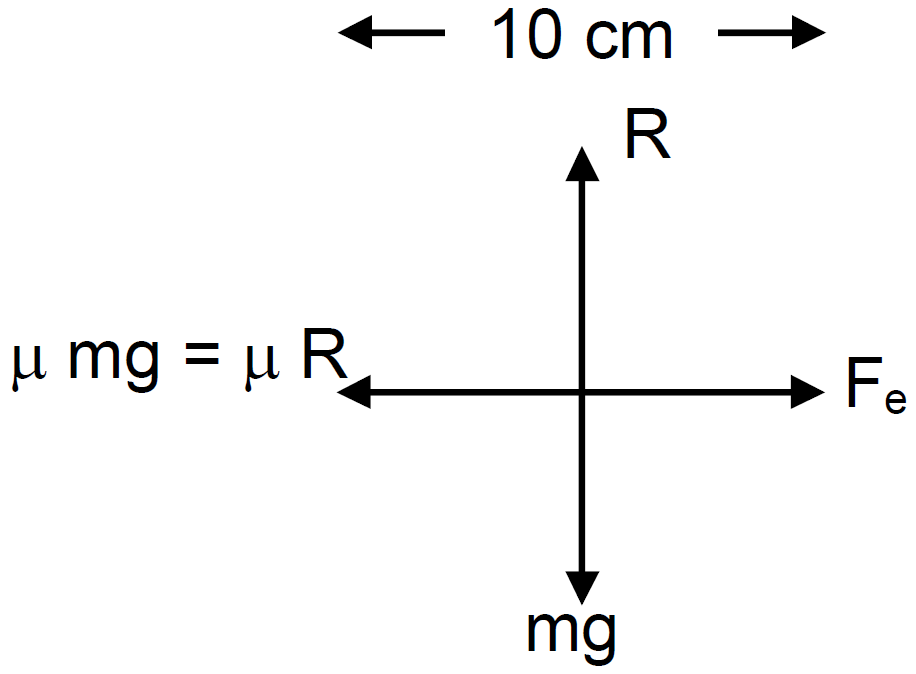
Since B is at equilibrium,
So, $\text{Fe}=\mu\text{R}$
$\Rightarrow\frac{\text{Kq}_\text{A}\text{q}_\text{B}}{\text{r}^2}=\mu\text{R}=\mu\text{m}\times\text{g}$
$\Rightarrow\frac{9\times10^9\times2\times10^{-6}\times\text{q}_\text{B}}{0.01}=0.2\times0.08\times9.8$
$\Rightarrow\text{q}_\text{B}=\frac{0.2\times0.08\times9.8\times0.01}{9\times10^9\times2\times10^{-6}}$
$=8.7\times10^{-8}\text{C}$
Range $=\pm8.7\times10^{-8}\text{C}$

Need a full question paper?

Generate a complete, print-ready paper with questions like this in minutes — across 16+ boards, with answer keys.

Start Generating Free

Similar questions

A small plane area is rotated in an electric field. In which orientation of the area is the flux of electric field through the area maximum? In which orientation is it zero?
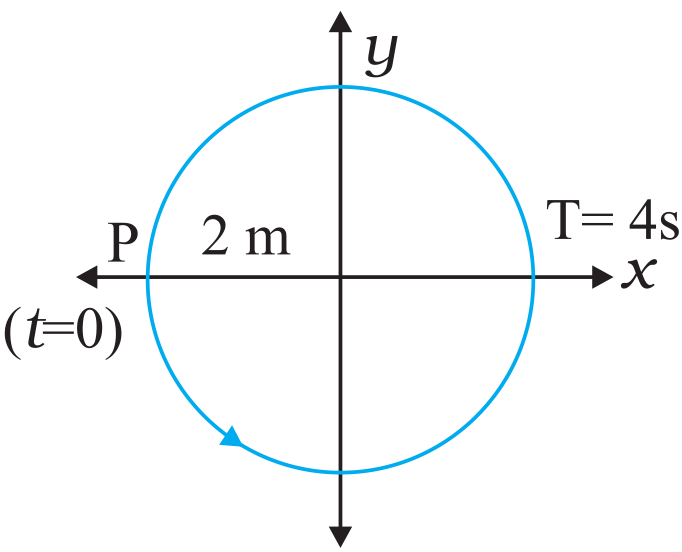
Figures correspond to two circular motions. The radius of the circle, the period of revolution, the initial position, and the sense of revolution (i.e. clockwise or anti-clockwise) are indicated on each figure.
Obtain the corresponding simple harmonic motions of the x-projection of the radius vector of the revolving particle P, in each case.
Two towns A and B are connected by a regular bus service with a bus leaving in either direction every T minutes. A man cycling with a speed of $20km h^{–1}$ in the direction A to B notices that a bus goes past him every $18$ min in the direction of his motion, and every $6$ min in the opposite direction. What is the period T of the bus service and with what speed (assumed constant) do the buses ply on the road?
A three-wheeler starts from rest, accelerates uniformly with $1m s^{–2}$ on a straight road for $10s$, and then moves with uniform velocity. Plot the distance covered by the vehicle during the nth second $(n = 1, 2, 3….)$ versus n. What do you expect this plot to be during accelerated motion : a straight line or a parabola?
The benches of a gallery in a cricket stadium are 1m wide and 1m high. A batsman strikes the ball at a level one metre above the ground and hits a mammoth sixer. The ball starts at 35m/s at an angle of 53° with the horizontal. The benches are perpendicular to the plane of motion and the first bench is 110m from the batsman. On which bench will the ball hit?
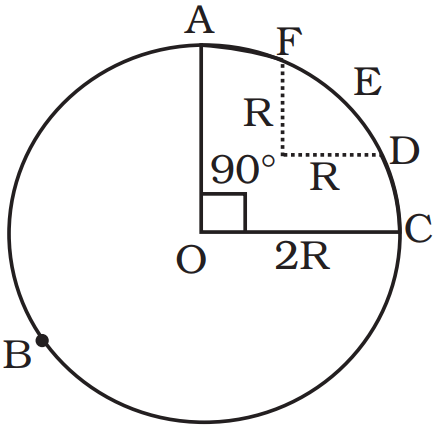
A racing car travels on a track (without banking) ABCDEFA ABC is a circular arc of radius 2 R. CD and FA are straight paths of length R and DEF is a circular arc of radius $R = 100 m$. The co-effecient of friction on the road is $\mu = 0.1.$ The maximum speed of the car is $50m s^{–1}$. Find the minimum time for completing one round.
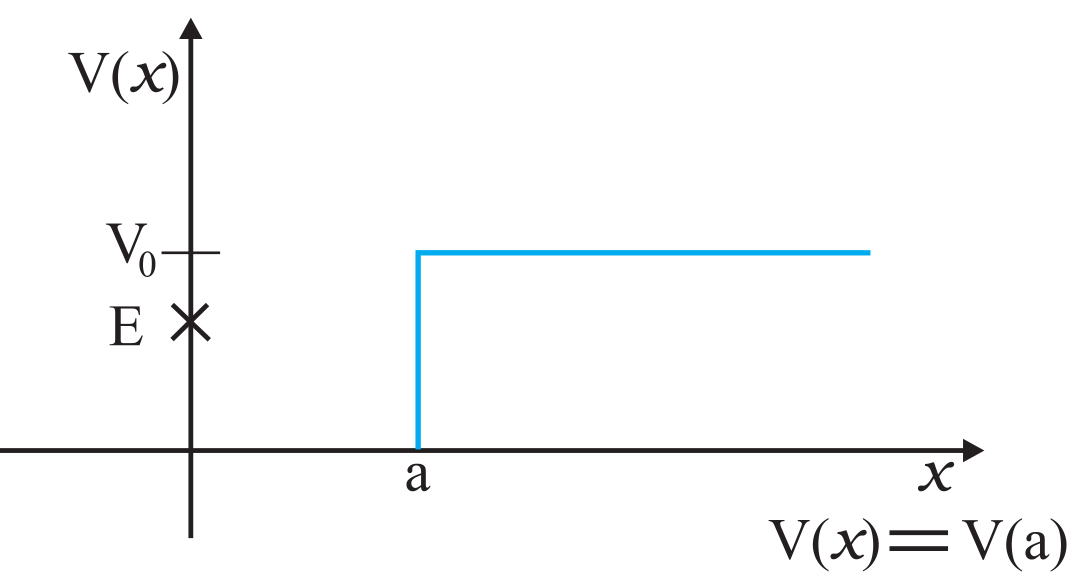
Given in are examples of some potential energy functions in one dimension. The total energy of the particle is indicated by a cross on the ordinate axis. In each case, specify the regions, if any, in which the particle cannot be found for the given energy. Also, indicate the minimum total energy the particle must have in each case. Think of simple physical contexts for which these potential energy shapes are relevan.
Explain why A spinning cricket ball in air does not follow a parabolic trajectory.
A small block of mass $200g$ is kept at the top of a frictionless incline which is $10m$ long and $3.2m$ high. How much work was required.
  1. To lift the block from the ground and put it at the top.
  2. To slide the block up the incline? What will be the speed of the block when it reaches the ground.
  3. It falls off the incline and drops vertically on the ground.
  4. It slides down the incline? Take $g = 10m/s^2$.
A marble rolls along a table at a constant speed of $1.00m/ s$ and then falls off the edge of the table to the floor $1.00m$ below.
  1. How long does the marble take to reach the floor?
  2. At what horizontal distance from the edge of the table does the marble land?
  3. What is its velocity as it strikes the floor?