MCQ
A particle describes a horizontal circle in a conical funnel whose inner surface is smooth with speed of $0.5 \,m/s$. What is the height of the plane of circle from vertex of the funnel ........ $cm$
  • A
    $0.25$
  • B
    $2 $
  • C
    $4$
  • $2.5 $

Answer

Correct option: D.
$2.5 $
d
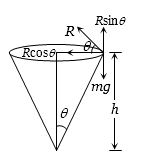
(d) The particle is moving in circular path

From the figure, $mg = R\sin \theta $ …$(i)$

$\;\frac{{m{v^2}}}{r} = R\cos \theta $ …$(ii)$

From equation $(i)$ and $(ii)$ we get

$\tan \theta = \frac{{rg}}{{{v^2}}}$  but $\tan \theta = \frac{r}{h}$

$h = \frac{{{v^2}}}{g} = \frac{{{{(0.5)}^2}}}{{10}} = 0.025m = 2.5\,cm$
Need a full question paper?

Generate a complete, print-ready paper with questions like this in minutes — across 16+ boards, with answer keys.
Start Generating Free

Similar questions

A simple harmonic progressive wave is represented by the equation : $y = 8\sin 2\pi (0.1x - 2t)$ where $x$ and $y$ are in $cm$ and $t$ is in seconds. At any instant the phase difference between two particles separated by $2.0 \,cm$ in the $x-$direction is ..... $^o$
Choose the correct option relating wavelengths of differnet parts of electromagnetic wave spectrum
In a transistor amplifier, $\beta = 62, R_L = 5000\, \Omega$ and internal resistance of the  transistor is $500\, \Omega$. The voltage amplification of the amplifier will be:
In Young's experiment, light of wavelength $4000\, Å$ is used to produce bright fringes of width $0.6 \,mm$, at a distance of $2$ meters. If the whole apparatus is dipped in a liquid of refractive index $1.5$, then fringe width will be.....$mm$
The velocity of a body at time $ t = 0$ is $10\sqrt 2 \,m/s$ in the north-east direction and it is moving with an acceleration of $ 2 \,m/s^{2}$ directed towards the south. The magnitude and direction of the velocity of the body after $5\, sec$ will be
What is the pressure on a swimmer $20 \,m$ below the surface of water ........ $atm$
A complex current wave is given by $i = 5 + 5\, sin\, (100\, \omega t)\, A$. Its average value over one time period is given as.....$A$
Dimensions of luminous flux are
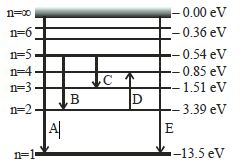
The energy levels of the hydrogen spectrum is shown in figure. There are some transitions $A, B, C, D$ and $E$. Transition $A, B$ and $C$ respectively represent
A container holds $10^{26} molecules/m^3$ each of mass $3 \times 10^{-27}\,\,kg$. Assume that $1/6$ of the molecules move with velocity $2000 \,\,m/s$ directly towards one wall of the container while the remaining $5/6$ of the molecules move either away from the wall or in perpendicular direction, and all collisions of the molecules with the wall are elastic