A particle executes simple harmonic motion with a frequency $f$. The frequency with which its kinetic energy oscillates is
IIT 1973, Easy


Download our appand get started for free
Experience the future of education. Simply download our apps or reach out to us for more information. Let's shape the future of learning together!No signup needed.*
Similar Questions
- 1View SolutionIdentify the correct definition
- 2An object of mass $0.5\, {kg}$ is executing simple harmonic motion. Its amplitude is $5\, {cm}$ and time period (T) is $0.2\, {s} .$ What will be the potential energy of the object at an instant $t=\frac{T}{4}$ s starting from mean position. Assume that the initial phase of the oscillation is zero. (In ${J}$)View Solution
- 3A vertical mass-spring system executes simple harmonic oscillations with a period of $2\,s$. A quantity of this system which exhibits simple harmonic variation with a period of $1\, s$ isView Solution
- 4View SolutionThe phase difference between displacement and acceleration of a particle in a simple harmonic motlon is
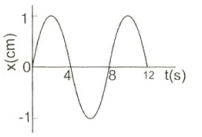
- 5The $x$-t graph of a particle undergoing simple harmonic motion is shown below. The acceleration of the particle at $t=4 / 3 \mathrm{~s}$ isView Solution
- 6A particle executes simple harmonic motion with a frequency $f$. The frequency with which its kinetic energy oscillates isView Solution
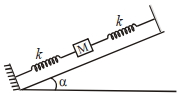
- 7In the given figure, a body of mass $M$ is held between two massless springs, on a smooth inclined plane. The free ends of the springs are attached to firm supports. If each spring has spring constant $k,$ the frequency of oscillation of given body is :View Solution
- 8The maximum velocity of a simple harmonic motion represented by $y = 3\sin \,\left( {100\,t + \frac{\pi }{6}} \right)$is given byView Solution
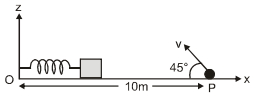
- 9A small block is connected to one end of a massless spring of un-stretched length $4.9 \ m$. The other end of the spring (see the figure) is fixed. The system lies on a horizontal frictionless surface. The block is stretched by $0.2$ $m$ and released from rest at $t =0$. It then executes simple harmonic motion with angular frequency $\omega=\frac{\pi}{3} \ rad / s$.View Solution
Simultaneously at $t=0$, a small pebble is projected with speed $v$ from point $P$ at an angle of $45^{\circ}$ as shown in the figure. Point $P$ is at a horizontal distance of $10 \ cm$ from $O$. If the pebble hits the block at $t=1 \ s$, the value of $v$ is (take $g =10 \ m / s ^2$ )
- 10The equation of motion of a particle is $x = a\,cos (\alpha\, t)$ . The motion isView Solution