MCQ
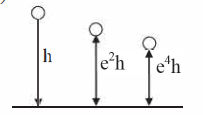
A particle falls from a height h on a fixed horizontal surface and rebounds. If e is the coefficient of restitution, then the total distance travelled by the particle before it stops rebounding is
  • $\frac{ h \left(1+ e ^2\right)}{\left(1- e ^2\right)}$
  • B
    $\frac{ h \left(1- e ^2\right)}{\left(1+ e ^2\right)}$
  • C
    $\frac{ h \left(1- e ^2\right)}{2\left(1+ e ^2\right)}$
  • D
    $\frac{ h \left(1+ e ^2\right)}{2\left(1- e ^2\right)}$
Answer

Correct option: A.
$\frac{ h \left(1+ e ^2\right)}{\left(1- e ^2\right)}$
(A)
Image
Total distance $=h+2 e^2 h+2 e^4 h \ldots$.
$=h+2 e^2 h\left(1+e^2+\ldots\right)$
Using binomial expansion,
$\left(1+ e ^2+ e ^4+\ldots\right)=\frac{1}{\left(1- e ^2\right)}$
$= h +\frac{2 e ^2 h}{1- e ^2}$
$=\frac{ h - e ^2 h+2 e ^2 h}{\left(1- e ^2\right)}$
$=\frac{ h \left(1+ e ^2\right)}{\left(1- e ^2\right)}$

Need a full question paper?

Generate a complete, print-ready paper with questions like this in minutes — across 16+ boards, with answer keys.

Start Generating Free

Similar questions

At t = 0, a particle starts moving from origin with velocity $5.0 im / s$ and it moves in x-y plane due to a force having a constant acceleration of $(2.0 \hat{ i }+3.0 \hat{ j }) m / s ^2$.Find the coordinate of the particle at t = 6 s.
Consider the following statements-
$(I)$ The coefficient of linear expansion has dimension $K ^{-1}$
$(II)$ The coefficient of volume expansion has dimension $K ^{-1}$
If mass, speed and radius of the circular path of the particle are increased by $100 \%$, then the necessary force required to maintain the circular path will have to be increased by
Which of the following changes, when a particle is moving with uniform velocity?
The bob of a conical pendulum undergoes ___________
Two point charges of A = +5.0 µC and B = -5.0 µC are separated by 5.0 cm. A point charge C = 1.0 µC is placed at 3.0 cm away from the centre on the perpendicular bisector of the line joining the two point charges. The charge at C will experience a force directed towards
A sphere, a cube and a thin circular plate all made of same material and having the same mass are heated to same temperature of $200^{\circ} C$. When these are left in a room
In a gravitational force field a particle is taken from A to B along different paths as shown in figure. Then
Image
A charge of + 7 µC is placed at the centre of two concentric spheres with radius 2.0 cm and 4.0 cm respectively. The ratio of the flux through them will be
An electron travelling with a speed of $5 \times 10^3 m / s$ passes through an electric field with an acceleration of $10^{12} m / s ^2$. How long will it take for electron to double its speed?