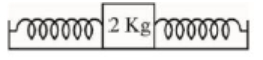
A particle free to move along the $x-$axis has potential energy given by $U(x) = k[1 - \exp {( - x)^2}]$ for $ - \infty \le x \le + \infty $, where k is a positive constant of appropriate dimensions. Then
IIT 1999,AIIMS 1995, Diffcult


Download our appand get started for free
Experience the future of education. Simply download our apps or reach out to us for more information. Let's shape the future of learning together!No signup needed.*
Similar Questions
- 1If the particle repeats its motion after a fixed time interval of $8 \,s$ then after how much time its maximum value of $PE$ will be attained after attaining its minimum value is ........... $s$View Solution
- 2View SolutionThe phase difference between displacement and acceleration of a particle in a simple harmonic motlon is
- 3The phase difference between two $SHM\,\,$ ${y_1}\, = \,10\,\sin \,\left( {10\pi t\, + \,\frac{\pi }{3}} \right)$ and ${y_2}\, = \,12\,\sin \,\left( {8\pi t\, + \,\frac{\pi }{4}} \right)$ at $t = 0.5\,s$ itView Solution
- 4A particle executes $S.H.M.$ and its position varies with time as $x=A$ sin $\omega t$. Its average speed during its motion from mean position to mid-point of mean and extreme position isView Solution
- 5View SolutionIn a simple harmonic oscillation, what fraction of total mechanical energy is in the form of kinetic energy, when the particle is midway between mean and extreme position.
- 6A particle of mass $m$ is moving along a trajectory given byView Solution
$x = x_0 + a\, cos\,\omega_1 t$
$y = y_0 + b\, sin\,\omega_2t$
The torque, acing on the particle about the origin, at $t = 0$ is - 7The acceleration displacement graph of a particle executing $SHM$ is shown in figure. The time period of simple harmonic motion isView Solution
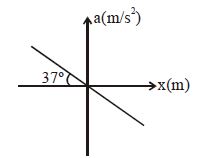
- 8Aheavy brass sphere is hung from a light spring and is set in vertical small oscillation with a period $T.$ The sphere is now immersed in a non-viscous liquid with a density $1/10\,th$ the density of the sphere. If the system is now set in vertical $S.H.M.,$ its period will beView Solution
- 9A uniform stick of mass $M$ and length $L$ is pivoted at its centre. Its ends are tied to two springs each of force constant $K$ . In the position shown in figure, the strings are in their natural length. When the stick is displaced through a small angle $\theta $ and released. The stickView Solution
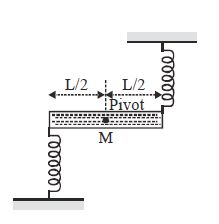
- 10A block of mass $2\,kg$ is attached with two identical springs of spring constant $20\,N / m$ each. The block is placed on a frictionless surface and the ends of the springs are attached to rigid supports (see figure). When the mass is displaced from its equilibrium position, it executes a simple harmonic motion. The time period of oscillation is $\frac{\pi}{\sqrt{x}}$ in SI unit. The value of $x$ is $..........$View Solution