MCQ
A particle has initial velocity $\left( {2\hat i + 3\hat j} \right)$ and acceleration $\left( {0.3\hat i + 0.2\hat j} \right)$. The magnitude of velocity after $10\, seconds$ will be 
  • A
    $5\, units$
  • B
    $9\, units$
  • C
    $9\sqrt 2 \,unit$
  • $5\sqrt 2 \,unit$

Answer

Correct option: D.
$5\sqrt 2 \,unit$
d
$(\overrightarrow{\mathrm{v}})_{\mathrm{att}=10 \mathrm{sec}}=\overrightarrow{\mathrm{u}}+\overrightarrow{\mathrm{a}} \mathrm{t}=(2 \hat{\mathrm{i}}+3 \hat{\mathrm{j}})+(0.3 \hat{\mathrm{i}}+0.2 \hat{\mathrm{j}}) \times 10$

$=5 \hat{\mathrm{i}}+5 \hat{\mathrm{j}}$

$\therefore$ Magnitude $=\sqrt{5^{2}+5^{2}}=5 \sqrt{2} \mathrm{units}$

Need a full question paper?

Generate a complete, print-ready paper with questions like this in minutes — across 16+ boards, with answer keys.

Start Generating Free

Similar questions

Ice at $0^o C$ is added to $200 \,\,g$ of water initially at $70^o C$ in a vacuum flask. When $50\,\, g$ of ice has been added and has all melted the temperature of the flask and contents is $40^o C$. When a further $80\,\,g$ of ice has been added and has all metled, the temperature of the whole is $10^o C$. Calculate the specific latent heat of fusion of ice.[Take $S_w =1\,\, cal /gm ^o C$.]
The area of the hole of heat furnace is $10^{-4}\,m^2.$ It radiates $1.58\times 10^5\,cal$ of heat per hour. If the emissivity of the furnace is $0.80,$ then its temperature is .......... $K$
In a particular system of units, a physical quantity can be expressed in terms of the electric charge $c$, electron mass $m_c$, Planck's constant $h$, and Coulomb's constant $k=\frac{1}{4 \pi \in_0}$, where $\in_0$ is the permittivity of vacuum. In terms of these physical constants, the dimension of the magnetic field is $[B]=[c]^\alpha\left[m_c\right]^\beta[h]^\gamma[k]^\delta$. The value of $\alpha+\beta+\gamma+\delta$ is. . . . .
A glass flask is filled up to a mark with $50\, cc$ of mercury at $18°C.$ If the flask and contents are heated to $38°C.$ ......... $cc$ mercury will be above the mark $?$ $(\alpha$ for glass is $ 9 × 10^{-6}{°}C^{-1}$ and coefficient of real expansion of mercury is $180 × 10^{-6}{°}C^{-1})$ 
$A$ system of $N$ particles is free from any external forces. Which of the following must be true for the sum of the magnitudes of the momenta of the individual particles in the system?
A man of mass $60 \,kg$ is standing on a boat of mass $140 \,kg$, which is at rest in still water. The man is initially at $20 \,m$ from the shore. He starts walking on the boat for $4 \,s$ with constant speed $1.5 \,m / s$ towards the shore. The final distance of the man from the shore is .......... $m$
The displacement of a particle is given by x = (t - 2)2 where x is in metres and t in seconds. The distance covered by the particle in first 4 seconds is:
  1. 4m.
  2. 8m.
  3. 12m.
  4. 16m.
A block of mass $M$ is attached to the lower end of a vertical spring. The spring is hung from a ceiling and has force constant value $k.$ The mass is released from rest with the spring initially unstretched. The maximum extension produced in the length of the spring will be
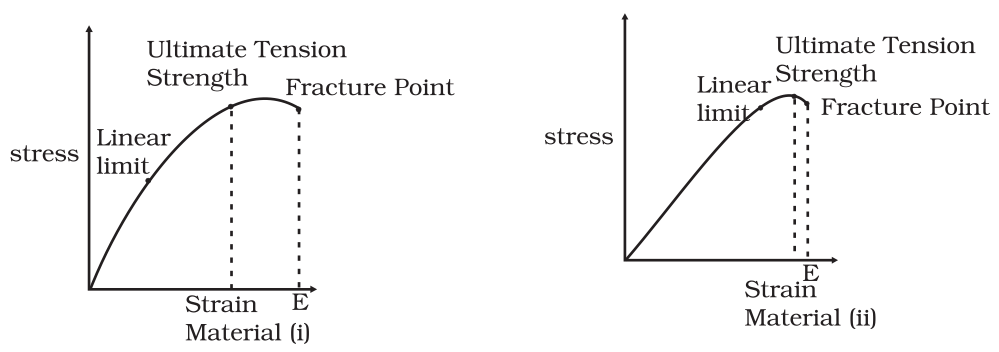
The stress - strain graphs for two materials are shown in (assume same scale).

 A certain body weighs $22.42\;g$ and has a measured volume of $4.7 \;cc .$ The possible error in the measurement of mass and volume are $0.01\; gm$ and $0.1 \;cc .$
Then maximum error in the density will be