Question
A particle having mass 10g oscillates according to the equation $\text{x}=(2.0\text{cm})\sin\big[(100\text{s}^{-1})\text{t}+\frac{\pi}{6}\big].$ Find (a) the amplitude, the time period and the spring constant (b) the position, the velocity and the acceleration at t = 0.
Answer

$\text{x}=(2.0\text{cm})\sin\Big[(100\text{s}^{-1})\text{t}+\Big(\frac{\pi}{6}\Big)\Big]$m = 10g.
  1. Amplitude = 2cm
$\omega=100\sec^{-1}$
$\therefore\text{T}=\frac{2\pi}{100}=\frac{\pi}{50}\sec=0.063\sec.$
We know that $\text{T}=2\pi\sqrt{\frac{\text{m}}{\text{k}}}$
$\Rightarrow\text{T}^2=4\pi^2\times\frac{\text{m}}{\text{k}}$
$\Rightarrow\text{k}=\frac{4\pi^2}{\text{T}^2}\text{m}$
$=10^5\text{dyne/cm}=100\text{N/m}$ $\Big[\text{because}\ \omega=\frac{2\pi}{\text{T}}=100\sec^{-1}\Big]$
  1. At t = 0
$\text{x}=2\text{cm}\sin\Big(\frac{\pi}{6}\Big)=2\times\Big(\frac{1}{2}\Big)=1\text{cm}.$ from the mean position.
We know that $\text{x}=\text{A}\sin(\omega\text{t}+\phi)$
$\text{v}=\text{A}\cos(\omega\text{t}+\phi)$
$=2\times100\cos\big(0+\frac{\pi}{6}\big)=200\times\frac{\sqrt{3}}{2}$
$=100\sqrt{3}\sec^{-1}=1.73\text{m/s}$
  1. $\text{a}=-\omega^2\text{x}=100^2\times1$
$=100\text{m/s}^2$

Need a full question paper?

Generate a complete, print-ready paper with questions like this in minutes — across 16+ boards, with answer keys.

Start Generating Free

Similar questions

A wheel in uniform motion about an axis passing through its centre and perpendicular to its plane is considered to be in mechanical (translational plus rotational) equilibrium because no net external force or torque is required to sustain its motion. However, the particles that constitute the wheel do experience a centripetal acceleration directed towards the centre.How do you reconcile this fact with the wheel being in equilibrium?
How would you set a half-wheel into uniform motion about an axis passing through the centre of mass of the wheel and perpendicular to its plane? Will you require external forces to sustain the motion?
A resistor of resistance $100\Omega$ is connected to an AC source $\in=(12\text{V})\sin(250\pi\text{s}^{-1})\text{t}.$ Find the energy dissipated as heat during $\text{t}=0$ to $\text{t}=1.0\text{ms}.$
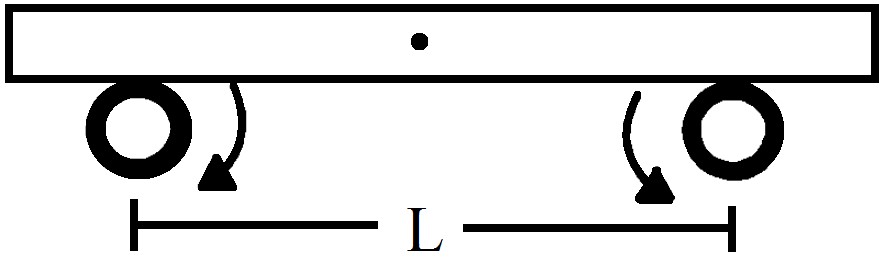
A uniform plate of mass M stays horizontally and symmetrically on two wheels rotating in opposite directions figure The separation between the wheels is L. The friction coefficient between each wheel and the plate is N. Find the time period of oscillation of the plate if it is slightly displayed along its length and released.
A spaceship is stationed on Mars. How much energy must be expended on the spaceship to launch it out of the solar system? Mass of the space ship $=1000 \mathrm{~kg}$; mass of the sun $=2 \times 10^{30} \mathrm{~kg}$; mass of mars $=6.4 \times 10^{23} \mathrm{~kg}$; radius of mars $=3395 \mathrm{~km}$; radius of the orbit of mars $=2.28 \times 10^8 \mathrm{~km} ; G=6.67 \times 10^{-11} \mathrm{~N} \mathrm{~m}^2 \mathrm{~kg}^{-2}$.
You are riding in an automatic vehicle of mass 3000 kg . Assume that you are testing the oscillatory characteristics of the suspension system of this vechicle when the entire vehicle is placed on it, the suspended is inclined by 15 cm . Also, the amplitude of oscillation decreases by $50 \%$ in the period of one complete oscillation. Estimate the value of the following
(a) spring constant, and
(b) for the shock absorber system of a spring and $a$ wheel damping constant $b$.
Assume that each wheel carries a mass of 750 kg is.
A long, straight wire is fixed horizontally and carries a current of $50.0A$. A second wire having linear mass density $1.0 \times 10^{-4}kg/m$ is placed parallel to and directly above this wire at a separation of $5.0mm$. What current should this second wire carry such that the magnetic repulsion can balance its weight?
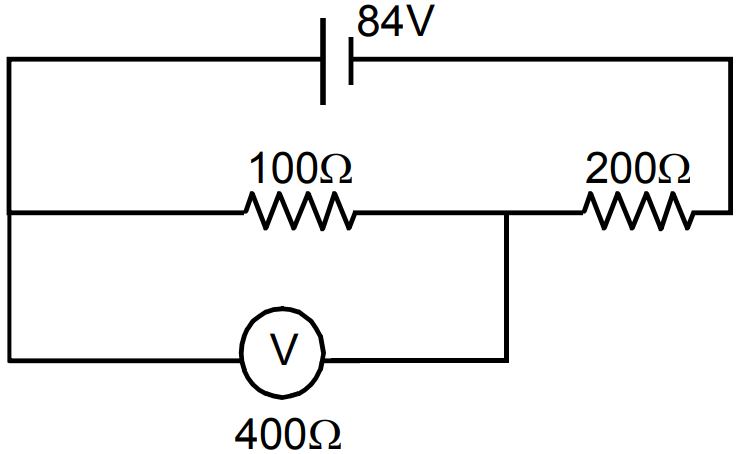
A voltmeter of resistance $400\Omega$ is used to measure the potential difference across the $100\Omega$ resistor in the circuit shown in the figure. (a) What will be the reading of the voltmeter? (b) What was the potential difference across $100\Omega$ before the voltmeter was connected?
According to Stefan’s law of radiation, a black body radiates energy $\sigma=\text{T}^4$ from its unit surface area every second where T is the surface temperature of the black body and $\sigma=5.67\times10^{-8}\text{w}/\text{m}^2\text{K}^4$ is known as Stefan’s constant. A nuclear weapon may be thought of as a ball of radius $0.5m$. When detonated, it reaches temperature of 106K and can be treated as a black body.
  1. Estimate the power it radiates.
  2. If surrounding has water at $30C°$, how much water can $10\%$ of the energy produced evaporate in $1s$?
$\big[\text{s}_w=4186.0\text{J/ kgK and L}_v=22.6\times10^5\text{J/ kg}\big]$
  1. If all this energy U is in the form of radiation, corresponding momentum is $\rho=\frac{\text{U}}{\text{c}}$ How much momentum per unit time does it impart on unit area at a distance of 1km?
A brass wire 1.8 m long at $27^{\circ} \mathrm{C}$ is held taut with little tension between two rigid supports. If the wire is cooled to a temperature of $-39^{\circ} \mathrm{C}$, what is the tension developed in the wire, if its diameter is 2.0 mm ? Co-efficient of linear expansion of brass $=2.0 \times 10^{-5} \mathrm{~K}^{-1}$; Young's modulus of brass $=0.91 \times 1011 \mathrm{~Pa}$.
If instead of mass, length and time as fundamental quantities, we choose velocity, acceleration and force as fundamental quantities and express their dimensions by V, A and F respectively, show that the dimensions of Young's modulus can be expressed as $\left[\mathrm{FA}^2 \mathrm{~V}^{-4}\right]$.