Question
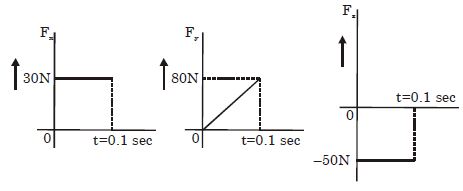
A particle is acted upon by a force whose  component's variations with time are shown in diagrams. Then the magnitude of change in momentum of the particle in $0.1\,\,sec$ will be :-
Answer

$\Delta p_{x}=3 \mathrm{NS}$

$\Delta p_{y}=4 \mathrm{NS}$

$\Delta p_{z}=-5 N S$

$\Delta p=\sqrt{3^{2}+4^{2}+5^{2}}=5 \sqrt{2} \mathrm{NS}$

Need a full question paper?

Generate a complete, print-ready paper with questions like this in minutes — across 16+ boards, with answer keys.

Start Generating Free

Similar questions

The balls, having linear momenta $\vec{p}_1=\hat{p} \hat{i}$ and $\vec{p}_2=-p \hat{i}$, undergo a collision in free space. There is no external force acting on the balls. Let $\vec{p}_1^{\prime}$ and $\vec{p}_2^{\prime}$ be their final momenta. The following option$(s)$ is (are) $NOT ALLOWED$ for any non-zero value of $\mathrm{p}, \mathrm{a}_1, \mathrm{a}_2, \mathrm{~b}_1, \mathrm{~b}_2, \mathrm{c}_1$ and $\mathrm{c}_2$.

$(A)$ $ \overrightarrow{\mathrm{p}}_1^{\prime}=\mathrm{a}_1 \hat{\mathrm{i}}+\mathrm{b}_1 \hat{\mathrm{j}}+\mathrm{c}_1 \hat{\mathrm{k}} $

$ \overrightarrow{\mathrm{p}}_2^{\prime}=\mathrm{a}_2 \hat{\mathrm{i}}+\mathrm{b}_2 \hat{\mathrm{j}}$

$(B)$ $ \overrightarrow{\mathrm{p}}_1^{\prime}=\mathrm{c}_1 \hat{\mathrm{k}} $

$ \overrightarrow{\mathrm{p}}_2^{\prime}=\mathrm{c}_2 \hat{\mathrm{k}}$

$(C)$ $ \overrightarrow{\mathrm{p}}_1^{\prime}=\mathrm{a}_1 \hat{\mathrm{i}}+\mathrm{b}_1 \hat{\mathrm{j}}+\mathrm{c}_1 \hat{\mathrm{k}} $

$ \overrightarrow{\mathrm{p}}_2=\mathrm{a}_2 \hat{\mathrm{i}}+\mathrm{b}_2 \hat{\mathrm{j}}-\mathrm{c}_1 \hat{\mathrm{k}}$

$(D)$ $ \vec{p}_1^{\prime}=a_1 \hat{i}+b_1 \hat{j} $

$ \overrightarrow{\mathrm{p}}_2^{\prime}=a_2 \hat{\mathrm{i}}+b_1 \hat{\mathrm{j}}$
A $4\, \,\mu F$ condenser is charged to $400\, V$ and then its plates are joined through a resistance. The heat produced in the resistance is.......$J$
Two solid cylinders $P$ and $Q$ of same mass and same radius start rolling down a fixed inclined plane form the same height at the same time. Cylinder $P$ has most of its mass concentrated near its surface, while $Q$ has most of its mass concentrated near the axis. Which statement $(s)$ is (are) correct?
In the given figure the total charge stored in the combination of capacitors is $100\,\mu C$. The value of ' $x$ ' is $............$.
Three forces $F,\,2F$ and $3F$ act on a rod $AB$ which is pivoted at $A$. The anticlockwise moment of forces $F,\,2F$ and $3F$ about the pivot are respectively
A ball is released from certain height. It loses $50\%$ of its kinetic energy on striking the ground. It will attain a height again equal to
Half life of $B{i^{210}}$ is $5$ days. If we start with $50,000$ atoms of this isotope, the number of atoms left over after $10$ days is
An electric motor operating on a $60\,V \,dc$ supply draws a current of $10\,A$ . If the efficiency of the motor is $50\%$ , the resistance of its winding is....$\Omega $
A black body is at a temperature of $500 \;K$, it emits energy at a rate which is proportional to
The decay constant $\lambda $ of the radioactive sample is the probability of decay of an atom in unit time, then