MCQ
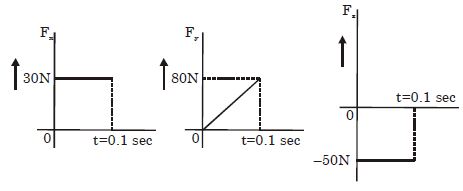
A particle is acted upon by a force whose  component's variations with time are shown in diagrams. Then the magnitude of change in momentum of the particle in $0.1\,\,sec$ will be :-
  • A
    $2\,\,kg\, m\,/\,sec$
  • B
    $10\,\,kg\, m\,/\,sec$
  • C
    $12\,\,kg\, m\,/\,sec$
  • $5\sqrt 2\,\,kg\, m\,/\,sec$

Answer

Correct option: D.
$5\sqrt 2\,\,kg\, m\,/\,sec$
d
$\Delta p_{x}=3 \mathrm{NS}$

$\Delta p_{y}=4 \mathrm{NS}$

$\Delta p_{z}=-5 N S$

$\Delta p=\sqrt{3^{2}+4^{2}+5^{2}}=5 \sqrt{2} \mathrm{NS}$

Need a full question paper?

Generate a complete, print-ready paper with questions like this in minutes — across 16+ boards, with answer keys.

Start Generating Free

Similar questions

When two harmonic sound waves of close $($but not equal$)$ frequencies are heard at the same time, we hear:
A hypothetical gas expands adiabatically such that its volume changes from $8$ litres to $27$ litres. If the ratio of final pressure of the gas to initial pressure of the gas is $\frac{16}{81}$. Then the ratio of $\frac{C_P}{C_V}$ will be
The terminal velocity of a copper ball of radius $2.0 \;mm$ falling through a tank of oll at $20\,^{\circ} C$ is $6.5 \;cm s ^{-1} .$ Compute the viscosity of the oil at $20\,^{\circ} C .$ Density of oil is $1.5 \times 10^{3} \;kg m ^{-3},$ density of copper is $8.9 \times 10^{3} \;kg m ^{-3}$
Three identical spheres, each of mass $1\ kg$ are placed touching each other with their centres on a straight line. Their centres are marked $K, L$ and $M$ respectively. The distance of centre of mass of the system from $K$ is
Angular momentum and angular velocity for a rolling sphere of radius $R$ are related by the formula:
A ball is thrown vertically downward with a velocity of $20\; m / s$ from the top of a tower. It hits the ground after some time with a velocity of $80\, m / s$. The helght of the tower is $......m$ : $\left( g =10\, m / s ^{2}\right)$
$2\, kg$ of a monoatomic gas is at a pressure of $4\times10^4\, N/m^2$. The density of the gas is $8\, kg/m^3$. What is the order of energy of the gas due to its thermal motion ?
For the acceleration-time $(a-t)$ graph shown in figure, the change in velocity of particle from $t=0$ to $t=6 \,s$ is ........ $m / s$
Wax is coated on the inner wall of a capillary tube and the tube is then dipped in water. Then, compared to the unwaxed capillary, the angle of contact $\theta $ and the height $h$ upto which water rises change. These changes are
A piece of metal weight $46\, gm$ in air, when it is immersed in the liquid of specific gravity $1.24$ at $27°C$ it weighs $30\, gm.$ When the temperature of liquid is raised to $42°C$ the metal piece weight $30.5\, gm,$ specific gravity of the liquid at $42°C$ is $1.20,$ then the linear expansion of the metal will be