Question
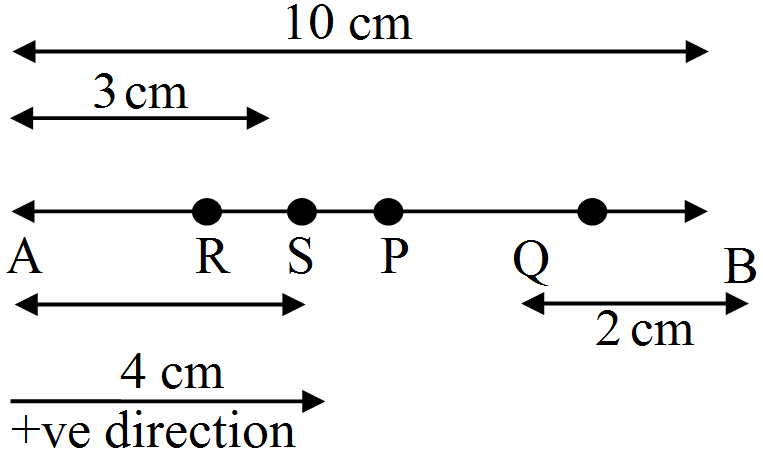
A particle is in linear simple harmonic motion between two points, A and B, 10cm apart. Take the direction from A to B as the positive direction and give the signs of velocity, acceleration and force on the particle when it is:At 4cm away from B going towards A.
Answer


From above figure, where A and B represent the two extreme positions of a SHM. For velocity, the direction from A to B is taken to b positive. The acceleration and the force, along AP are taken as positive and along Bp are taken as negative.
At 4cm away from A going towards A, the particles is at S, with a tendency to move along SA, which is negative direction. Therefore, velocity is negative but acceleration is directed towards mean position, along SP. Hence it is positive and also force is positive similarly.

Need a full question paper?

Generate a complete, print-ready paper with questions like this in minutes — across 16+ boards, with answer keys.

Start Generating Free

Similar questions

Is air a material medium? Name two characteristics of the material medium necessary for the onward propagation of momentum and energy.
State with reasons, whether the following algebraic operations with scalar and vector physical quantities are meaningful:
  1. adding any two scalars.
  2. adding a scalar to a vector of the same dimensions.
  3. multiplying any vector by any scalar.
  4. multiplying any two scalars.
  5. adding any two vectors.
  6. adding a component of a vector to the same vector.
The total energy of particle remains in simple harmonic motion.
Minimum angle of inclined plane with horizontal plane at which when a body is placed, just start sliding down is known as _______.
Draw position-time graph for a body at rest.
A mass thrown up returns to the surface of earth. What is the nature of total energy possessed?
The velocity of a particle is towards west at an instant. Its acceleration is not towards west, not towards east, not towards north and not towards south. Give an example of this type of motion.
What is the condition for there to be a difference in the lengths of a brass rod and an iron rod at all temperatures?
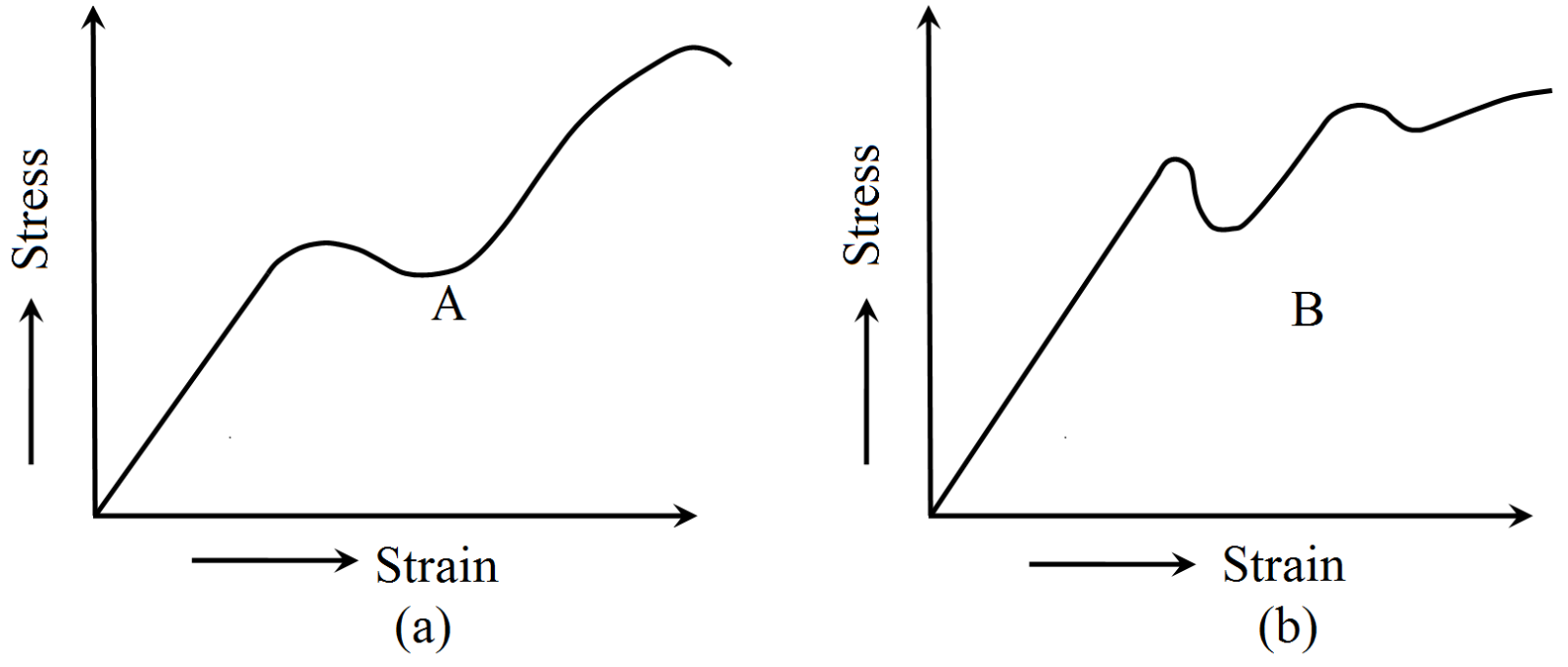
The stress versus strain graphs for two materials $A$ and $B$ are shown below: $($The graphs are to the same scale$)$.
  1. Which material has greater Young's modulus?
  2. Which material is more ductile?
  3. Which is more brittle?
For the travelling harmonic wave
$\text{y}(\text{x, t})=2.0\cos2\pi(10\text{t}-0.0080\text{x}+0.35)$
where x and y are in cm and t in s. Calculate the phase difference between oscillatory motion of two points separated by a distance of
$\frac{\lambda}{2},$