Question
A particle is in linear simple harmonic motion between two points, A and B, 10cm apart. Take the direction from A to B as the positive direction and give the signs of velocity, acceleration and force on the particle when it is:

At the mid-point of AB going towards A.
Answer


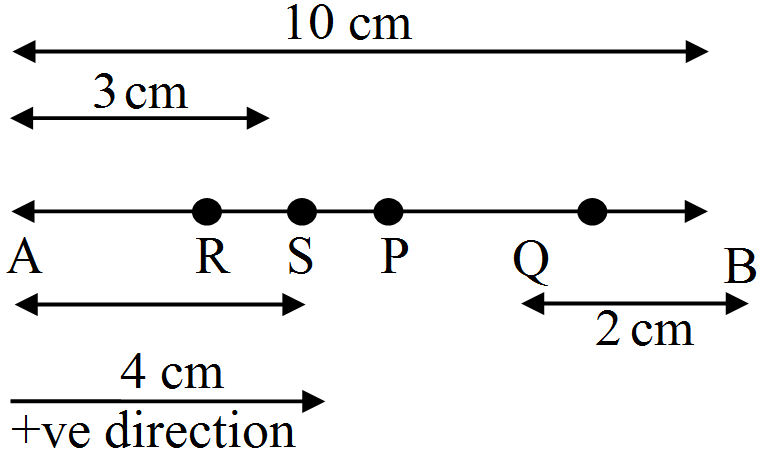
From above figure, where A and B represent the two extreme positions of a SHM. For velocity, the direction from A to B is taken to b positive. The acceleration and the force, along AP are taken as positive and along Bp are taken as negative.

At the mid-point of AB going towards A, the particle is at its mean position P, with a tendency to move along PA. Hence, velocity is positive. Both acceleration and force are zero.

Need a full question paper?

Generate a complete, print-ready paper with questions like this in minutes — across 16+ boards, with answer keys.

Start Generating Free

Similar questions

Explain this statement clearly:
“To call a dimensional quantity ‘large’ or ‘small’ is meaningless without specifying a standard for comparison”. In view of this, reframe the following statements wherever necessary:
  1. Atoms are very small objects
  2. A jet plane moves with great speed
  3. The mass of Jupiter is very large
  4. The air inside this room contains a large number of molecules
  5. A proton is much more massive than an electron
  6. The speed of sound is much smaller than the speed of light.
If it were possible for a gas in a container to reach the temperature 0K, its pressure would be zero. Would the molecules not collide with the walls? Would they not transfer momentum to the walls?
A retarding force is applied to stop a motor car. If the speed of the motor car is doubled, how much more distance will it cover before stopping under the same retarding force?
Which of the following examples represent periodic motion?
A freely suspended bar magnet displaced from its N-S direction and released.
What has the height capacity for diffusion?
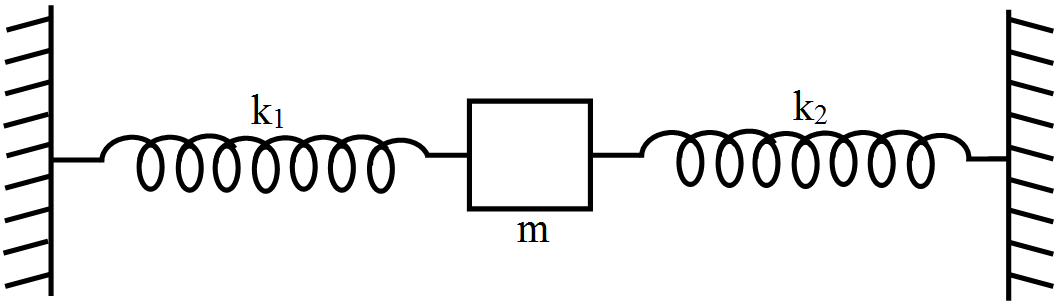
In the arrangement shown in the figure, the block of mass m is displaced, what is the frequency of oscillation?

Is the total linear momentum conserved during the short time of an elastic collision of two balls?
In which of the gases, liquids or solids is the speed of sound heighest?
Can a physical quantity have dimensions but still have no units?
A steel rod of cross-sectional area 4cm2 and length 2m shrinks by 0.1cm as the temperature decreases in night. If the rod is clamped at both ends during the day hours, find the tension developed in it during night hours. Young's modulus of steel = 1.9 × 10¹¹N/m2.